 Add to Chrome
 Add to Firefox
 Add to Edge
Real-time optimal control with shallow recurrent decoder networks
Jul 21, 2026
Controlling dynamical systems in real-time across multiple scenarios is critical to enabling adaptive control strategies, ensuring stability and efficiency. However, to tailor control actions in response to varying scenarios, traditional optimal control problems typically require several system simulations, which are often computationally demanding due to the high-dimensionality of the underlying spatio-temporal dynamics. In this work, we exploit SHallow REcurrent Decoder networks-based Reduced Order Modeling (SHRED-ROM) to synthesize a real-time closed-loop controller for high-dimensional and parametric dynamics, relying solely on limited state sensor readings. After training the model on a few optimal examples given by an expert demonstrator, SHRED-ROM mimics the expert behavior with effective distributed control actions in new scenarios, alleviating the curse of dimensionality. Moreover, a sensor forecaster is synthesized and used to close the loop at the latent level, thus efficiently mitigating possible sensor failures or delays. The performance of the proposed optimal control strategy is finally assessed on three challenging high-dimensional cases dealing with either parametric density control or fluid flow control.

Physics-enhanced reinforcement learning for real-time optimal control of dynamical systems
Jul 17, 2026Reinforcement learning (RL) has recently emerged as a promising feedback control strategy for nonlinear and complex dynamical systems. However, RL algorithms are sample inefficient and require a large number of interaction with the environment to synthesize optimal control strategies. Consequently, applications of RL are typically limited to sparse sensors and actuators due to the curse of dimensionality entailed by the exploration-exploitation dilemma in high-dimensional spaces. In this work, we bridge RL and traditional optimal control for dynamical system with a novel Physics-EnhAnced Reinforcement Learning (PEARL) paradigm tailored to the control of high-dimensional and parametric dynamical systems, exploiting the differentibility of their dynamics. Specifically, PEARL employs an actor-adjoint algorithm that leverages automatic differentiation to compute policy gradients over short horizons and adjoint-based sensitivities of future returns approximated via neural networks, significantly reducing the number of environment interactions, while mitigating long-term gradient instabilities. Through two challenging parametric navigation problems in unsteady flows, we show that PEARL (i) effectively exploits differentiable environments to outperform state-of-the-art RL algorithms, (ii) is sample efficient, thanks to the physics-guided policy learning, (iii) generalizes across multiple scenarios, which is crucial when dealing with parametric systems, and (iv) enables scaling RL to high-dimensional state and action spaces, without requiring low-dimensional state representations or multi-agent strategies.
Flow-aware Optimal Navigation in Unsteady Flows through Reinforcement Learning
Jul 15, 2026Autonomous robotic navigation in nonstationary time-varying fluid flows remains a fundamental challenge due to partial observability and the unpredictability of realistic environments. While classical optimal control frameworks employed in robotics require unrealistic a-priori global flow knowledge, biological systems are able to navigate successfully by exploiting localized sensory cues. In this work we present a reinforcement learning approach using the TD3 algorithm to train autonomous agents to reach arbitrary targets within a parametric, chaotic double-gyre flow. To investigate optimal sensory mechanisms, we evaluate five bio-inspired observation strategies based on relative position, local velocity or local vorticity measures, and short-term memory variants. Additionally, we analyze the impact of providing agents with explicit global flow parameters. Numerical results demonstrate that an agent that is able to sense and remember a set number of flow velocity measures achieves the highest performance. The experiments reveal a trade-off in sensor utility: velocity-aware agents optimize energy efficiency, whereas vorticity sensors provide superior structural mapping and achieve better target proximity. Incorporating explicit global flow parameters is shown to decrease navigation performance. This behavior suggests that reinforcement learning-based autonomous systems develop more robust and general policies when restricted to implicit flow representations. The presented results offer insights for improving the transition of bio-inspired robotic navigation from simulation to real-world environments.
The Seismic Wavefield Common Task Framework
Dec 22, 2025Seismology faces fundamental challenges in state forecasting and reconstruction (e.g., earthquake early warning and ground motion prediction) and managing the parametric variability of source locations, mechanisms, and Earth models (e.g., subsurface structure and topography effects). Addressing these with simulations is hindered by their massive scale, both in synthetic data volumes and numerical complexity, while real-data efforts are constrained by models that inadequately reflect the Earth's complexity and by sparse sensor measurements from the field. Recent machine learning (ML) efforts offer promise, but progress is obscured by a lack of proper characterization, fair reporting, and rigorous comparisons. To address this, we introduce a Common Task Framework (CTF) for ML for seismic wavefields, starting with three distinct wavefield datasets. Our CTF features a curated set of datasets at various scales (global, crustal, and local) and task-specific metrics spanning forecasting, reconstruction, and generalization under realistic constraints such as noise and limited data. Inspired by CTFs in fields like natural language processing, this framework provides a structured and rigorous foundation for head-to-head algorithm evaluation. We illustrate the evaluation procedure with scores reported for two of the datasets, showcasing the performance of various methods and foundation models for reconstructing seismic wavefields from both simulated and real-world sensor measurements. The CTF scores reveal the strengths, limitations, and suitability for specific problem classes. Our vision is to replace ad hoc comparisons with standardized evaluations on hidden test sets, raising the bar for rigor and reproducibility in scientific ML.
PySHRED: A Python package for SHallow REcurrent Decoding for sparse sensing, model reduction and scientific discovery
Jul 28, 2025SHallow REcurrent Decoders (SHRED) provide a deep learning strategy for modeling high-dimensional dynamical systems and/or spatiotemporal data from dynamical system snapshot observations. PySHRED is a Python package that implements SHRED and several of its major extensions, including for robust sensing, reduced order modeling and physics discovery. In this paper, we introduce the version 1.0 release of PySHRED, which includes data preprocessors and a number of cutting-edge SHRED methods specifically designed to handle real-world data that may be noisy, multi-scale, parameterized, prohibitively high-dimensional, and strongly nonlinear. The package is easy to install, thoroughly-documented, supplemented with extensive code examples, and modularly-structured to support future additions. The entire codebase is released under the MIT license and is available at https://github.com/pyshred-dev/pyshred.
Latent feedback control of distributed systems in multiple scenarios through deep learning-based reduced order models
Dec 13, 2024Continuous monitoring and real-time control of high-dimensional distributed systems are often crucial in applications to ensure a desired physical behavior, without degrading stability and system performances. Traditional feedback control design that relies on full-order models, such as high-dimensional state-space representations or partial differential equations, fails to meet these requirements due to the delay in the control computation, which requires multiple expensive simulations of the physical system. The computational bottleneck is even more severe when considering parametrized systems, as new strategies have to be determined for every new scenario. To address these challenges, we propose a real-time closed-loop control strategy enhanced by nonlinear non-intrusive Deep Learning-based Reduced Order Models (DL-ROMs). Specifically, in the offline phase, (i) full-order state-control pairs are generated for different scenarios through the adjoint method, (ii) the essential features relevant for control design are extracted from the snapshots through a combination of Proper Orthogonal Decomposition (POD) and deep autoencoders, and (iii) the low-dimensional policy bridging latent control and state spaces is approximated with a feedforward neural network. After data generation and neural networks training, the optimal control actions are retrieved in real-time for any observed state and scenario. In addition, the dynamics may be approximated through a cheap surrogate model in order to close the loop at the latent level, thus continuously controlling the system in real-time even when full-order state measurements are missing. The effectiveness of the proposed method, in terms of computational speed, accuracy, and robustness against noisy data, is finally assessed on two different high-dimensional optimal transport problems, one of which also involving an underlying fluid flow.
Real-time optimal control of high-dimensional parametrized systems by deep learning-based reduced order models
Sep 09, 2024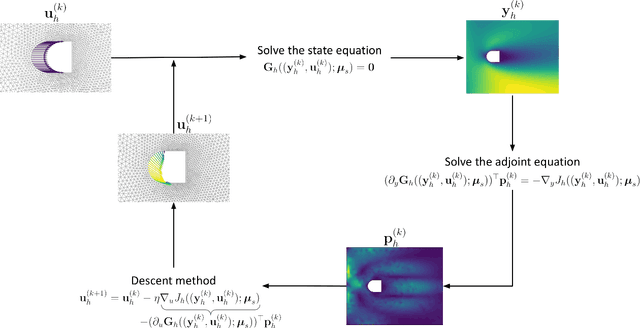
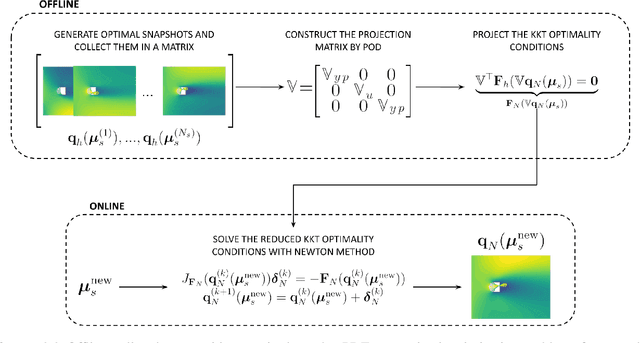
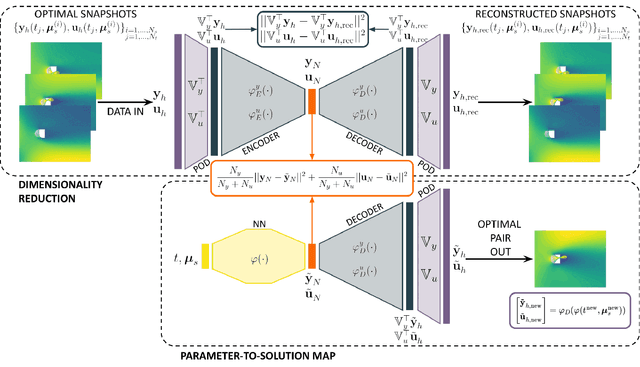
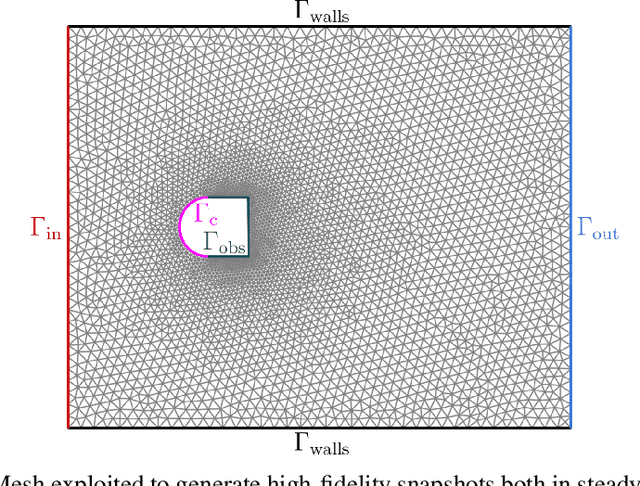
Steering a system towards a desired target in a very short amount of time is challenging from a computational standpoint. Indeed, the intrinsically iterative nature of optimal control problems requires multiple simulations of the physical system to be controlled. Moreover, the control action needs to be updated whenever the underlying scenario undergoes variations. Full-order models based on, e.g., the Finite Element Method, do not meet these requirements due to the computational burden they usually entail. On the other hand, conventional reduced order modeling techniques such as the Reduced Basis method, are intrusive, rely on a linear superimposition of modes, and lack of efficiency when addressing nonlinear time-dependent dynamics. In this work, we propose a non-intrusive Deep Learning-based Reduced Order Modeling (DL-ROM) technique for the rapid control of systems described in terms of parametrized PDEs in multiple scenarios. In particular, optimal full-order snapshots are generated and properly reduced by either Proper Orthogonal Decomposition or deep autoencoders (or a combination thereof) while feedforward neural networks are exploited to learn the map from scenario parameters to reduced optimal solutions. Nonlinear dimensionality reduction therefore allows us to consider state variables and control actions that are both low-dimensional and distributed. After (i) data generation, (ii) dimensionality reduction, and (iii) neural networks training in the offline phase, optimal control strategies can be rapidly retrieved in an online phase for any scenario of interest. The computational speedup and the high accuracy obtained with the proposed approach are assessed on different PDE-constrained optimization problems, ranging from the minimization of energy dissipation in incompressible flows modelled through Navier-Stokes equations to the thermal active cooling in heat transfer.