 Add to Chrome
 Add to Firefox
 Add to Edge
Uncertainty-Aware Explanations Through Probabilistic Self-Explainable Neural Networks
Mar 20, 2024
The lack of transparency of Deep Neural Networks continues to be a limitation that severely undermines their reliability and usage in high-stakes applications. Promising approaches to overcome such limitations are Prototype-Based Self-Explainable Neural Networks (PSENNs), whose predictions rely on the similarity between the input at hand and a set of prototypical representations of the output classes, offering therefore a deep, yet transparent-by-design, architecture. So far, such models have been designed by considering pointwise estimates for the prototypes, which remain fixed after the learning phase of the model. In this paper, we introduce a probabilistic reformulation of PSENNs, called Prob-PSENN, which replaces point estimates for the prototypes with probability distributions over their values. This provides not only a more flexible framework for an end-to-end learning of prototypes, but can also capture the explanatory uncertainty of the model, which is a missing feature in previous approaches. In addition, since the prototypes determine both the explanation and the prediction, Prob-PSENNs allow us to detect when the model is making uninformed or uncertain predictions, and to obtain valid explanations for them. Our experiments demonstrate that Prob-PSENNs provide more meaningful and robust explanations than their non-probabilistic counterparts, thus enhancing the explainability and reliability of the models.

Learning Algorithms for Verification of Markov Decision Processes
Mar 20, 2024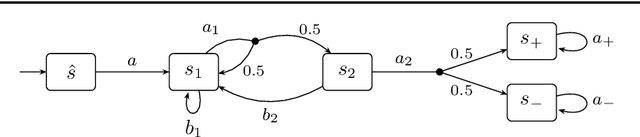
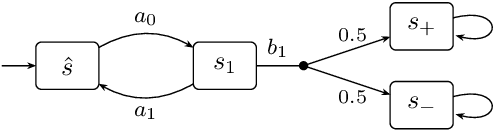


We present a general framework for applying learning algorithms and heuristical guidance to the verification of Markov decision processes (MDPs). The primary goal of our techniques is to improve performance by avoiding an exhaustive exploration of the state space, instead focussing on particularly relevant areas of the system, guided by heuristics. Our work builds on the previous results of Br{\'{a}}zdil et al., significantly extending it as well as refining several details and fixing errors. The presented framework focuses on probabilistic reachability, which is a core problem in verification, and is instantiated in two distinct scenarios. The first assumes that full knowledge of the MDP is available, in particular precise transition probabilities. It performs a heuristic-driven partial exploration of the model, yielding precise lower and upper bounds on the required probability. The second tackles the case where we may only sample the MDP without knowing the exact transition dynamics. Here, we obtain probabilistic guarantees, again in terms of both the lower and upper bounds, which provides efficient stopping criteria for the approximation. In particular, the latter is an extension of statistical model-checking (SMC) for unbounded properties in MDPs. In contrast to other related approaches, we do not restrict our attention to time-bounded (finite-horizon) or discounted properties, nor assume any particular structural properties of the MDP.
Partially Observable Stochastic Games with Neural Perception Mechanisms
Oct 17, 2023Stochastic games are a well established model for multi-agent sequential decision making under uncertainty. In reality, though, agents have only partial observability of their environment, which makes the problem computationally challenging, even in the single-agent setting of partially observable Markov decision processes. Furthermore, in practice, agents increasingly perceive their environment using data-driven approaches such as neural networks trained on continuous data. To tackle this problem, we propose the model of neuro-symbolic partially-observable stochastic games (NS-POSGs), a variant of continuous-space concurrent stochastic games that explicitly incorporates perception mechanisms. We focus on a one-sided setting, comprising a partially-informed agent with discrete, data-driven observations and a fully-informed agent with continuous observations. We present a new point-based method, called one-sided NS-HSVI, for approximating values of one-sided NS-POSGs and implement it based on the popular particle-based beliefs, showing that it has closed forms for computing values of interest. We provide experimental results to demonstrate the practical applicability of our method for neural networks whose preimage is in polyhedral form.
Probabilistic Reach-Avoid for Bayesian Neural Networks
Oct 03, 2023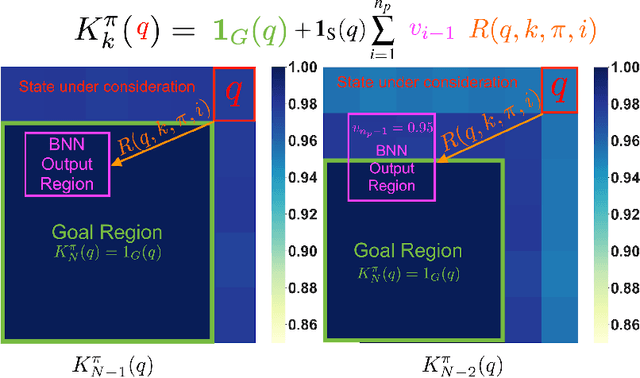
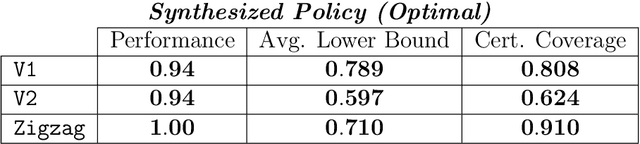
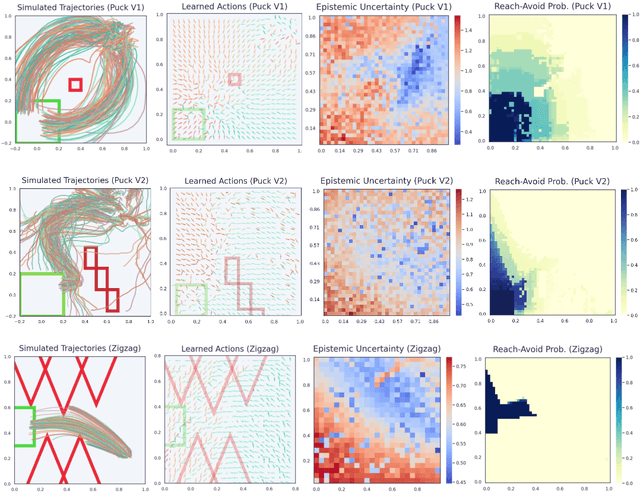
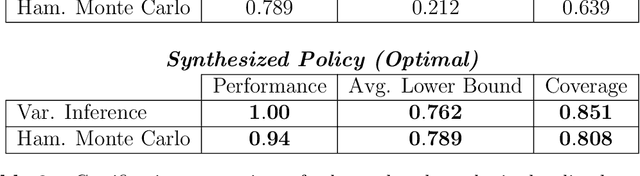
Model-based reinforcement learning seeks to simultaneously learn the dynamics of an unknown stochastic environment and synthesise an optimal policy for acting in it. Ensuring the safety and robustness of sequential decisions made through a policy in such an environment is a key challenge for policies intended for safety-critical scenarios. In this work, we investigate two complementary problems: first, computing reach-avoid probabilities for iterative predictions made with dynamical models, with dynamics described by Bayesian neural network (BNN); second, synthesising control policies that are optimal with respect to a given reach-avoid specification (reaching a "target" state, while avoiding a set of "unsafe" states) and a learned BNN model. Our solution leverages interval propagation and backward recursion techniques to compute lower bounds for the probability that a policy's sequence of actions leads to satisfying the reach-avoid specification. Such computed lower bounds provide safety certification for the given policy and BNN model. We then introduce control synthesis algorithms to derive policies maximizing said lower bounds on the safety probability. We demonstrate the effectiveness of our method on a series of control benchmarks characterized by learned BNN dynamics models. On our most challenging benchmark, compared to purely data-driven policies the optimal synthesis algorithm is able to provide more than a four-fold increase in the number of certifiable states and more than a three-fold increase in the average guaranteed reach-avoid probability.
Trust-Aware Motion Planning for Human-Robot Collaboration under Distribution Temporal Logic Specifications
Oct 02, 2023
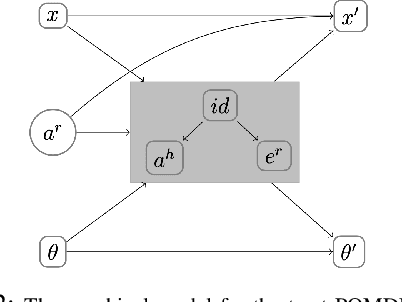
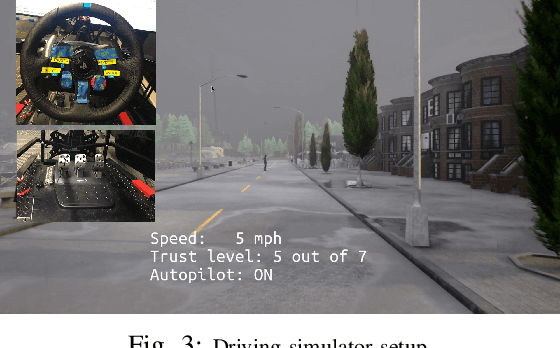
Recent work has considered trust-aware decision making for human-robot collaboration (HRC) with a focus on model learning. In this paper, we are interested in enabling the HRC system to complete complex tasks specified using temporal logic that involve human trust. Since human trust in robots is not observable, we adopt the widely used partially observable Markov decision process (POMDP) framework for modelling the interactions between humans and robots. To specify the desired behaviour, we propose to use syntactically co-safe linear distribution temporal logic (scLDTL), a logic that is defined over predicates of states as well as belief states of partially observable systems. The incorporation of belief predicates in scLDTL enhances its expressiveness while simultaneously introducing added complexity. This also presents a new challenge as the belief predicates must be evaluated over the continuous (infinite) belief space. To address this challenge, we present an algorithm for solving the optimal policy synthesis problem. First, we enhance the belief MDP (derived by reformulating the POMDP) with a probabilistic labelling function. Then a product belief MDP is constructed between the probabilistically labelled belief MDP and the automaton translation of the scLDTL formula. Finally, we show that the optimal policy can be obtained by leveraging existing point-based value iteration algorithms with essential modifications. Human subject experiments with 21 participants on a driving simulator demonstrate the effectiveness of the proposed approach.
When to Trust AI: Advances and Challenges for Certification of Neural Networks
Sep 20, 2023Artificial intelligence (AI) has been advancing at a fast pace and it is now poised for deployment in a wide range of applications, such as autonomous systems, medical diagnosis and natural language processing. Early adoption of AI technology for real-world applications has not been without problems, particularly for neural networks, which may be unstable and susceptible to adversarial examples. In the longer term, appropriate safety assurance techniques need to be developed to reduce potential harm due to avoidable system failures and ensure trustworthiness. Focusing on certification and explainability, this paper provides an overview of techniques that have been developed to ensure safety of AI decisions and discusses future challenges.
Point-based Value Iteration for Neuro-Symbolic POMDPs
Jun 30, 2023Neuro-symbolic artificial intelligence is an emerging area that combines traditional symbolic techniques with neural networks. In this paper, we consider its application to sequential decision making under uncertainty. We introduce neuro-symbolic partially observable Markov decision processes (NS-POMDPs), which model an agent that perceives a continuous-state environment using a neural network and makes decisions symbolically, and study the problem of optimising discounted cumulative rewards. This requires functions over continuous-state beliefs, for which we propose a novel piecewise linear and convex representation (P-PWLC) in terms of polyhedra covering the continuous-state space and value vectors, and extend Bellman backups to this representation. We prove the convexity and continuity of value functions and present two value iteration algorithms that ensure finite representability by exploiting the underlying structure of the continuous-state model and the neural perception mechanism. The first is a classical (exact) value iteration algorithm extending $\alpha$-functions of Porta et al (2006) to the P-PWLC representation for continuous-state spaces. The second is a point-based (approximate) method called NS-HSVI, which uses the P-PWLC representation and belief-value induced functions to approximate value functions from below and above for two types of beliefs, particle-based and region-based. Using a prototype implementation, we show the practical applicability of our approach on two case studies that employ (trained) ReLU neural networks as perception functions, dynamic car parking and an aircraft collision avoidance system, by synthesising (approximately) optimal strategies. An experimental comparison with the finite-state POMDP solver SARSOP demonstrates that NS-HSVI is more robust to particle disturbances.
Adversarial Robustness Certification for Bayesian Neural Networks
Jun 23, 2023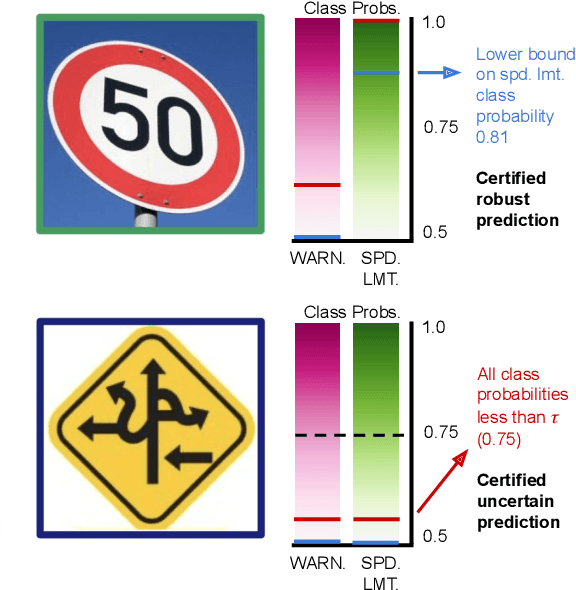
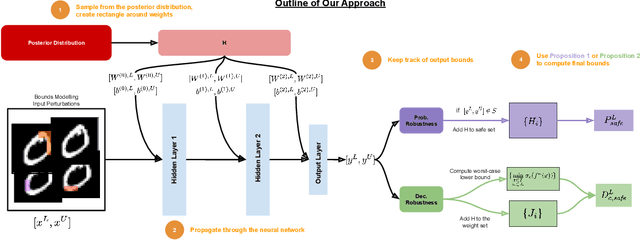
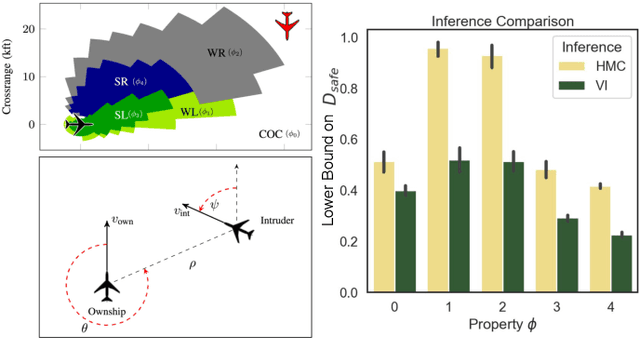
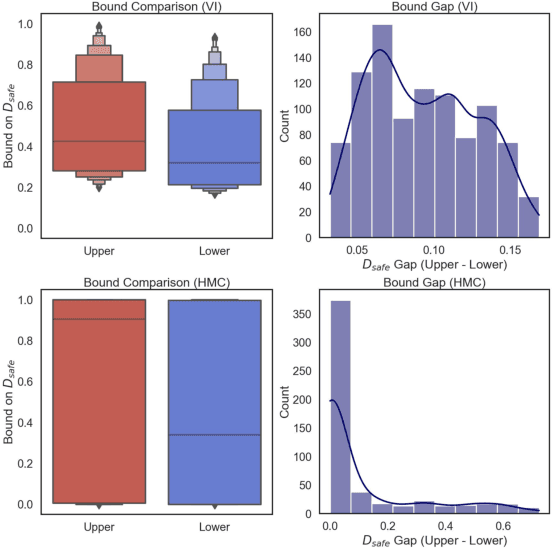
We study the problem of certifying the robustness of Bayesian neural networks (BNNs) to adversarial input perturbations. Given a compact set of input points $T \subseteq \mathbb{R}^m$ and a set of output points $S \subseteq \mathbb{R}^n$, we define two notions of robustness for BNNs in an adversarial setting: probabilistic robustness and decision robustness. Probabilistic robustness is the probability that for all points in $T$ the output of a BNN sampled from the posterior is in $S$. On the other hand, decision robustness considers the optimal decision of a BNN and checks if for all points in $T$ the optimal decision of the BNN for a given loss function lies within the output set $S$. Although exact computation of these robustness properties is challenging due to the probabilistic and non-convex nature of BNNs, we present a unified computational framework for efficiently and formally bounding them. Our approach is based on weight interval sampling, integration, and bound propagation techniques, and can be applied to BNNs with a large number of parameters, and independently of the (approximate) inference method employed to train the BNN. We evaluate the effectiveness of our methods on various regression and classification tasks, including an industrial regression benchmark, MNIST, traffic sign recognition, and airborne collision avoidance, and demonstrate that our approach enables certification of robustness and uncertainty of BNN predictions.
On Preimage Approximation for Neural Networks
May 08, 2023Neural network verification mainly focuses on local robustness properties. However, often it is important to know whether a given property holds globally for the whole input domain, and if not then for what proportion of the input the property is true. While exact preimage generation can construct an equivalent representation of neural networks that can aid such (quantitative) global robustness verification, it is intractable at scale. In this work, we propose an efficient and practical anytime algorithm for generating symbolic under-approximations of the preimage of neural networks based on linear relaxation. Our algorithm iteratively minimizes the volume approximation error by partitioning the input region into subregions, where the neural network relaxation bounds become tighter. We further employ sampling and differentiable approximations to the volume in order to prioritize regions to split and optimize the parameters of the relaxation, leading to faster improvement and more compact under-approximations. Evaluation results demonstrate that our approach is able to generate preimage approximations significantly faster than exact methods and scales to neural network controllers for which exact preimage generation is intractable. We also demonstrate an application of our approach to quantitative global verification.
Sample Efficient Model-free Reinforcement Learning from LTL Specifications with Optimality Guarantees
May 03, 2023Linear Temporal Logic (LTL) is widely used to specify high-level objectives for system policies, and it is highly desirable for autonomous systems to learn the optimal policy with respect to such specifications. However, learning the optimal policy from LTL specifications is not trivial. We present a model-free Reinforcement Learning (RL) approach that efficiently learns an optimal policy for an unknown stochastic system, modelled using Markov Decision Processes (MDPs). We propose a novel and more general product MDP, reward structure and discounting mechanism that, when applied in conjunction with off-the-shelf model-free RL algorithms, efficiently learn the optimal policy that maximizes the probability of satisfying a given LTL specification with optimality guarantees. We also provide improved theoretical results on choosing the key parameters in RL to ensure optimality. To directly evaluate the learned policy, we adopt probabilistic model checker PRISM to compute the probability of the policy satisfying such specifications. Several experiments on various tabular MDP environments across different LTL tasks demonstrate the improved sample efficiency and optimal policy convergence.