 Add to Chrome
 Add to Firefox
 Add to Edge
Medical Model Synthesis Architectures: A Case Study
May 10, 2026
Medicine is rife with high-stakes uncertainty. Doctors routinely make clinical judgments and decisions that juggle many fundamental unknowns, like predictions about what might be causing a patients' symptoms or decisions about what treatment to try next. Despite increasing interest in developing AI systems that aid or even replace doctors in clinical settings, current systems struggle with calibrated reasoning under uncertainty, and are often deeply opaque about their reasoning. We propose a framework for AI systems that can make practically useful but formally transparent clinical predictions under uncertainty. Given a clinical situation, our framework (MedMSA) uses language models to retrieve relevant prior knowledge, but constructs a formal probabilistic model to support calibrated and verifiable inferences under uncertainty. We show how an initial proof-of-concept of this framework can be used for differential diagnosis, producing an uncertainty-weighted list of potential diagnoses that could explain a patients' symptoms, and discuss future applications and directions for applying this framework more generally for safe clinical collaborations.

Learning a Metacognition for Object Detection
Oct 06, 2021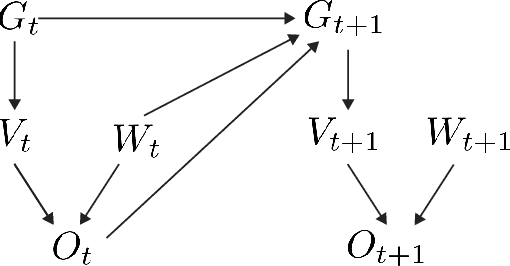
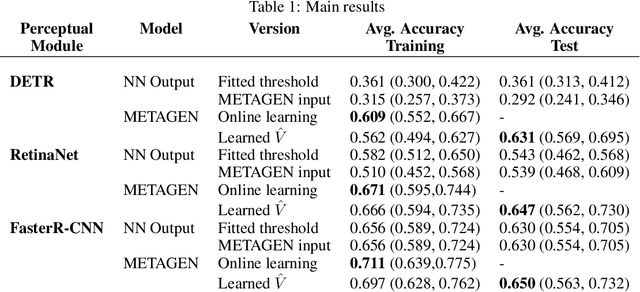
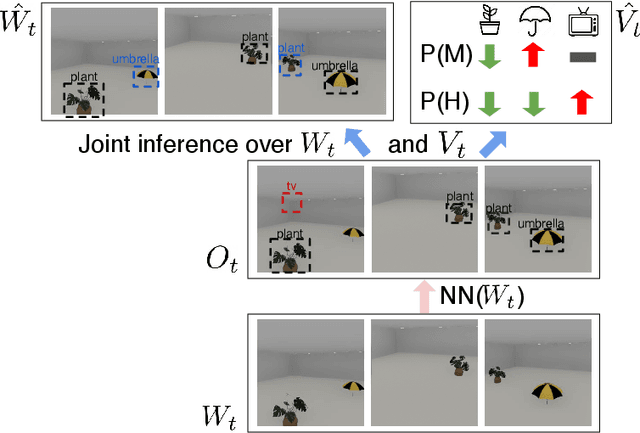
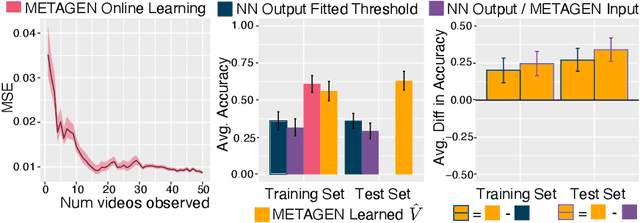
In contrast to object recognition models, humans do not blindly trust their perception when building representations of the world, instead recruiting metacognition to detect percepts that are unreliable or false, such as when we realize that we mistook one object for another. We propose METAGEN, an unsupervised model that enhances object recognition models through a metacognition. Given noisy output from an object-detection model, METAGEN learns a meta-representation of how its perceptual system works and uses it to infer the objects in the world responsible for the detections. METAGEN achieves this by conditioning its inference on basic principles of objects that even human infants understand (known as Spelke principles: object permanence, cohesion, and spatiotemporal continuity). We test METAGEN on a variety of state-of-the-art object detection neural networks. We find that METAGEN quickly learns an accurate metacognitive representation of the neural network, and that this improves detection accuracy by filling in objects that the detection model missed and removing hallucinated objects. This approach enables generalization to out-of-sample data and outperforms comparison models that lack a metacognition.
Learning a metacognition for object perception
Nov 30, 2020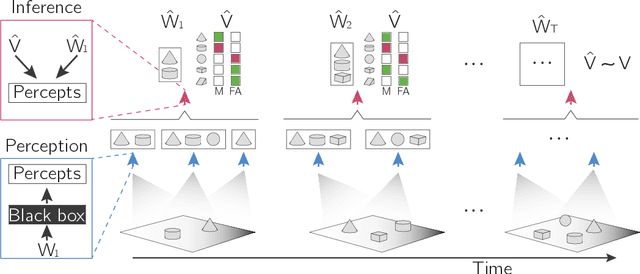
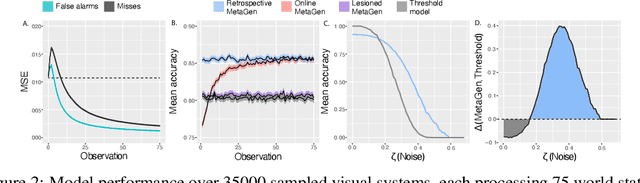
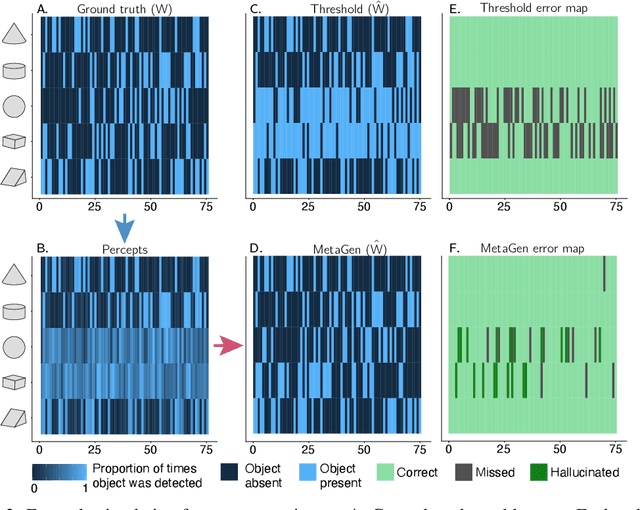
Beyond representing the external world, humans also represent their own cognitive processes. In the context of perception, this metacognition helps us identify unreliable percepts, such as when we recognize that we are seeing an illusion. Here we propose MetaGen, a model for the unsupervised learning of metacognition. In MetaGen, metacognition is expressed as a generative model of how a perceptual system produces noisy percepts. Using basic principles of how the world works (such as object permanence, part of infants' core knowledge), MetaGen jointly infers the objects in the world causing the percepts and a representation of its own perceptual system. MetaGen can then use this metacognition to infer which objects are actually present in the world. On simulated data, we find that MetaGen quickly learns a metacognition and improves overall accuracy, outperforming models that lack a metacognition.