 Add to Chrome
 Add to Firefox
 Add to Edge
Accelerating Vision Foundation Models with Drop-in Depthwise Convolution
May 21, 2026
Pretrained vision foundation models deliver strong performance across tasks with limited fine-tuning. However, their Vision Transformer (ViT) backbones impose high inference costs, limiting deployment on resource-constrained devices. In this work, we accelerate large-scale pretrained ViTs while preserving their feature extraction capabilities by exploiting the intrinsic convolution-like behavior of some attention heads. Specifically, we introduce an efficient depthwise convolution-based layer that serves as a drop-in replacement for these heads. Additionally, we propose simple strategies to identify which heads can be replaced and introduce a fine-tuning procedure that recovers downstream task performance. Across both image classification and segmentation tasks, our method achieves 17-20\% percent inference speedup with minimal performance degradation. We validate the approach through detailed derivations, extensive experiments, and efficiency benchmarks. The reference implementation is publicly available.

Low-Latency Embedded Driver Monitoring System with a Multi-Task Neural Network
May 04, 2026Road traffic accidents remain a significant global concern, with the majority attributed to human factors such as driver distraction and fatigue. This study proposes a camera-based approach to derive useful indicators to assess driver attentiveness and alertness. The proposed pipeline jointly satisfies the stringent real-time requirements imposed by the critical application and minimizes the computational requirements to allow for deployment on a tight computational budget. To this end, we develop a lightweight multi-task neural network that predicts multiple indicators for the face region in a single forward pass. The developed model is integrated into a complete execution workflow to produce a real-time estimate of attentiveness, fatigue, and engagement in distracting activities.
RAGE-XY: RADAR-Aided Longitudinal and Lateral Forces Estimation For Autonomous Race Cars
Apr 09, 2026In this work, we present RAGE-XY, an extended version of RAGE, a real-time estimation framework that simultaneously infers vehicle velocity, tire slip angles, and the forces acting on the vehicle using only standard onboard sensors such as IMUs and RADARs. Compared to the original formulation, the proposed method incorporates an online RADAR calibration module, improving the accuracy of lateral velocity estimation in the presence of sensor misalignment. Furthermore, we extend the underlying vehicle model from a single-track approximation to a tricycle model, enabling the estimation of rear longitudinal tire forces in addition to lateral dynamics. We validate the proposed approach through both high-fidelity simulations and real-world experiments conducted on the EAV-24 autonomous race car, demonstrating improved accuracy and robustness in estimating both lateral and longitudinal vehicle dynamics.
RAGE: A Tightly Coupled Radar-Aided Grip Estimator For Autonomous Race Cars
Apr 03, 2026Real-time estimation of vehicle-tire-road friction is critical for allowing autonomous race cars to safely and effectively operate at their physical limits. Traditional approaches to measure tire grip often depend on costly, specialized sensors that require custom installation, limiting scalability and deployment. In this work, we introduce RAGE, a novel real-time estimator that simultaneously infers the vehicle velocity, slip angles of the tires and the lateral forces that act on them, using only standard sensors, such as IMUs and RADARs, which are commonly available on most of modern autonomous platforms. We validate our approach through both high-fidelity simulations and real-world experiments conducted on the EAV-24 autonomous race car, demonstrating the accuracy and effectiveness of our method in estimating the vehicle lateral dynamics.
Fast and Realistic Automated Scenario Simulations and Reporting for an Autonomous Racing Stack
Dec 30, 2025In this paper, we describe the automated simulation and reporting pipeline implemented for our autonomous racing stack, ur.autopilot. The backbone of the simulation is based on a high-fidelity model of the vehicle interfaced as a Functional Mockup Unit (FMU). The pipeline can execute the software stack and the simulation up to three times faster than real-time, locally or on GitHub for Continuous Integration/- Continuous Delivery (CI/CD). As the most important input of the pipeline, there is a set of running scenarios. Each scenario allows the initialization of the ego vehicle in different initial conditions (position and speed), as well as the initialization of any other configuration of the stack. This functionality is essential to validate efficiently critical modules, like the one responsible for high-speed overtaking maneuvers or localization, which are among the most challenging aspects of autonomous racing. Moreover, we describe how we implemented a fault injection module, capable of introducing sensor delays and perturbations as well as modifying outputs of any node of the stack. Finally, we describe the design of our automated reporting process, aimed at maximizing the effectiveness of the simulation analysis.
BETTY Dataset: A Multi-modal Dataset for Full-Stack Autonomy
May 12, 2025We present the BETTY dataset, a large-scale, multi-modal dataset collected on several autonomous racing vehicles, targeting supervised and self-supervised state estimation, dynamics modeling, motion forecasting, perception, and more. Existing large-scale datasets, especially autonomous vehicle datasets, focus primarily on supervised perception, planning, and motion forecasting tasks. Our work enables multi-modal, data-driven methods by including all sensor inputs and the outputs from the software stack, along with semantic metadata and ground truth information. The dataset encompasses 4 years of data, currently comprising over 13 hours and 32TB, collected on autonomous racing vehicle platforms. This data spans 6 diverse racing environments, including high-speed oval courses, for single and multi-agent algorithm evaluation in feature-sparse scenarios, as well as high-speed road courses with high longitudinal and lateral accelerations and tight, GPS-denied environments. It captures highly dynamic states, such as 63 m/s crashes, loss of tire traction, and operation at the limit of stability. By offering a large breadth of cross-modal and dynamic data, the BETTY dataset enables the training and testing of full autonomy stack pipelines, pushing the performance of all algorithms to the limits. The current dataset is available at https://pitt-mit-iac.github.io/betty-dataset/.
A Simulation Benchmark for Autonomous Racing with Large-Scale Human Data
Jul 24, 2024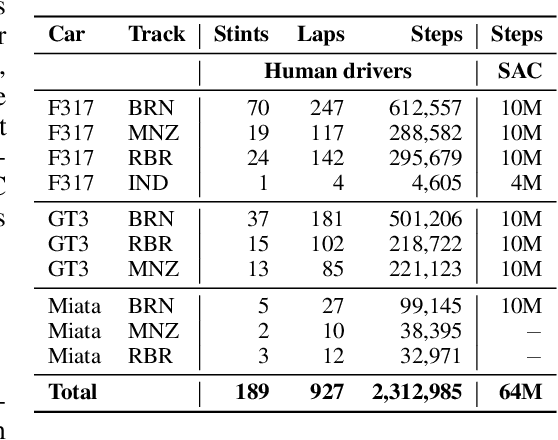
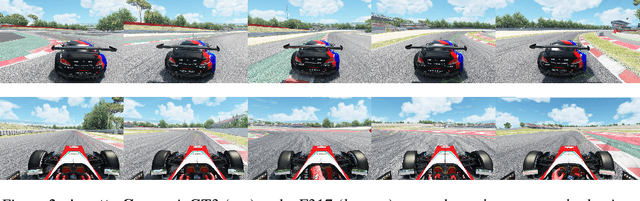
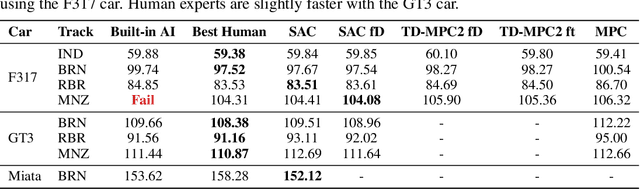
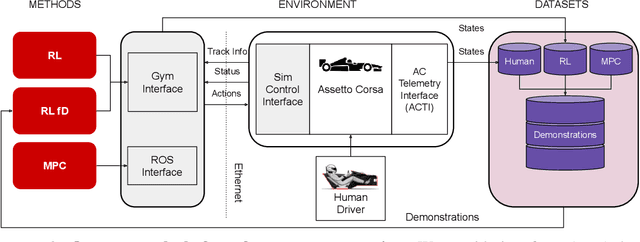
Despite the availability of international prize-money competitions, scaled vehicles, and simulation environments, research on autonomous racing and the control of sports cars operating close to the limit of handling has been limited by the high costs of vehicle acquisition and management, as well as the limited physics accuracy of open-source simulators. In this paper, we propose a racing simulation platform based on the simulator Assetto Corsa to test, validate, and benchmark autonomous driving algorithms, including reinforcement learning (RL) and classical Model Predictive Control (MPC), in realistic and challenging scenarios. Our contributions include the development of this simulation platform, several state-of-the-art algorithms tailored to the racing environment, and a comprehensive dataset collected from human drivers. Additionally, we evaluate algorithms in the offline RL setting. All the necessary code (including environment and benchmarks), working examples, datasets, and videos are publicly released and can be found at: https://assetto-corsa-gym.github.io
Guess the Drift with LOP-UKF: LiDAR Odometry and Pacejka Model for Real-Time Racecar Sideslip Estimation
May 09, 2024The sideslip angle, crucial for vehicle safety and stability, is determined using both longitudinal and lateral velocities. However, measuring the lateral component often necessitates costly sensors, leading to its common estimation, a topic thoroughly explored in existing literature. This paper introduces LOP-UKF, a novel method for estimating vehicle lateral velocity by integrating Lidar Odometry with the Pacejka tire model predictions, resulting in a robust estimation via an Unscendent Kalman Filter (UKF). This combination represents a distinct alternative to more traditional methodologies, resulting in a reliable solution also in edge cases. We present experimental results obtained using the Dallara AV-21 across diverse circuits and track conditions, demonstrating the effectiveness of our method.
A Tricycle Model to Accurately Control an Autonomous Racecar with Locked Differential
Dec 22, 2023In this paper, we present a novel formulation to model the effects of a locked differential on the lateral dynamics of an autonomous open-wheel racecar. The model is used in a Model Predictive Controller in which we included a micro-steps discretization approach to accurately linearize the dynamics and produce a prediction suitable for real-time implementation. The stability analysis of the model is presented, as well as a brief description of the overall planning and control scheme which includes an offline trajectory generation pipeline, an online local speed profile planner, and a low-level longitudinal controller. An improvement of the lateral path tracking is demonstrated in preliminary experimental results that have been produced on a Dallara AV-21 during the first Indy Autonomous Challenge event on the Monza F1 racetrack. Final adjustments and tuning have been performed in a high-fidelity simulator demonstrating the effectiveness of the solution when performing close to the tire limits.
er.autopilot 1.0: The Full Autonomous Stack for Oval Racing at High Speeds
Oct 27, 2023

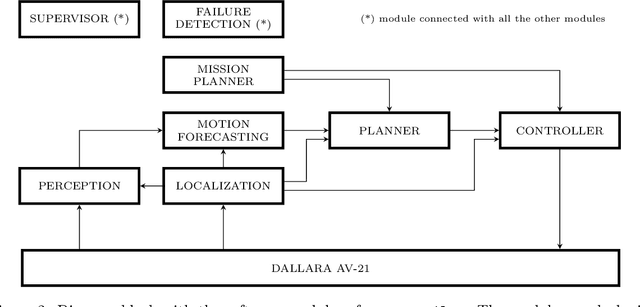
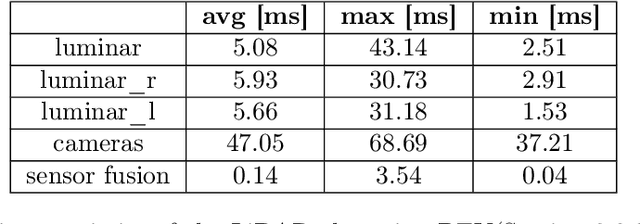
The Indy Autonomous Challenge (IAC) brought together for the first time in history nine autonomous racing teams competing at unprecedented speed and in head-to-head scenario, using independently developed software on open-wheel racecars. This paper presents the complete software architecture used by team TII EuroRacing (TII-ER), covering all the modules needed to avoid static obstacles, perform active overtakes and reach speeds above 75 m/s (270 km/h). In addition to the most common modules related to perception, planning, and control, we discuss the approaches used for vehicle dynamics modelling, simulation, telemetry, and safety. Overall results and the performance of each module are described, as well as the lessons learned during the first two events of the competition on oval tracks, where the team placed respectively second and third.