 Add to Chrome
 Add to Firefox
 Add to Edge
A Framework for Evaluating Zero-Shot Image Generation in Concept-based Explainability
May 19, 2026
Concept-based Explainable Artificial Intelligence (XAI) interprets deep learning models using human-understandable visual features (e.g., textures or object parts) by linking internal representations to class predictions, thereby bridging the gap between low-level image data and high-level semantics. A major challenge, however, is the reliance on large sets of labeled images to represent each concept, which limits scalability. In this work, we investigate the use of zero-shot Text-to-Image (T2I) generative models as a source of synthetic concept datasets for concept-based XAI methods. Specifically, we generate concepts using predefined prompts and evaluate their faithfulness to real ones through four complementary analyses: (1) comparing synthetic vs. real concept images via concept representation similarity; (2) evaluating their intra-similarity by comparing pairs of subsets of the same concept with progressively increasing size; (3) evaluating their performance for downstream explanation tasks using relevant class images; (4) evaluating how removing a concept from tested class images affects explanations of generated concepts. While current T2I generative models promise a shortcut to concept-based XAI, our study highlights challenges and raises open questions about the use of synthetic data generated by zero-shot pipelines in model analyses. The resulting dataset is available at https://github.com/DataSciencePolimi/ZeroShot-T2I-Concepts.

LLM-Enhanced Semantic Data Integration of Electronic Component Qualifications in the Aerospace Domain
Mar 20, 2026Large manufacturing companies face challenges in information retrieval due to data silos maintained by different departments, leading to inconsistencies and misalignment across databases. This paper presents an experience in integrating and retrieving qualification data for electronic components used in satellite board design. Due to data silos, designers cannot immediately determine the qualification status of individual components. However, this process is critical during the planning phase, when assembly drawings are issued before production, to optimize new qualifications and avoid redundant efforts. To address this, we propose a pipeline that uses Virtual Knowledge Graphs for a unified view over heterogeneous data sources and LLMs to enhance retrieval and reduce manual effort in data cleansing. The retrieval of qualifications is then performed through an Ontology-based Data Access approach for structured queries and a vector search mechanism for retrieving qualifications based on similar textual properties. We perform a comparative cost-benefit analysis, demonstrating that the proposed pipeline also outperforms approaches relying solely on LLMs, such as Retrieval-Augmented Generation (RAG), in terms of long-term efficiency.
MDER-DR: Multi-Hop Question Answering with Entity-Centric Summaries
Mar 11, 2026Retrieval-Augmented Generation (RAG) over Knowledge Graphs (KGs) suffers from the fact that indexing approaches may lose important contextual nuance when text is reduced to triples, thereby degrading performance in downstream Question-Answering (QA) tasks, particularly for multi-hop QA, which requires composing answers from multiple entities, facts, or relations. We propose a domain-agnostic, KG-based QA framework that covers both the indexing and retrieval/inference phases. A new indexing approach called Map-Disambiguate-Enrich-Reduce (MDER) generates context-derived triple descriptions and subsequently integrates them with entity-level summaries, thus avoiding the need for explicit traversal of edges in the graph during the QA retrieval phase. Complementing this, we introduce Decompose-Resolve (DR), a retrieval mechanism that decomposes user queries into resolvable triples and grounds them in the KG via iterative reasoning. Together, MDER and DR form an LLM-driven QA pipeline that is robust to sparse, incomplete, and complex relational data. Experiments show that on standard and domain specific benchmarks, MDER-DR achieves substantial improvements over standard RAG baselines (up to 66%), while maintaining cross-lingual robustness. Our code is available at https://github.com/DataSciencePolimi/MDER-DR_RAG.
Visual-TCAV: Concept-based Attribution and Saliency Maps for Post-hoc Explainability in Image Classification
Nov 08, 2024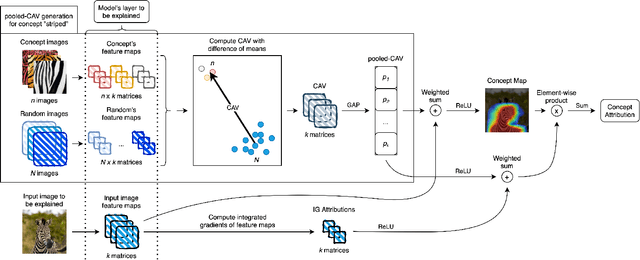
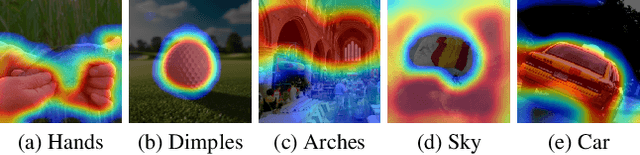
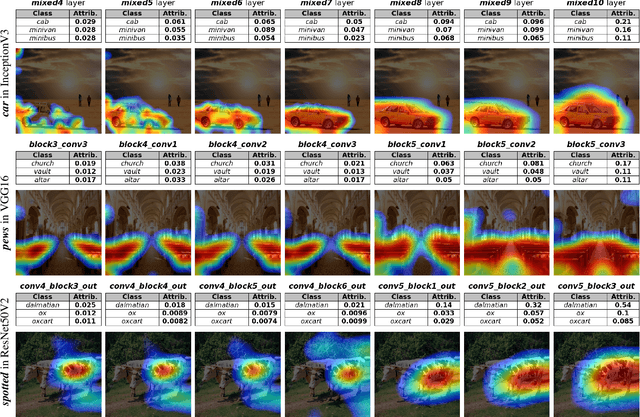
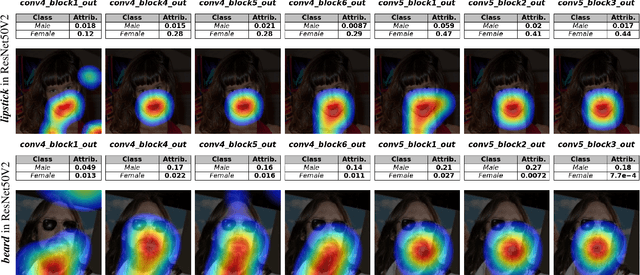
Convolutional Neural Networks (CNNs) have seen significant performance improvements in recent years. However, due to their size and complexity, they function as black-boxes, leading to transparency concerns. State-of-the-art saliency methods generate local explanations that highlight the area in the input image where a class is identified but cannot explain how a concept of interest contributes to the prediction, which is essential for bias mitigation. On the other hand, concept-based methods, such as TCAV (Testing with Concept Activation Vectors), provide insights into how sensitive is the network to a concept, but cannot compute its attribution in a specific prediction nor show its location within the input image. This paper introduces a novel post-hoc explainability framework, Visual-TCAV, which aims to bridge the gap between these methods by providing both local and global explanations for CNN-based image classification. Visual-TCAV uses Concept Activation Vectors (CAVs) to generate saliency maps that show where concepts are recognized by the network. Moreover, it can estimate the attribution of these concepts to the output of any class using a generalization of Integrated Gradients. This framework is evaluated on popular CNN architectures, with its validity further confirmed via experiments where ground truth for explanations is known, and a comparison with TCAV. Our code will be made available soon.
Integrating Large Language Models and Knowledge Graphs for Extraction and Validation of Textual Test Data
Aug 03, 2024Aerospace manufacturing companies, such as Thales Alenia Space, design, develop, integrate, verify, and validate products characterized by high complexity and low volume. They carefully document all phases for each product but analyses across products are challenging due to the heterogeneity and unstructured nature of the data in documents. In this paper, we propose a hybrid methodology that leverages Knowledge Graphs (KGs) in conjunction with Large Language Models (LLMs) to extract and validate data contained in these documents. We consider a case study focused on test data related to electronic boards for satellites. To do so, we extend the Semantic Sensor Network ontology. We store the metadata of the reports in a KG, while the actual test results are stored in parquet accessible via a Virtual Knowledge Graph. The validation process is managed using an LLM-based approach. We also conduct a benchmarking study to evaluate the performance of state-of-the-art LLMs in executing this task. Finally, we analyze the costs and benefits of automating preexisting processes of manual data extraction and validation for subsequent cross-report analyses.
Interpretable Network Visualizations: A Human-in-the-Loop Approach for Post-hoc Explainability of CNN-based Image Classification
May 06, 2024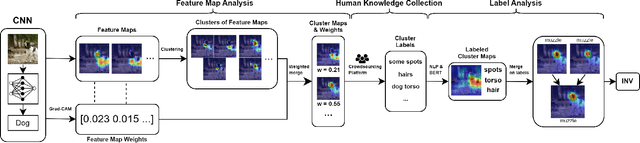
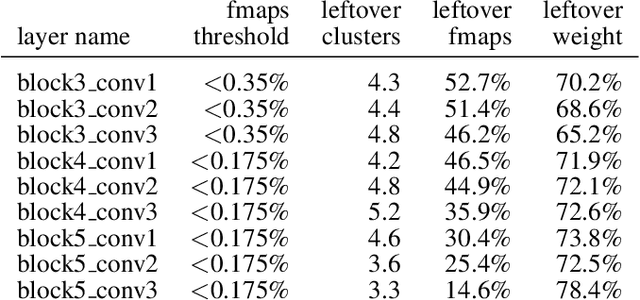
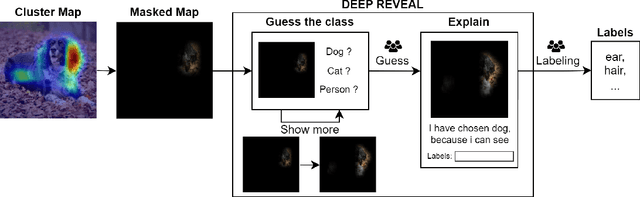

Transparency and explainability in image classification are essential for establishing trust in machine learning models and detecting biases and errors. State-of-the-art explainability methods generate saliency maps to show where a specific class is identified, without providing a detailed explanation of the model's decision process. Striving to address such a need, we introduce a post-hoc method that explains the entire feature extraction process of a Convolutional Neural Network. These explanations include a layer-wise representation of the features the model extracts from the input. Such features are represented as saliency maps generated by clustering and merging similar feature maps, to which we associate a weight derived by generalizing Grad-CAM for the proposed methodology. To further enhance these explanations, we include a set of textual labels collected through a gamified crowdsourcing activity and processed using NLP techniques and Sentence-BERT. Finally, we show an approach to generate global explanations by aggregating labels across multiple images.
A.I. Robustness: a Human-Centered Perspective on Technological Challenges and Opportunities
Oct 19, 2022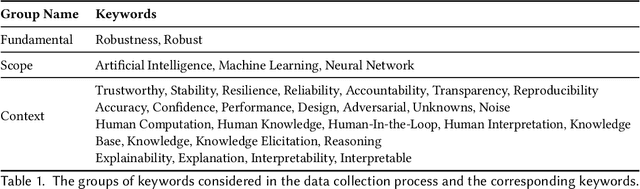
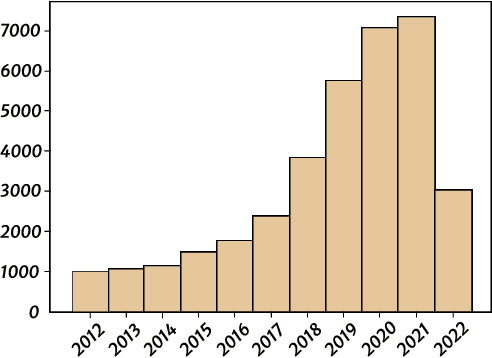
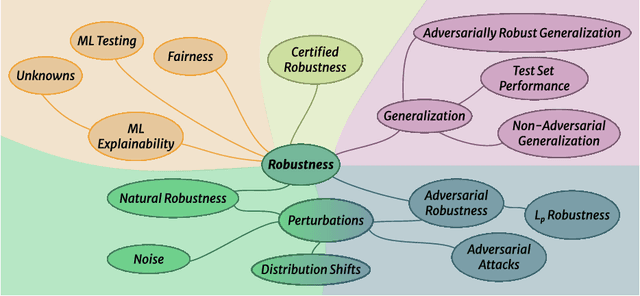
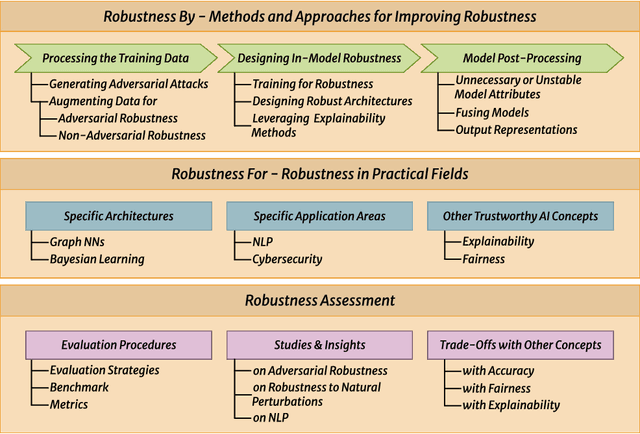
Despite the impressive performance of Artificial Intelligence (AI) systems, their robustness remains elusive and constitutes a key issue that impedes large-scale adoption. Robustness has been studied in many domains of AI, yet with different interpretations across domains and contexts. In this work, we systematically survey the recent progress to provide a reconciled terminology of concepts around AI robustness. We introduce three taxonomies to organize and describe the literature both from a fundamental and applied point of view: 1) robustness by methods and approaches in different phases of the machine learning pipeline; 2) robustness for specific model architectures, tasks, and systems; and in addition, 3) robustness assessment methodologies and insights, particularly the trade-offs with other trustworthiness properties. Finally, we identify and discuss research gaps and opportunities and give an outlook on the field. We highlight the central role of humans in evaluating and enhancing AI robustness, considering the necessary knowledge humans can provide, and discuss the need for better understanding practices and developing supportive tools in the future.
Exploiting Twitter as Source of Large Corpora of Weakly Similar Pairs for Semantic Sentence Embeddings
Oct 05, 2021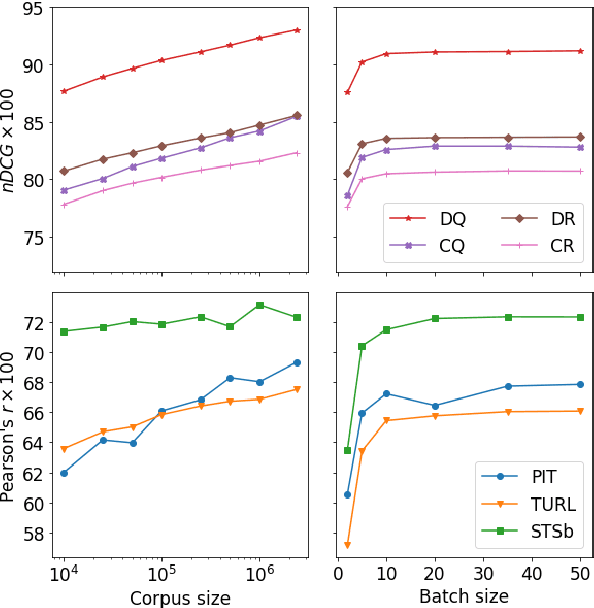
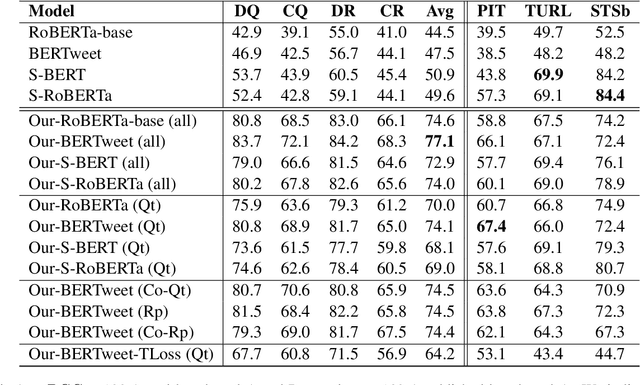
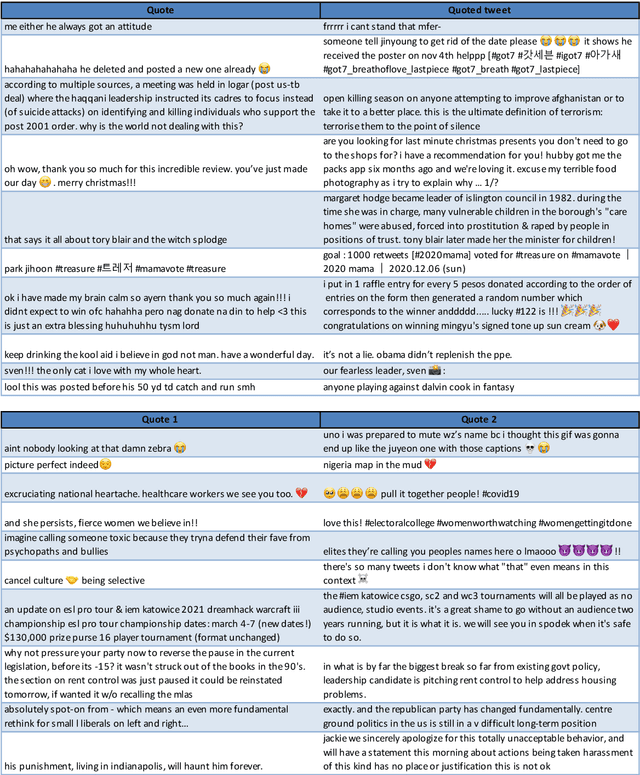
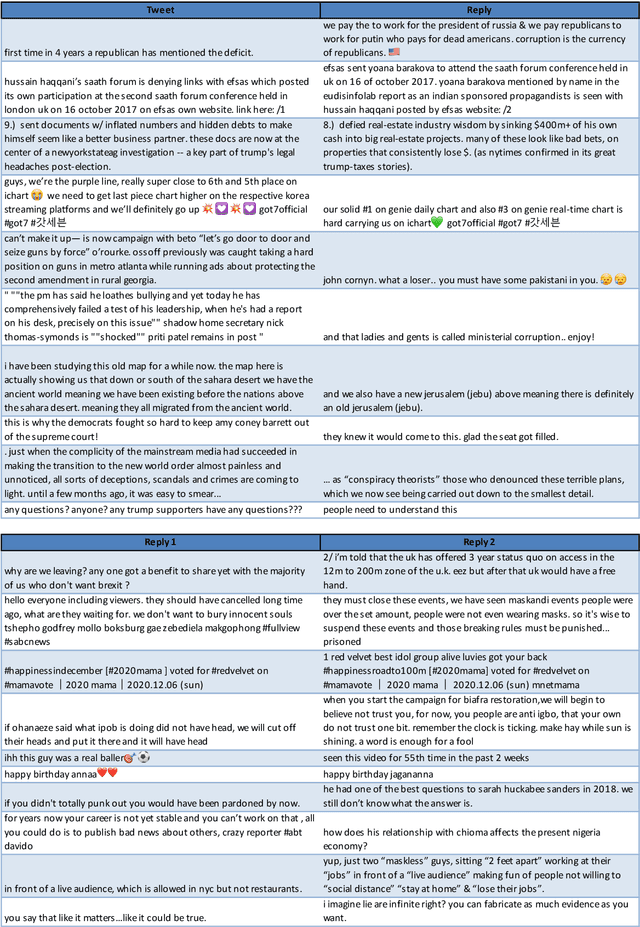
Semantic sentence embeddings are usually supervisedly built minimizing distances between pairs of embeddings of sentences labelled as semantically similar by annotators. Since big labelled datasets are rare, in particular for non-English languages, and expensive, recent studies focus on unsupervised approaches that require not-paired input sentences. We instead propose a language-independent approach to build large datasets of pairs of informal texts weakly similar, without manual human effort, exploiting Twitter's intrinsic powerful signals of relatedness: replies and quotes of tweets. We use the collected pairs to train a Transformer model with triplet-like structures, and we test the generated embeddings on Twitter NLP similarity tasks (PIT and TURL) and STSb. We also introduce four new sentence ranking evaluation benchmarks of informal texts, carefully extracted from the initial collections of tweets, proving not only that our best model learns classical Semantic Textual Similarity, but also excels on tasks where pairs of sentences are not exact paraphrases. Ablation studies reveal how increasing the corpus size influences positively the results, even at 2M samples, suggesting that bigger collections of Tweets still do not contain redundant information about semantic similarities.
EFSG: Evolutionary Fooling Sentences Generator
Oct 12, 2020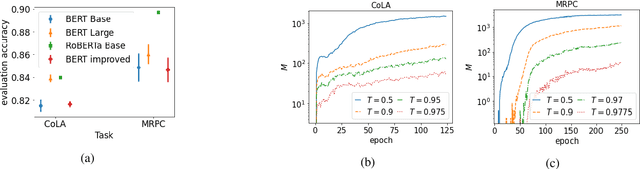
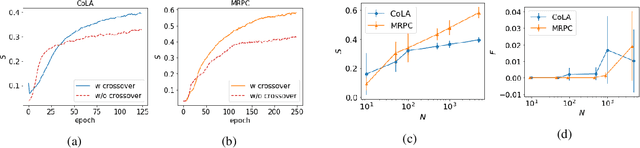
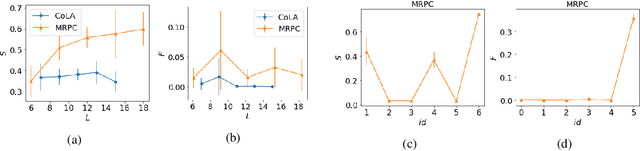
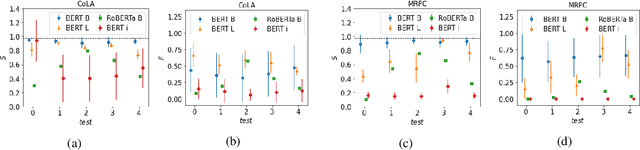
Large pre-trained language representation models (LMs) have recently collected a huge number of successes in many NLP tasks. In 2018 BERT, and later its successors (e.g. RoBERTa), obtained state-of-the-art results in classical benchmark tasks, such as GLUE benchmark. After that, works about adversarial attacks have been published to test their generalization proprieties and robustness. In this work, we design Evolutionary Fooling Sentences Generator (EFSG), a model- and task-agnostic adversarial attack algorithm built using an evolutionary approach to generate false-positive sentences for binary classification tasks. We successfully apply EFSG to CoLA and MRPC tasks, on BERT and RoBERTa, comparing performances. Results prove the presence of weak spots in state-of-the-art LMs. We finally test adversarial training as a data augmentation defence approach against EFSG, obtaining stronger improved models with no loss of accuracy when tested on the original datasets.
Semi-supervised Neural Networks solve an inverse problem for modeling Covid-19 spread
Oct 10, 2020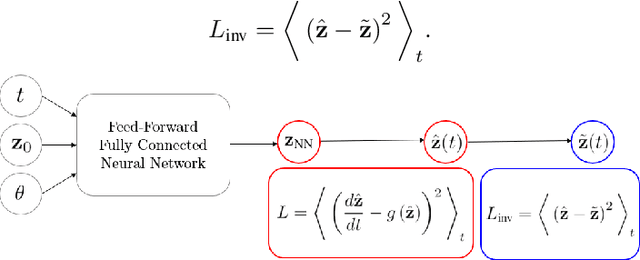
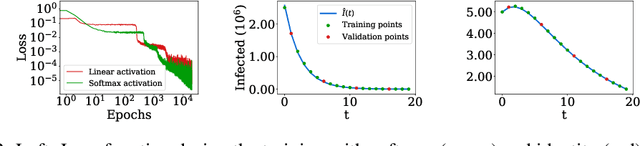
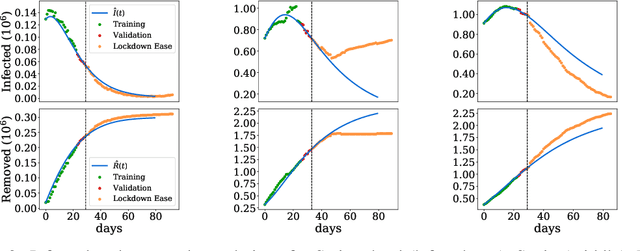
Studying the dynamics of COVID-19 is of paramount importance to understanding the efficiency of restrictive measures and develop strategies to defend against upcoming contagion waves. In this work, we study the spread of COVID-19 using a semi-supervised neural network and assuming a passive part of the population remains isolated from the virus dynamics. We start with an unsupervised neural network that learns solutions of differential equations for different modeling parameters and initial conditions. A supervised method then solves the inverse problem by estimating the optimal conditions that generate functions to fit the data for those infected by, recovered from, and deceased due to COVID-19. This semi-supervised approach incorporates real data to determine the evolution of the spread, the passive population, and the basic reproduction number for different countries.