 Add to Chrome
 Add to Firefox
 Add to Edge
A Framework for Evaluating Zero-Shot Image Generation in Concept-based Explainability
May 19, 2026
Concept-based Explainable Artificial Intelligence (XAI) interprets deep learning models using human-understandable visual features (e.g., textures or object parts) by linking internal representations to class predictions, thereby bridging the gap between low-level image data and high-level semantics. A major challenge, however, is the reliance on large sets of labeled images to represent each concept, which limits scalability. In this work, we investigate the use of zero-shot Text-to-Image (T2I) generative models as a source of synthetic concept datasets for concept-based XAI methods. Specifically, we generate concepts using predefined prompts and evaluate their faithfulness to real ones through four complementary analyses: (1) comparing synthetic vs. real concept images via concept representation similarity; (2) evaluating their intra-similarity by comparing pairs of subsets of the same concept with progressively increasing size; (3) evaluating their performance for downstream explanation tasks using relevant class images; (4) evaluating how removing a concept from tested class images affects explanations of generated concepts. While current T2I generative models promise a shortcut to concept-based XAI, our study highlights challenges and raises open questions about the use of synthetic data generated by zero-shot pipelines in model analyses. The resulting dataset is available at https://github.com/DataSciencePolimi/ZeroShot-T2I-Concepts.

MDER-DR: Multi-Hop Question Answering with Entity-Centric Summaries
Mar 11, 2026Retrieval-Augmented Generation (RAG) over Knowledge Graphs (KGs) suffers from the fact that indexing approaches may lose important contextual nuance when text is reduced to triples, thereby degrading performance in downstream Question-Answering (QA) tasks, particularly for multi-hop QA, which requires composing answers from multiple entities, facts, or relations. We propose a domain-agnostic, KG-based QA framework that covers both the indexing and retrieval/inference phases. A new indexing approach called Map-Disambiguate-Enrich-Reduce (MDER) generates context-derived triple descriptions and subsequently integrates them with entity-level summaries, thus avoiding the need for explicit traversal of edges in the graph during the QA retrieval phase. Complementing this, we introduce Decompose-Resolve (DR), a retrieval mechanism that decomposes user queries into resolvable triples and grounds them in the KG via iterative reasoning. Together, MDER and DR form an LLM-driven QA pipeline that is robust to sparse, incomplete, and complex relational data. Experiments show that on standard and domain specific benchmarks, MDER-DR achieves substantial improvements over standard RAG baselines (up to 66%), while maintaining cross-lingual robustness. Our code is available at https://github.com/DataSciencePolimi/MDER-DR_RAG.
Visual-TCAV: Concept-based Attribution and Saliency Maps for Post-hoc Explainability in Image Classification
Nov 08, 2024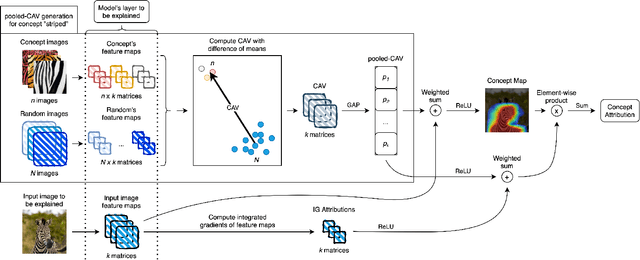
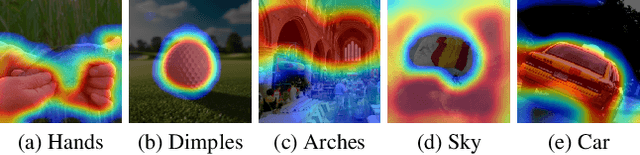
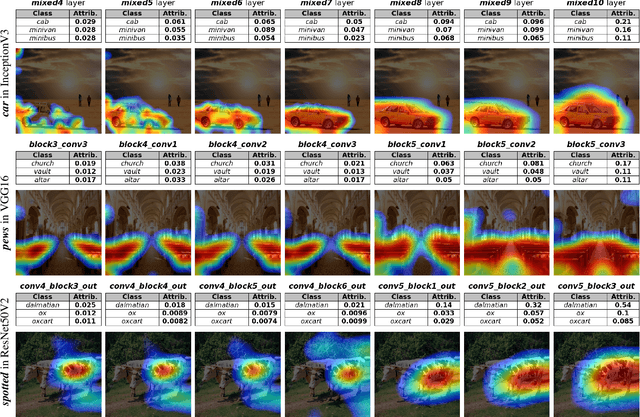
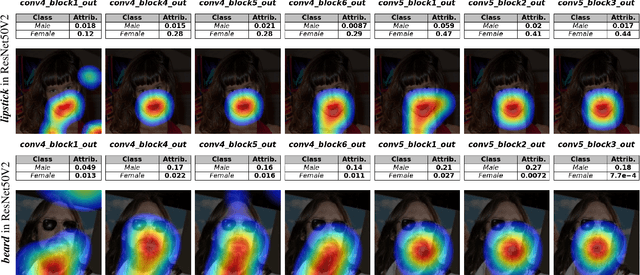
Convolutional Neural Networks (CNNs) have seen significant performance improvements in recent years. However, due to their size and complexity, they function as black-boxes, leading to transparency concerns. State-of-the-art saliency methods generate local explanations that highlight the area in the input image where a class is identified but cannot explain how a concept of interest contributes to the prediction, which is essential for bias mitigation. On the other hand, concept-based methods, such as TCAV (Testing with Concept Activation Vectors), provide insights into how sensitive is the network to a concept, but cannot compute its attribution in a specific prediction nor show its location within the input image. This paper introduces a novel post-hoc explainability framework, Visual-TCAV, which aims to bridge the gap between these methods by providing both local and global explanations for CNN-based image classification. Visual-TCAV uses Concept Activation Vectors (CAVs) to generate saliency maps that show where concepts are recognized by the network. Moreover, it can estimate the attribution of these concepts to the output of any class using a generalization of Integrated Gradients. This framework is evaluated on popular CNN architectures, with its validity further confirmed via experiments where ground truth for explanations is known, and a comparison with TCAV. Our code will be made available soon.