 Add to Chrome
 Add to Firefox
 Add to Edge
Back to the Future: A workbook time machine for spread sheet creation benchmarks
Aug 08, 2026
We introduce the workbook time machine, a pipeline that automatically creates benchmarks evaluating the ability of language models to create derived objects in spreadsheets (formulas, charts, pivot tables, and conditional formatting). Applied to public workbook corpora, it produces wtmcorpus--a collection of (input workbook, output workbook, query) triples spanning four artifact types and varying complexity. From this corpus we curate wtmbench, a 150-task evaluation benchmark with queries at three levels of specificity. We evaluate existing spreadsheet manipulation agents and baselines on wtmbench across artifact types, step complexity, and instruction granularity. Our evaluations show that query specificity, agent orchestration, and interface API used to control spreadsheets play a big role in LLM performance on Excel tasks.

Server-Side Local Gradient Averaging and Learning Rate Acceleration for Scalable Split Learning
Dec 11, 2021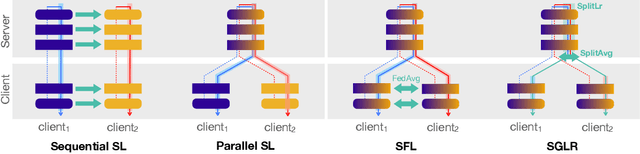
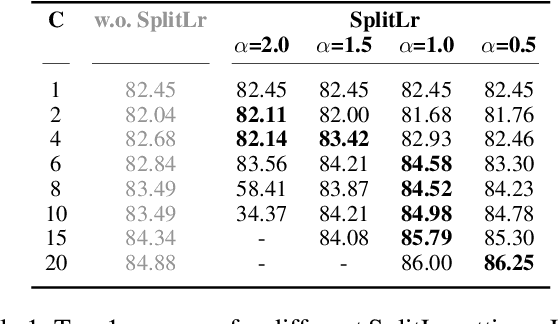
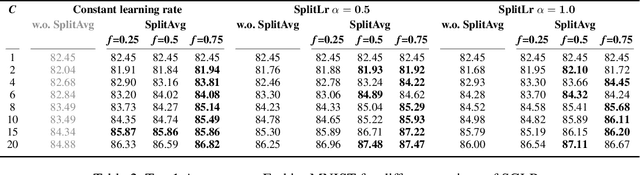

In recent years, there have been great advances in the field of decentralized learning with private data. Federated learning (FL) and split learning (SL) are two spearheads possessing their pros and cons, and are suited for many user clients and large models, respectively. To enjoy both benefits, hybrid approaches such as SplitFed have emerged of late, yet their fundamentals have still been illusive. In this work, we first identify the fundamental bottlenecks of SL, and thereby propose a scalable SL framework, coined SGLR. The server under SGLR broadcasts a common gradient averaged at the split-layer, emulating FL without any additional communication across clients as opposed to SplitFed. Meanwhile, SGLR splits the learning rate into its server-side and client-side rates, and separately adjusts them to support many clients in parallel. Simulation results corroborate that SGLR achieves higher accuracy than other baseline SL methods including SplitFed, which is even on par with FL consuming higher energy and communication costs. As a secondary result, we observe greater reduction in leakage of sensitive information via mutual information using SLGR over the baselines.