 Add to Chrome
 Add to Firefox
 Add to Edge
Reason Wide, Not Deep: Amortizing the Reasoning Premium into Distilled Skills
Aug 08, 2026
Reasoning modes of language models outperform their non-reasoning counterparts on multi-step agentic tasks, but pay a 3-6x premium in output tokens on every episode -- much of it spent re-deriving procedures that are shared across episodes of the same domain. We show this recurring cost can be amortized: a coding agent analyses a small corpus of existing trajectories from a training split and compiles a compact natural-language skill that is injected into the non-reasoning model's system prompt. Across four agentic benchmarks (ALFWorld, tau$^2$-bench telecom and retail, and SpreadsheetBench-Verified), skills recover 55%-100%+ of the reasoning gap for GPT-5.4-mini on held-out tasks -- exceeding the reasoning mode outright on two of four -- while emitting 2.7-6x fewer output tokens and zero reasoning tokens. Notably, reasoning traces are not a prerequisite: skills distilled from non-reasoning trajectories alone remain competitive with skills distilled from paired reasoning/non-reasoning corpora, with domain-dependent differences between the two sources. We interpret these results through a search lens: test-time reasoning is deep search inside a single episode, re-paid at every deployment, while corpus distillation is wide search across episodes, paid once. The two recover overlapping procedural knowledge, and width over cheap trajectories is often the better buy -- with the residual gap on some domains (telecom, SpreadsheetBench) delineating where genuinely per-instance deep search remains necessary.

Back to the Future: A workbook time machine for spread sheet creation benchmarks
Aug 08, 2026We introduce the workbook time machine, a pipeline that automatically creates benchmarks evaluating the ability of language models to create derived objects in spreadsheets (formulas, charts, pivot tables, and conditional formatting). Applied to public workbook corpora, it produces wtmcorpus--a collection of (input workbook, output workbook, query) triples spanning four artifact types and varying complexity. From this corpus we curate wtmbench, a 150-task evaluation benchmark with queries at three levels of specificity. We evaluate existing spreadsheet manipulation agents and baselines on wtmbench across artifact types, step complexity, and instruction granularity. Our evaluations show that query specificity, agent orchestration, and interface API used to control spreadsheets play a big role in LLM performance on Excel tasks.
Soft-Label Training Preserves Epistemic Uncertainty
Nov 18, 2025Many machine learning tasks involve inherent subjectivity, where annotators naturally provide varied labels. Standard practice collapses these label distributions into single labels, aggregating diverse human judgments into point estimates. We argue that this approach is epistemically misaligned for ambiguous data--the annotation distribution itself should be regarded as the ground truth. Training on collapsed single labels forces models to express false confidence on fundamentally ambiguous cases, creating a misalignment between model certainty and the diversity of human perception. We demonstrate empirically that soft-label training, which treats annotation distributions as ground truth, preserves epistemic uncertainty. Across both vision and NLP tasks, soft-label training achieves 32% lower KL divergence from human annotations and 61% stronger correlation between model and annotation entropy, while matching the accuracy of hard-label training. Our work repositions annotation distributions from noisy signals to be aggregated away, to faithful representations of epistemic uncertainty that models should learn to reproduce.
Poze: Sports Technique Feedback under Data Constraints
Nov 08, 2024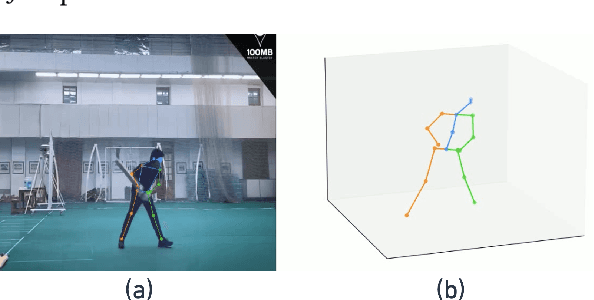
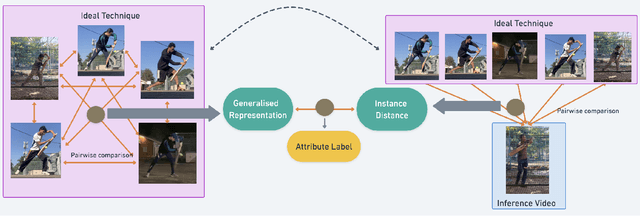

Access to expert coaching is essential for developing technique in sports, yet economic barriers often place it out of reach for many enthusiasts. To bridge this gap, we introduce Poze, an innovative video processing framework that provides feedback on human motion, emulating the insights of a professional coach. Poze combines pose estimation with sequence comparison and is optimized to function effectively with minimal data. Poze surpasses state-of-the-art vision-language models in video question-answering frameworks, achieving 70% and 196% increase in accuracy over GPT4V and LLaVAv1.6 7b, respectively.