 Add to Chrome
 Add to Firefox
 Add to Edge
VERITAS: Verifier-Guided Proof Search for Zero-Shot Formal Theorem Proving
Jun 17, 2026
LLM-based formal provers often collapse rich verifier signals (syntax errors, type mismatches, partial goal progress) into a binary pass/fail bit. We present VERITAS, a zero-shot framework that routes every verifier signal back into proof search through a two-phase protocol: Best-of-N sampling first, then a critic-guided MCTS pass that ingests Phase 1 failures as explicit negative examples. The protocol preserves every theorem solved by its own Phase 1 sweep, so Phase 2's additional solves are attributable to feedback-driven exploration. VERITAS reaches 40.6% on miniF2F (vs. an independently run Best-of-5 at 36.9%, Portfolio 26.2%) and 7.3% on VERITAS-CombiBench, a 55-theorem combinatorics benchmark we release on which Best-of-5 (1.8%) falls below Portfolio (3.6%), exposing that unguided sampling hurts when correct lemma names must be recovered iteratively from verifier feedback. Artifacts are available on GitHub.

Optimizing Code Runtime Performance through Context-Aware Retrieval-Augmented Generation
Jan 29, 2025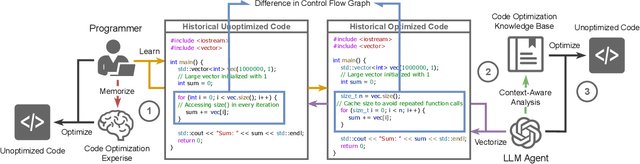
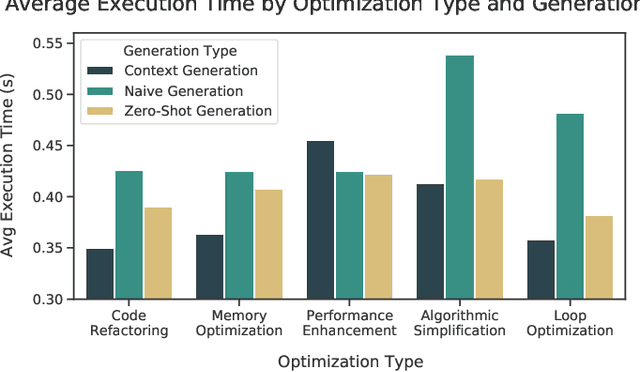
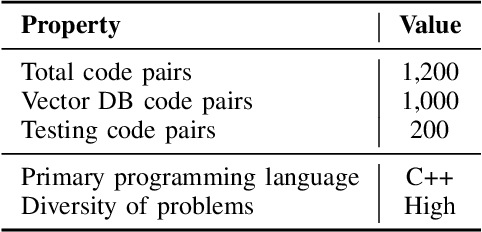
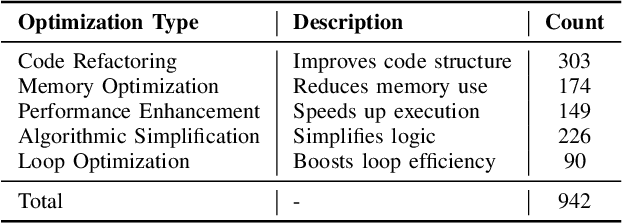
Optimizing software performance through automated code refinement offers a promising avenue for enhancing execution speed and efficiency. Despite recent advancements in LLMs, a significant gap remains in their ability to perform in-depth program analysis. This study introduces AUTOPATCH, an in-context learning approach designed to bridge this gap by enabling LLMs to automatically generate optimized code. Inspired by how programmers learn and apply knowledge to optimize software, AUTOPATCH incorporates three key components: (1) an analogy-driven framework to align LLM optimization with human cognitive processes, (2) a unified approach that integrates historical code examples and CFG analysis for context-aware learning, and (3) an automated pipeline for generating optimized code through in-context prompting. Experimental results demonstrate that AUTOPATCH achieves a 7.3% improvement in execution efficiency over GPT-4o across common generated executable code, highlighting its potential to advance automated program runtime optimization.
An Application of Large Language Models to Coding Negotiation Transcripts
Jul 18, 2024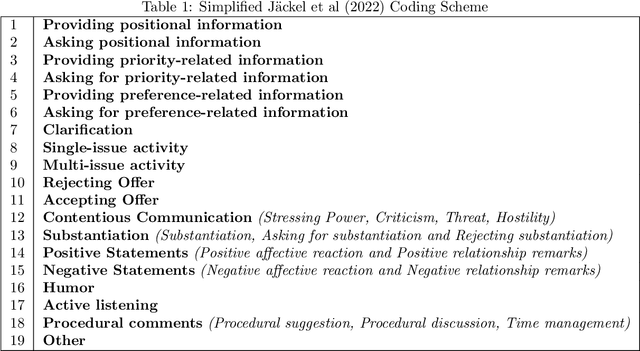


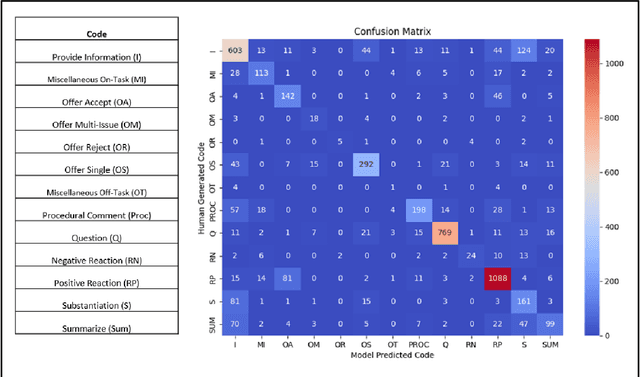
In recent years, Large Language Models (LLM) have demonstrated impressive capabilities in the field of natural language processing (NLP). This paper explores the application of LLMs in negotiation transcript analysis by the Vanderbilt AI Negotiation Lab. Starting in September 2022, we applied multiple strategies using LLMs from zero shot learning to fine tuning models to in-context learning). The final strategy we developed is explained, along with how to access and use the model. This study provides a sense of both the opportunities and roadblocks for the implementation of LLMs in real life applications and offers a model for how LLMs can be applied to coding in other fields.