 Add to Chrome
 Add to Firefox
 Add to Edge
MIDST Challenge at SaTML 2025: Membership Inference over Diffusion-models-based Synthetic Tabular data
Mar 19, 2026
Synthetic data is often perceived as a silver-bullet solution to data anonymization and privacy-preserving data publishing. Drawn from generative models like diffusion models, synthetic data is expected to preserve the statistical properties of the original dataset while remaining resilient to privacy attacks. Recent developments of diffusion models have been effective on a wide range of data types, but their privacy resilience, particularly for tabular formats, remains largely unexplored. MIDST challenge sought a quantitative evaluation of the privacy gain of synthetic tabular data generated by diffusion models, with a specific focus on its resistance to membership inference attacks (MIAs). Given the heterogeneity and complexity of tabular data, multiple target models were explored for MIAs, including diffusion models for single tables of mixed data types and multi-relational tables with interconnected constraints. MIDST inspired the development of novel black-box and white-box MIAs tailored to these target diffusion models as a key outcome, enabling a comprehensive evaluation of their privacy efficacy. The MIDST GitHub repository is available at https://github.com/VectorInstitute/MIDST

From Features to Actions: Explainability in Traditional and Agentic AI Systems
Feb 09, 2026Over the last decade, explainable AI has primarily focused on interpreting individual model predictions, producing post-hoc explanations that relate inputs to outputs under a fixed decision structure. Recent advances in large language models (LLMs) have enabled agentic AI systems whose behaviour unfolds over multi-step trajectories. In these settings, success and failure are determined by sequences of decisions rather than a single output. While useful, it remains unclear how explanation approaches designed for static predictions translate to agentic settings where behaviour emerges over time. In this work, we bridge the gap between static and agentic explainability by comparing attribution-based explanations with trace-based diagnostics across both settings. To make this distinction explicit, we empirically compare attribution-based explanations used in static classification tasks with trace-based diagnostics used in agentic benchmarks (TAU-bench Airline and AssistantBench). Our results show that while attribution methods achieve stable feature rankings in static settings (Spearman $ρ= 0.86$), they cannot be applied reliably to diagnose execution-level failures in agentic trajectories. In contrast, trace-grounded rubric evaluation for agentic settings consistently localizes behaviour breakdowns and reveals that state tracking inconsistency is 2.7$\times$ more prevalent in failed runs and reduces success probability by 49\%. These findings motivate a shift towards trajectory-level explainability for agentic systems when evaluating and diagnosing autonomous AI behaviour. Resources: https://github.com/VectorInstitute/unified-xai-evaluation-framework https://vectorinstitute.github.io/unified-xai-evaluation-framework
EHRMamba: Towards Generalizable and Scalable Foundation Models for Electronic Health Records
May 23, 2024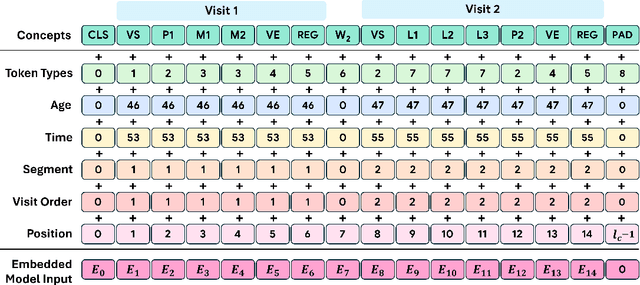
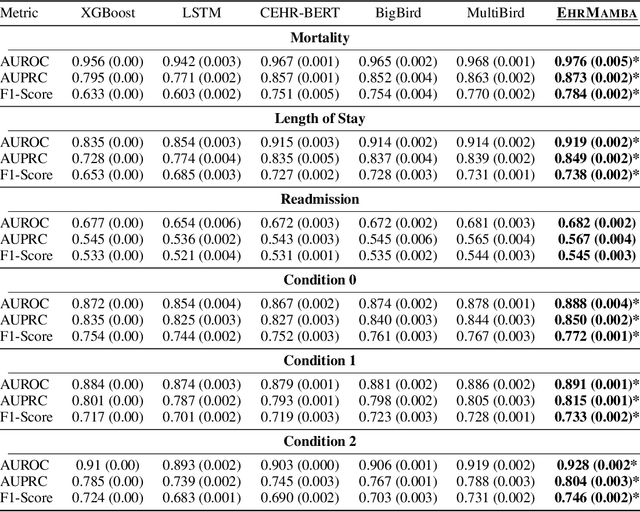
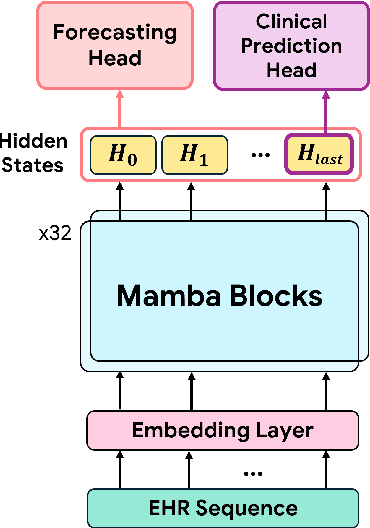
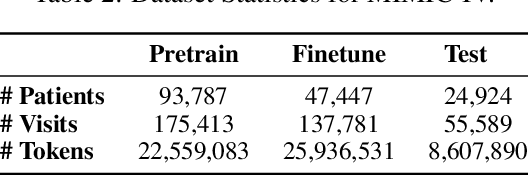
Transformers have significantly advanced the modeling of Electronic Health Records (EHR), yet their deployment in real-world healthcare is limited by several key challenges. Firstly, the quadratic computational cost and insufficient context length of these models pose significant obstacles for hospitals in processing the extensive medical histories typical in EHR data. Additionally, existing models employ separate finetuning for each clinical task, complicating maintenance in healthcare environments. Moreover, these models focus exclusively on either clinical prediction or EHR forecasting, lacking the flexibility to perform well across both. To overcome these limitations, we introduce EHRMamba, a robust foundation model built on the Mamba architecture. EHRMamba can process sequences up to four times longer than previous models due to its linear computational cost. We also introduce a novel approach to Multitask Prompted Finetuning (MTF) for EHR data, which enables EHRMamba to simultaneously learn multiple clinical tasks in a single finetuning phase, significantly enhancing deployment and cross-task generalization. Furthermore, our model leverages the HL7 FHIR data standard to simplify integration into existing hospital systems. Alongside EHRMamba, we open-source Odyssey, a toolkit designed to support the development and deployment of EHR foundation models, with an emphasis on data standardization and interpretability. Our evaluations on the MIMIC-IV dataset demonstrate that EHRMamba advances state-of-the-art performance across 6 major clinical tasks and excels in EHR forecasting, marking a significant leap forward in the field.