 Add to Chrome
 Add to Firefox
 Add to Edge
PROVE: Training-Free Prompt Recovery using Verifiable Evidence
Aug 13, 2026
Modern text-to-image models can generate highly realistic images from natural-language prompts, while recent advances in prompt inversion have made it increasingly feasible to recover those prompts from generated outputs, raising new concerns for copyright protection and content ownership. As prompt marketplaces emerge, recovered prompts can enable both the unauthorized reproduction and redistribution of copyrighted creative works, and the exposure of the prompts that encode an artist's creative recipe in AI-generated content. Existing prompt inversion methods rely on gradient-based optimization, autoregressive captioning, or reinforcement learning. However, optimization-based methods often produce unreadable prompts, captioning methods hallucinate unverified details, and RL-based approaches frequently overfit to specific generators while introducing evaluation circularity. We introduce PROVE (Prompt Recovery with Verified Evidence), a training-free, black-box prompt inversion attack that reconstructs prompts by composing verifiable scene descriptions rather than optimizing token sequences, targeting both original copyrighted works and AI-generated content. The resulting prompts are fully auditable, with every recovered claim grounded in explicit image evidence, and are formalized through a precision-constrained recall maximization objective. Across MS-COCO, Flickr30K, and Lexica, using state-of-the-art text-to-image generators, PROVE consistently outperforms optimization, captioning, and RL-based baselines on image similarity (DINO, LPIPS) and text-image alignment (CLIP), without any training, generator access, or fine-tuning, demonstrating a stronger and more practical prompt inversion attack.

ChartProbe: A Diagnostic Study on Visual Reasoning through Perception, Grounding, and Simple Reasoning
Aug 13, 2026Vision-language models (VLMs) remain unreliable on chart questions that require reasoning over visual quantities, and this weakness is usually attributed to a reasoning deficit and addressed with more reasoning supervision. We ask whether the difficulty lies in reasoning itself, or in the simpler skills that reasoning operates on: reading the plotted elements (\emph{perception}), locating them and binding them to their labels (\emph{grounding}), and performing single-step computations such as ranking, totals, and differences (\emph{simple reasoning}). We introduce \textbf{ChartProbe}, a diagnostic framework whose probes are generated directly from the code that renders each chart, so every gold answer is exact by construction, needs no human annotation, and attributes each failure to a single skill. ChartProbe enables an intervention prior work does not attempt: instead of synthesizing complex-reasoning data, we withhold complex questions and reasoning traces entirely, fine-tune on one simple skill at a time, and measure transfer to held-out complex-reasoning questions. Across three open-weight VLMs, supervising the simpler skills alone produces large gains on complex-reasoning questions the model never trained on: where these skills are weak and the model can be taught to read the image, training them recovers much of complex reasoning at no reasoning-data cost. The gains hold across three out-of-distribution settings: an unseen chart type (pie charts), a human-written benchmark disjoint from our images and templates (ChartQA), and a non-chart visual domain (CLEVR). Complex visual reasoning can therefore improve without complex-reasoning supervision.
A Comprehensive Survey of Accelerated Generation Techniques in Large Language Models
May 15, 2024Despite the crucial importance of accelerating text generation in large language models (LLMs) for efficiently producing content, the sequential nature of this process often leads to high inference latency, posing challenges for real-time applications. Various techniques have been proposed and developed to address these challenges and improve efficiency. This paper presents a comprehensive survey of accelerated generation techniques in autoregressive language models, aiming to understand the state-of-the-art methods and their applications. We categorize these techniques into several key areas: speculative decoding, early exiting mechanisms, and non-autoregressive methods. We discuss each category's underlying principles, advantages, limitations, and recent advancements. Through this survey, we aim to offer insights into the current landscape of techniques in LLMs and provide guidance for future research directions in this critical area of natural language processing.
Who Evaluates the Evaluations? Objectively Scoring Text-to-Image Prompt Coherence Metrics with T2IScoreScore (TS2)
Apr 05, 2024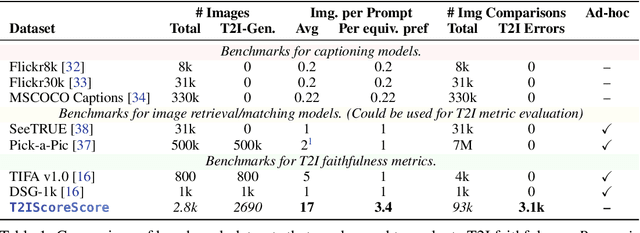
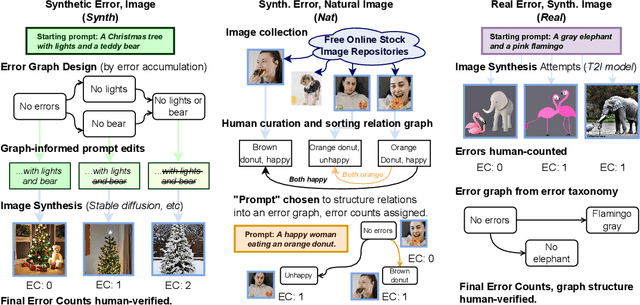
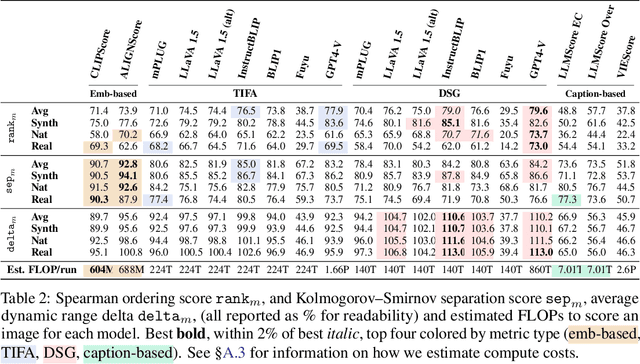
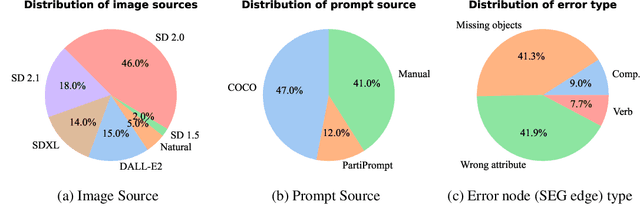
With advances in the quality of text-to-image (T2I) models has come interest in benchmarking their prompt faithfulness-the semantic coherence of generated images to the prompts they were conditioned on. A variety of T2I faithfulness metrics have been proposed, leveraging advances in cross-modal embeddings and vision-language models (VLMs). However, these metrics are not rigorously compared and benchmarked, instead presented against few weak baselines by correlation to human Likert scores over a set of easy-to-discriminate images. We introduce T2IScoreScore (TS2), a curated set of semantic error graphs containing a prompt and a set increasingly erroneous images. These allow us to rigorously judge whether a given prompt faithfulness metric can correctly order images with respect to their objective error count and significantly discriminate between different error nodes, using meta-metric scores derived from established statistical tests. Surprisingly, we find that the state-of-the-art VLM-based metrics (e.g., TIFA, DSG, LLMScore, VIEScore) we tested fail to significantly outperform simple feature-based metrics like CLIPScore, particularly on a hard subset of naturally-occurring T2I model errors. TS2 will enable the development of better T2I prompt faithfulness metrics through more rigorous comparison of their conformity to expected orderings and separations under objective criteria.