 Add to Chrome
 Add to Firefox
 Add to Edge
Curriculum-Driven 3D CT Report Generation via Language-Free Visual Grafting and Zone-Constrained Compression
Mar 24, 2026
Automated radiology report generation from 3D computed tomography (CT) volumes is challenging due to extreme sequence lengths, severe class imbalance, and the tendency of large language models (LLMs) to ignore visual tokens in favor of linguistic priors. We present Ker-VLJEPA-3B, a four-phase curriculum learning framework for free-text report generation from thoracic CT volumes. A phased training curriculum progressively adapts a Llama 3.2 3B decoder to ground its output in visual features from a frozen, self-supervised encoder. Our visual backbone (LeJEPA ViT-Large) is trained via self-supervised joint-embedding prediction on unlabeled CTs, without text supervision. Unlike contrastive models (CLIP, BiomedCLIP), this language-free backbone yields modality-pure representations. Vision-language alignment is deferred to the curriculum's bridge and generation phases. This modality-agnostic design can integrate any self-supervised encoder into an LLM without paired text during foundation training. Methodological innovations include: (1) zone-constrained cross-attention compressing slice embeddings into 32 spatially-grounded visual tokens; (2) PCA whitening of anisotropic LLM embeddings; (3) a positive-findings-only strategy eliminating posterior collapse; (4) warm bridge initialization transferring projection weights; and (5) selective cross-attention freezing with elastic weight consolidation to prevent catastrophic forgetting. Evaluated on the CT-RATE benchmark (2,984 validation volumes, 18 classes), Ker-VLJEPA-3B achieves a macro F1 of 0.429, surpassing the state-of-the-art (U-VLM, macro F1 = 0.414) by 3.6%, and reaching 0.448 (+8.2%) with threshold optimization. Ablation studies confirm 56.6% of generation quality derives from patient-specific visual content. Code and weights are available.

A Framework for Cross-Domain Generalization in Coronary Artery Calcium Scoring Across Gated and Non-Gated Computed Tomography
Feb 25, 2026Coronary artery calcium (CAC) scoring is a key predictor of cardiovascular risk, but it relies on ECG-gated CT scans, restricting its use to specialized cardiac imaging settings. We introduce an automated framework for CAC detection and lesion-specific Agatston scoring that operates across both gated and non-gated CT scans. At its core is CARD-ViT, a self-supervised Vision Transformer trained exclusively on gated CT data using DINO. Without any non-gated training data, our framework achieves 0.707 accuracy and a Cohen's kappa of 0.528 on the Stanford non-gated dataset, matching models trained directly on non-gated scans. On gated test sets, the framework achieves 0.910 accuracy with Cohen's kappa scores of 0.871 and 0.874 across independent datasets, demonstrating robust risk stratification. These results demonstrate the feasibility of cross-domain CAC scoring from gated to non-gated domains, supporting scalable cardiovascular screening in routine chest imaging without additional scans or annotations.
Magnification-Aware Distillation (MAD): A Self-Supervised Framework for Unified Representation Learning in Gigapixel Whole-Slide Images
Dec 16, 2025Whole-slide images (WSIs) contain tissue information distributed across multiple magnification levels, yet most self-supervised methods treat these scales as independent views. This separation prevents models from learning representations that remain stable when resolution changes, a key requirement for practical neuropathology workflows. This study introduces Magnification-Aware Distillation (MAD), a self-supervised strategy that links low-magnification context with spatially aligned high-magnification detail, enabling the model to learn how coarse tissue structure relates to fine cellular patterns. The resulting foundation model, MAD-NP, is trained entirely through this cross-scale correspondence without annotations. A linear classifier trained only on 10x embeddings maintains 96.7% of its performance when applied to unseen 40x tiles, demonstrating strong resolution-invariant representation learning. Segmentation outputs remain consistent across magnifications, preserving anatomical boundaries and minimizing noise. These results highlight the feasibility of scalable, magnification-robust WSI analysis using a unified embedding space
Enhancing Low Dose Computed Tomography Images Using Consistency Training Techniques
Nov 19, 2024Diffusion models have significant impact on wide range of generative tasks, especially on image inpainting and restoration. Although the improvements on aiming for decreasing number of function evaluations (NFE), the iterative results are still computationally expensive. Consistency models are as a new family of generative models, enable single-step sampling of high quality data without the need for adversarial training. In this paper, we introduce the beta noise distribution, which provides flexibility in adjusting noise levels. This is combined with a sinusoidal curriculum that enhances the learning of the trajectory between the noise distribution and the posterior distribution of interest, allowing High Noise Improved Consistency Training (HN-iCT) to be trained in a supervised fashion. Additionally, High Noise Improved Consistency Training with Image Condition (HN-iCT-CN) architecture is introduced, enables to take Low Dose images as a condition for extracting significant features by Weighted Attention Gates (WAG).Our results indicate that unconditional image generation using HN-iCT significantly outperforms basic CT and iCT training techniques with NFE=1 on the CIFAR10 and CelebA datasets. Moreover, our image-conditioned model demonstrates exceptional performance in enhancing low-dose (LD) CT scans.
DINO-LG: A Task-Specific DINO Model for Coronary Calcium Scoring
Nov 13, 2024Coronary artery disease (CAD), one of the most common cause of mortality in the world. Coronary artery calcium (CAC) scoring using computed tomography (CT) is key for risk assessment to prevent coronary disease. Previous studies on risk assessment and calcification detection in CT scans primarily use approaches based on UNET architecture, frequently implemented on pre-built models. However, these models are limited by the availability of annotated CT scans containing CAC and suffering from imbalanced dataset, decreasing performance of CAC segmentation and scoring. In this study, we extend this approach by incorporating the self-supervised learning (SSL) technique of DINO (self-distillation with no labels) to eliminate limitations of scarce annotated data in CT scans. The DINO model's ability to train without requiring CAC area annotations enhances its robustness in generating distinct features. The DINO model is trained on to focus specifically on calcified areas by using labels, aiming to generate features that effectively capture and highlight key characteristics. The label-guided DINO (DINO-LG) enhances classification by distinguishing CT slices that contain calcification from those that do not, performing 57% better than the standard DINO model in this task. CAC scoring and segmentation tasks are performed by a basic U-NET architecture, fed specifically with CT slices containing calcified areas as identified by the DINO-LG model. This targeted identification performed by DINO-LG model improves CAC segmentation performance by approximately 10% and significant increase in CAC scoring accuracy.
High Noise Scheduling is a Must
Apr 09, 2024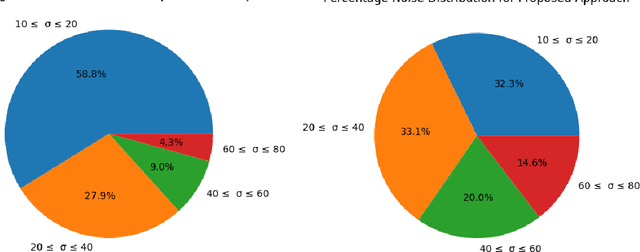

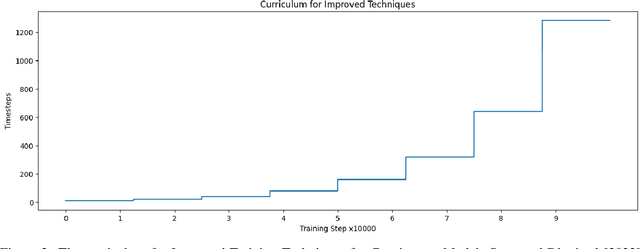

Consistency models possess high capabilities for image generation, advancing sampling steps to a single step through their advanced techniques. Current advancements move one step forward consistency training techniques and eliminates the limitation of distillation training. Even though the proposed curriculum and noise scheduling in improved training techniques yield better results than basic consistency models, it lacks well balanced noise distribution and its consistency between curriculum. In this study, it is investigated the balance between high and low noise levels in noise distribution and offered polynomial noise distribution to maintain the stability. This proposed polynomial noise distribution is also supported with a predefined Karras noises to prevent unique noise levels arises with Karras noise generation algorithm. Furthermore, by elimination of learned noisy steps with a curriculum based on sinusoidal function increase the performance of the model in denoising. To make a fair comparison with the latest released consistency model training techniques, experiments are conducted with same hyper-parameters except curriculum and noise distribution. The models utilized during experiments are determined with low depth to prove the robustness of our proposed technique. The results show that the polynomial noise distribution outperforms the model trained with log-normal noise distribution, yielding a 33.54 FID score after 100,000 training steps with constant discretization steps. Additionally, the implementation of a sinusoidal-based curriculum enhances denoising performance, resulting in a FID score of 30.48.