 Add to Chrome
 Add to Firefox
 Add to Edge
An Unsupervised Normalizing Flow-Based Neyman-Pearson Detector for Covert Communications in the Presence of Disco Reconfigurable Intelligent Surfaces
Feb 10, 2026
Covert communications, also known as low probability of detection (LPD) communications, offer a higher level of privacy protection compared to cryptography and physical-layer security (PLS) by hiding the transmission within ambient environments. Here, we investigate covert communications in the presence of a disco reconfigurable intelligent surface (DRIS) deployed by the warden Willie, which simultaneously reduces his detection error probabilities and degrades the communication performance between Alice and Bob, without relying on either channel state information (CSI) or additional jamming power. However, the introduction of the DRIS renders it intractable for Willie to construct a Neyman-Pearson (NP) detector, since the probability density function (PDF) of the test statistic is analytically intractable under the Alice-Bob transmission hypothesis. Moreover, given the adversarial relationship between Willie and Alice/Bob, it is unrealistic to assume that Willie has access to a labeled training dataset. To address these challenges, we propose an unsupervised masked autoregressive flow (MAF)-based NP detection framework that exploits prior knowledge inherent in covert communications. We further define the false alarm rate (FAR) and the missed detection rate (MDR) as monitoring performance metrics for Willie, and the signal-to-jamming-plus-noise ratio (SJNR) as a communication performance metric for Alice-Bob transmissions. Furthermore, we derive theoretical expressions for SJNR and uncover unique properties of covert communications in the presence of a DRIS. Simulations validate the theory and show that the proposed unsupervised MAF-based NP detector achieves performance comparable to its supervised counterpart.

Disco Intelligent Omni-Surfaces: 360-degree Fully-Passive Jamming Attacks
Nov 20, 2024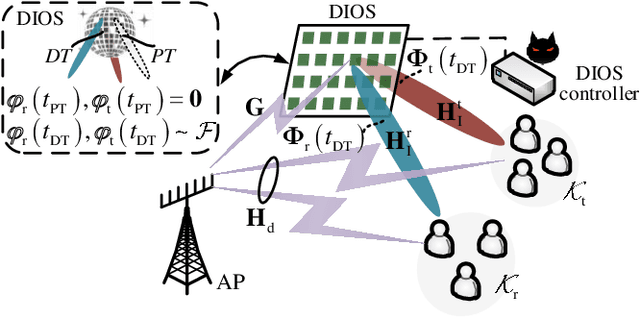
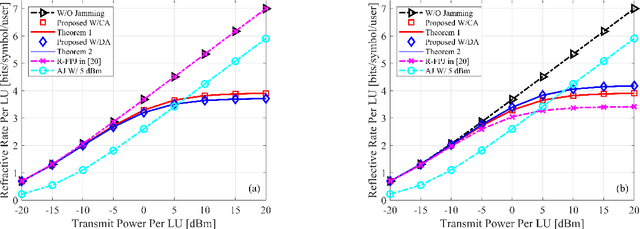
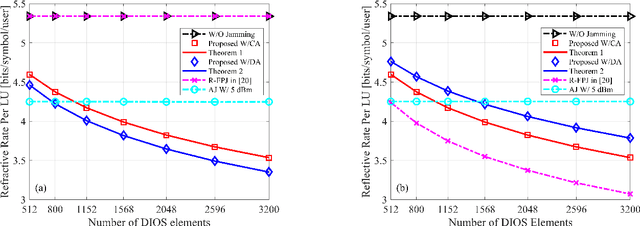
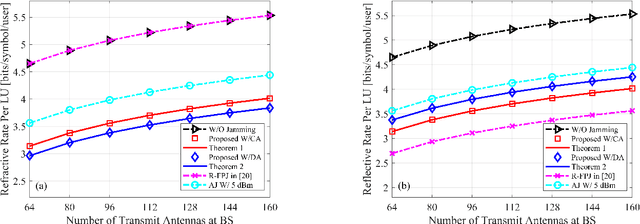
Intelligent omni-surfaces (IOSs) with 360-degree electromagnetic radiation significantly improves the performance of wireless systems, while an adversarial IOS also poses a significant potential risk for physical layer security. In this paper, we propose a "DISCO" IOS (DIOS) based fully-passive jammer (FPJ) that can launch omnidirectional fully-passive jamming attacks. In the proposed DIOS-based FPJ, the interrelated refractive and reflective (R&R) coefficients of the adversarial IOS are randomly generated, acting like a "DISCO" that distributes wireless energy radiated by the base station. By introducing active channel aging (ACA) during channel coherence time, the DIOS-based FPJ can perform omnidirectional fully-passive jamming without neither jamming power nor channel knowledge of legitimate users (LUs). To characterize the impact of the DIOS-based PFJ, we derive the statistical characteristics of DIOS-jammed channels based on two widely-used IOS models, i.e., the constant-amplitude model and the variable-amplitude model. Consequently, the asymptotic analysis of the ergodic achievable sum rates under the DIOS-based omnidirectional fully-passive jamming is given based on the derived stochastic characteristics for both the two IOS models. Based on the derived analysis, the omnidirectional jamming impact of the proposed DIOS-based FPJ implemented by a constant-amplitude IOS does not depend on either the quantization number or the stochastic distribution of the DIOS coefficients, while the conclusion does not hold on when a variable-amplitude IOS is used. Numerical results based on one-bit quantization of the IOS phase shifts are provided to verify the effectiveness of the derived theoretical analysis. The proposed DIOS-based FPJ can not only launch omnidirectional fully-passive jamming, but also improve the jamming impact by about 55% at 10 dBm transmit power per LU.