 Add to Chrome
 Add to Firefox
 Add to Edge
DreamTraj: Generating 6-DoF Object Trajectories by Reading Unrendered Video Diffusion Latents
Aug 01, 2026
Accurate prediction of object trajectories during manipulation is essential for closing the perception-action loop. Progress is limited on two fronts: available datasets lack fine-grained language-to-motion annotations, and existing predictors either rely on privileged inputs such as video, depth, or CAD models, or recover motion from fully generated videos through costly, error-prone perception pipelines. We close the supervision gap with the MOVE dataset, 5,038 object-centric egocentric trajectories, each paired with a fine-grained natural-language instruction rather than a coarse verb-noun label. We further propose DreamTraj, which predicts a 6-DoF object trajectory from a single RGB image and a task instruction, requiring no video, depth, or CAD model at inference: rather than generating a video, it reads motion from the internal representations of a frozen image-to-video diffusion model at an early denoising step. A lightweight flow-matching Reader decodes query-key attention tracks and pooled hidden states into relative 6-DoF poses. To our knowledge, this is the first approach to directly decode object 6-DoF trajectories from intermediate video diffusion representations rather than generated pixels. DreamTraj sets a new state of the art on both translation and rotation against forecasters that consume multi-frame or privileged inputs, and runs 4.6x faster than generate-then-extract pipelines.

ArtiWorld: LLM-Driven Articulation of 3D Objects in Scenes
Nov 18, 2025Building interactive simulators and scalable robot-learning environments requires a large number of articulated assets. However, most existing 3D assets in simulation are rigid, and manually converting them into articulated objects is extremely labor- and cost-intensive. This raises a natural question: can we automatically identify articulable objects in a scene and convert them into articulated assets directly? In this paper, we present ArtiWorld, a scene-aware pipeline that localizes candidate articulable objects from textual scene descriptions and reconstructs executable URDF models that preserve the original geometry. At the core of this pipeline is Arti4URDF, which leverages 3D point cloud, prior knowledge of a large language model (LLM), and a URDF-oriented prompt design to rapidly convert rigid objects into interactive URDF-based articulated objects while maintaining their 3D shape. We evaluate ArtiWorld at three levels: 3D simulated objects, full 3D simulated scenes, and real-world scan scenes. Across all three settings, our method consistently outperforms existing approaches and achieves state-of-the-art performance, while preserving object geometry and correctly capturing object interactivity to produce usable URDF-based articulated models. This provides a practical path toward building interactive, robot-ready simulation environments directly from existing 3D assets. Code and data will be released.
InfiniteWorld: A Unified Scalable Simulation Framework for General Visual-Language Robot Interaction
Dec 08, 2024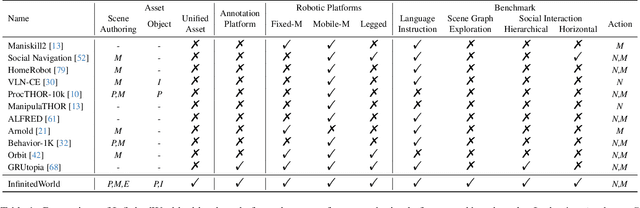
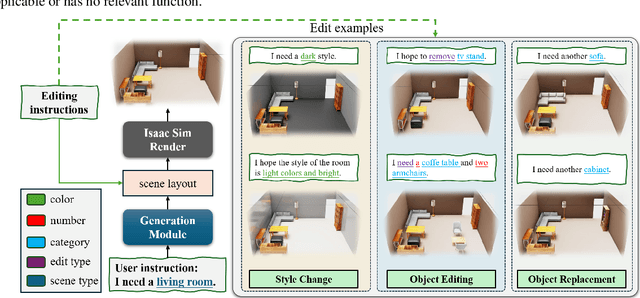
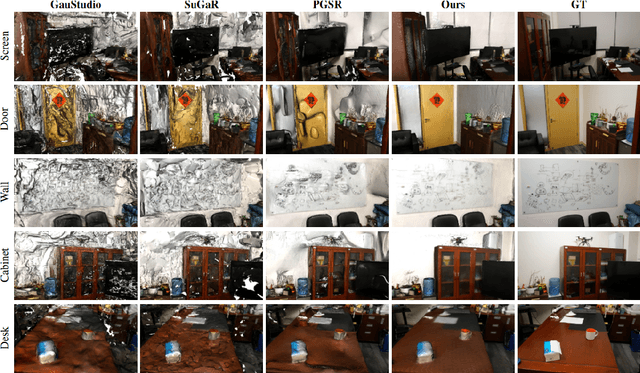
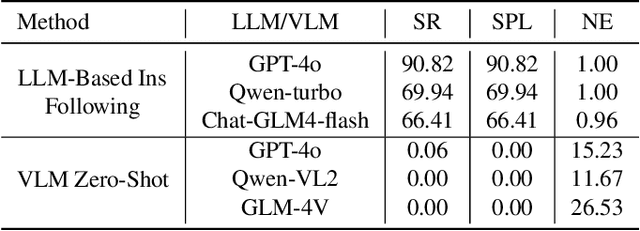
Realizing scaling laws in embodied AI has become a focus. However, previous work has been scattered across diverse simulation platforms, with assets and models lacking unified interfaces, which has led to inefficiencies in research. To address this, we introduce InfiniteWorld, a unified and scalable simulator for general vision-language robot interaction built on Nvidia Isaac Sim. InfiniteWorld encompasses a comprehensive set of physics asset construction methods and generalized free robot interaction benchmarks. Specifically, we first built a unified and scalable simulation framework for embodied learning that integrates a series of improvements in generation-driven 3D asset construction, Real2Sim, automated annotation framework, and unified 3D asset processing. This framework provides a unified and scalable platform for robot interaction and learning. In addition, to simulate realistic robot interaction, we build four new general benchmarks, including scene graph collaborative exploration and open-world social mobile manipulation. The former is often overlooked as an important task for robots to explore the environment and build scene knowledge, while the latter simulates robot interaction tasks with different levels of knowledge agents based on the former. They can more comprehensively evaluate the embodied agent's capabilities in environmental understanding, task planning and execution, and intelligent interaction. We hope that this work can provide the community with a systematic asset interface, alleviate the dilemma of the lack of high-quality assets, and provide a more comprehensive evaluation of robot interactions.