 Add to Chrome
 Add to Firefox
 Add to Edge
Empowering Long-form Omni-modal Understanding with Robust Audio Perception
Jul 11, 2026
Recent advances in large-scale multimodal models have drivenremarkable progress in vision-language tasks; however, comprehensiveomni-modal understanding remains under-explored, largely due to thescarcity of datasets with rich, explicitly aligned auditory cues. To bridgethis gap, we present AVDC (Audio-Visual Decoupled Captions), a large-scaledataset designed to disentangle visual and auditory semantics. Specifi-cally, we propose an automated pipeline that leverages off-the-shelf mod-els to annotate videos with tripartite captions: visual-only (V), audio-only (A), and joint audio-visual (AV). This decoupled structure explic-itly captures both modality-specific nuances and complex cross-modalinteractions. Building upon this, we introduce AVDC-QA-CoT, a Chain-of-Thought augmented question-answering dataset to foster audio-visualreasoning. To fully exploit these resources, we employ a two-stage train-ing paradigm: omni-modal caption generation pre-training on AVDC, fol-lowed by instruction tuning on AVDC-QA-CoT. Extensive experiments acrossdiverse downstream tasks, spanning video captioning, audio-centric anal-ysis, and omni-modal benchmarks, demonstrate consistent and signifi-cant performance gains, showing the efficacy of our proposed datasetsand training strategy in advancing omni-modal perception. Code anddataset are related on https://radiant0726.github.io/AVDC-web/.

A Knowledge-enhanced Pathology Vision-language Foundation Model for Cancer Diagnosis
Dec 17, 2024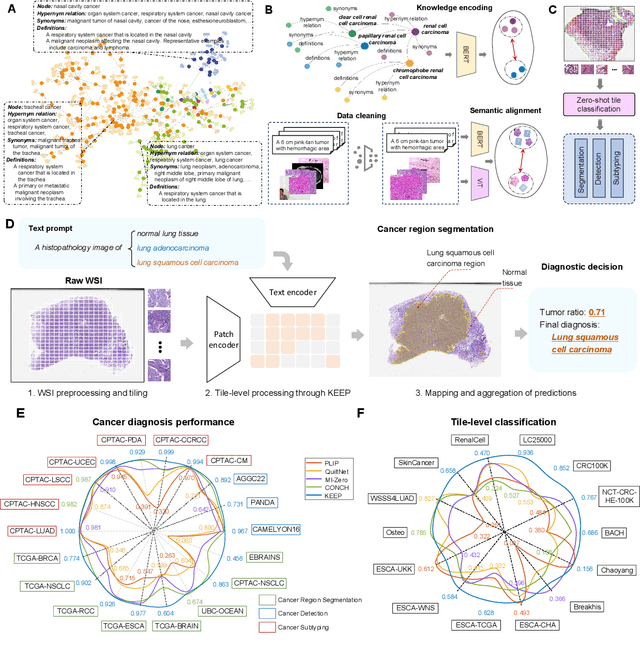
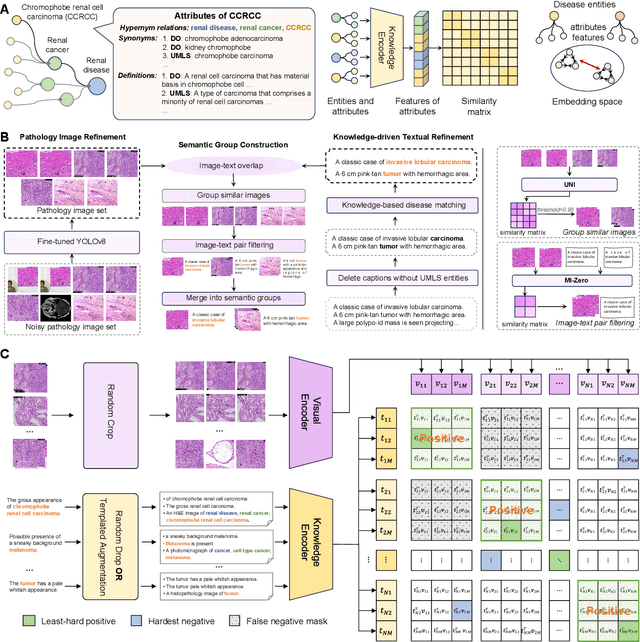
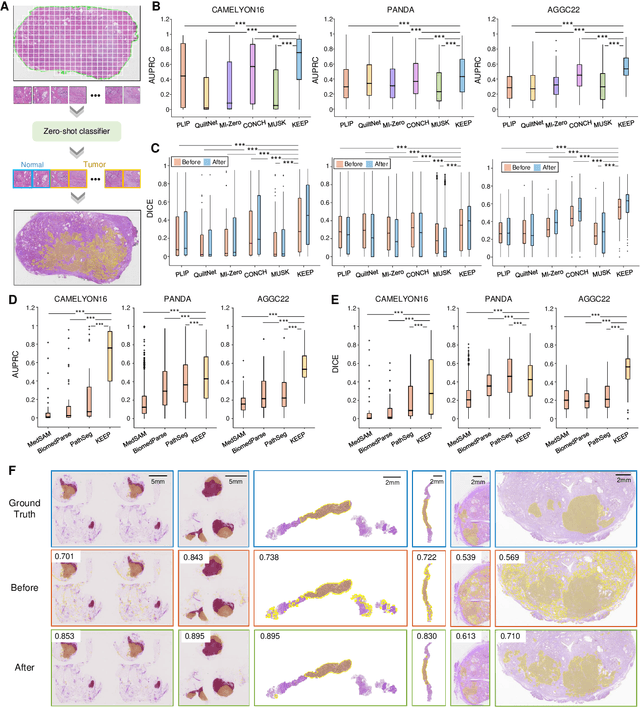
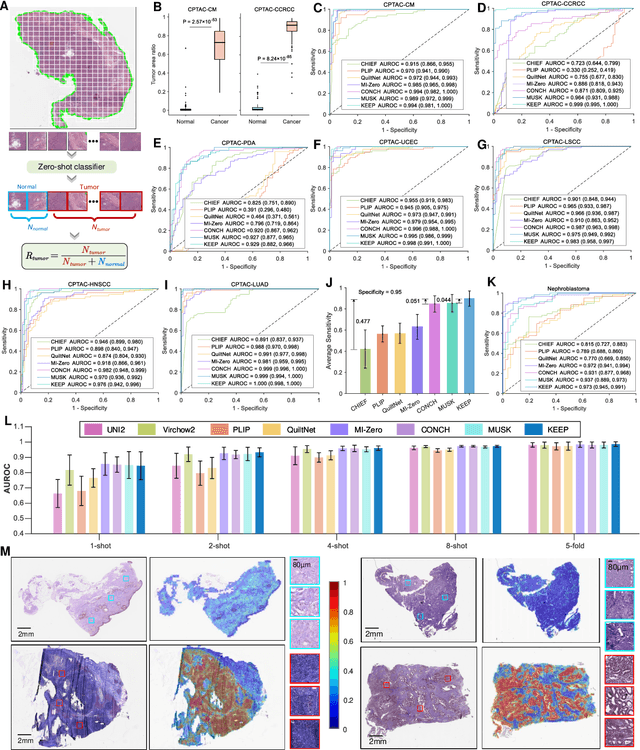
Deep learning has enabled the development of highly robust foundation models for various pathological tasks across diverse diseases and patient cohorts. Among these models, vision-language pre-training, which leverages large-scale paired data to align pathology image and text embedding spaces, and provides a novel zero-shot paradigm for downstream tasks. However, existing models have been primarily data-driven and lack the incorporation of domain-specific knowledge, which limits their performance in cancer diagnosis, especially for rare tumor subtypes. To address this limitation, we establish a Knowledge-enhanced Pathology (KEEP) foundation model that harnesses disease knowledge to facilitate vision-language pre-training. Specifically, we first construct a disease knowledge graph (KG) that covers 11,454 human diseases with 139,143 disease attributes, including synonyms, definitions, and hypernym relations. We then systematically reorganize the millions of publicly available noisy pathology image-text pairs, into 143K well-structured semantic groups linked through the hierarchical relations of the disease KG. To derive more nuanced image and text representations, we propose a novel knowledge-enhanced vision-language pre-training approach that integrates disease knowledge into the alignment within hierarchical semantic groups instead of unstructured image-text pairs. Validated on 18 diverse benchmarks with more than 14,000 whole slide images (WSIs), KEEP achieves state-of-the-art performance in zero-shot cancer diagnostic tasks. Notably, for cancer detection, KEEP demonstrates an average sensitivity of 89.8% at a specificity of 95.0% across 7 cancer types. For cancer subtyping, KEEP achieves a median balanced accuracy of 0.456 in subtyping 30 rare brain cancers, indicating strong generalizability for diagnosing rare tumors.
A Large-scale Dataset for Audio-Language Representation Learning
Oct 03, 2023The AI community has made significant strides in developing powerful foundation models, driven by large-scale multimodal datasets. However, in the audio representation learning community, the present audio-language datasets suffer from limitations such as insufficient volume, simplistic content, and arduous collection procedures. To tackle these challenges, we present an innovative and automatic audio caption generation pipeline based on a series of public tools or APIs, and construct a large-scale, high-quality, audio-language dataset, named as Auto-ACD, comprising over 1.9M audio-text pairs. To demonstrate the effectiveness of the proposed dataset, we train popular models on our dataset and show performance improvement on various downstream tasks, namely, audio-language retrieval, audio captioning, environment classification. In addition, we establish a novel test set and provide a benchmark for audio-text tasks. The proposed dataset will be released at https://auto-acd.github.io/.