 Add to Chrome
 Add to Firefox
 Add to Edge
Stress-testing large language model agents in a robotic chemistry laboratory
Jul 25, 2026
AI is evaluated through knowledge, reasoning and plan generation, yet scientific agency requires reliable physical action and adaptation to evidence. Here, we use a robotic chemistry laboratory as a physical-world testbed to make scientific agency measurable. Its 45 modular workstations exposed as machine-readable skills enabled 4,608 trials. Only 3.3% of trials produced expert-assessed executable workflows under laboratory constraints; even the best system achieved 28.1%. Long-horizon planning remained a challenge: only three executable workflows exceeded 30 operations, although the longest contained 44. Across five rounds, experimental feedback prompted local adjustments but no workflow-level replanning or analytical-method redesign. By making physical executability and evidence-driven replanning measurable, our study provides an evidence-based assessment of deployment readiness and a diagnostic framework to guide closed-loop improvements towards physically grounded autonomous research.

A Decision-Making GPT Model Augmented with Entropy Regularization for Autonomous Vehicles
Jun 20, 2024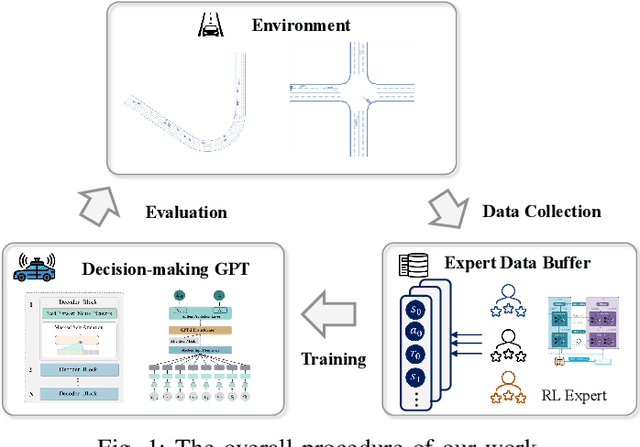


In the domain of autonomous vehicles (AVs), decision-making is a critical factor that significantly influences the efficacy of autonomous navigation. As the field progresses, the enhancement of decision-making capabilities in complex environments has become a central area of research within data-driven methodologies. Despite notable advances, existing learning-based decision-making strategies in autonomous vehicles continue to reveal opportunities for further refinement, particularly in the articulation of policies and the assurance of safety. In this study, the decision-making challenges associated with autonomous vehicles are conceptualized through the framework of the Constrained Markov Decision Process (CMDP) and approached as a sequence modeling problem. Utilizing the Generative Pre-trained Transformer (GPT), we introduce a novel decision-making model tailored for AVs, which incorporates entropy regularization techniques to bolster exploration and enhance safety performance. Comprehensive experiments conducted across various scenarios affirm that our approach surpasses several established baseline methods, particularly in terms of safety and overall efficacy.