 Add to Chrome
 Add to Firefox
 Add to Edge
Toward Cooperative Driving in Mixed Traffic: An Adaptive Potential Game-Based Approach with Field Test Verification
Apr 22, 2026
Connected autonomous vehicles (CAVs), which represent a significant advancement in autonomous driving technology, have the potential to greatly increase traffic safety and efficiency through cooperative decision-making. However, existing methods often overlook the individual needs and heterogeneity of cooperative participants, making it difficult to transfer them to environments where they coexist with human-driven vehicles (HDVs).To address this challenge, this paper proposes an adaptive potential game (APG) cooperative driving framework. First, the system utility function is established on the basis of a general form of individual utility and its monotonic relationship, allowing for the simultaneous optimization of both individual and system objectives. Second, the Shapley value is introduced to compute each vehicle's marginal utility within the system, allowing its varying impact to be quantified. Finally, the HDV preference estimation is dynamically refined by continuously comparing the observed HDV behavior with the APG's estimated actions, leading to improvements in overall system safety and efficiency. Ablation studies demonstrate that adaptively updating Shapley values and HDV preference estimation significantly improve cooperation success rates in mixed traffic. Comparative experiments further highlight the APG's advantages in terms of safety and efficiency over other cooperative methods. Moreover, the applicability of the approach to real-world scenarios was validated through field tests.

A Decision-Making GPT Model Augmented with Entropy Regularization for Autonomous Vehicles
Jun 20, 2024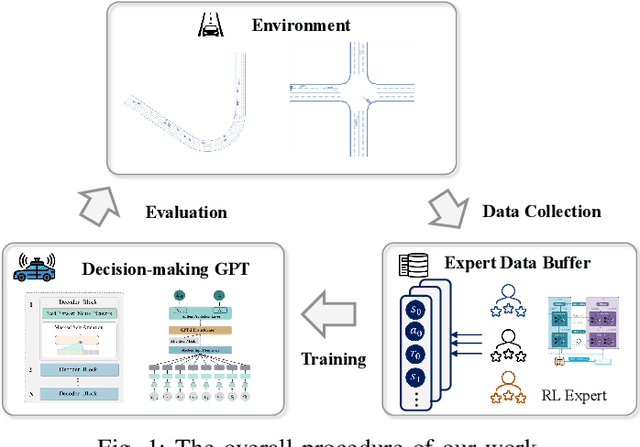


In the domain of autonomous vehicles (AVs), decision-making is a critical factor that significantly influences the efficacy of autonomous navigation. As the field progresses, the enhancement of decision-making capabilities in complex environments has become a central area of research within data-driven methodologies. Despite notable advances, existing learning-based decision-making strategies in autonomous vehicles continue to reveal opportunities for further refinement, particularly in the articulation of policies and the assurance of safety. In this study, the decision-making challenges associated with autonomous vehicles are conceptualized through the framework of the Constrained Markov Decision Process (CMDP) and approached as a sequence modeling problem. Utilizing the Generative Pre-trained Transformer (GPT), we introduce a novel decision-making model tailored for AVs, which incorporates entropy regularization techniques to bolster exploration and enhance safety performance. Comprehensive experiments conducted across various scenarios affirm that our approach surpasses several established baseline methods, particularly in terms of safety and overall efficacy.