 Add to Chrome
 Add to Firefox
 Add to Edge
stable-worldmodel: A Platform for Reproducible World Modeling Research and Evaluation
May 20, 2026
World models are central to building agents that can reason, plan, and generalize beyond their training data. However, research on world models is currently fragmented, with disparate codebases, data pipelines, and evaluation protocols hindering reproducibility and fair comparison. Current practice is further limited by three key bottlenecks: fragile one-off codebases, slow video data loading, and the lack of standardized generalization benchmarks. We present stable-worldmodel (swm), an open-source platform for standardized and reproducible world modeling research and evaluation. It delivers (1) a high-performance Lance-based data layer with native support and conversion tools for MP4, HDF5, and LeRobot datasets, (2) clean, well-tested implementations of modern world model baselines and planning solvers, and (3) a broad suite of environments and tasks extended with controllable visual, geometric, and physical factors of variation for systematic in-silico evaluation of dynamics understanding, control performance, representation quality, and out-of-distribution generalization. By unifying the full pipeline under a single, scalable framework, \texttt{swm} dramatically reduces research overhead and accelerates trustworthy progress toward reliable world models.

Causal-JEPA: Learning World Models through Object-Level Latent Interventions
Feb 11, 2026World models require robust relational understanding to support prediction, reasoning, and control. While object-centric representations provide a useful abstraction, they are not sufficient to capture interaction-dependent dynamics. We therefore propose C-JEPA, a simple and flexible object-centric world model that extends masked joint embedding prediction from image patches to object-centric representations. By applying object-level masking that requires an object's state to be inferred from other objects, C-JEPA induces latent interventions with counterfactual-like effects and prevents shortcut solutions, making interaction reasoning essential. Empirically, C-JEPA leads to consistent gains in visual question answering, with an absolute improvement of about 20\% in counterfactual reasoning compared to the same architecture without object-level masking. On agent control tasks, C-JEPA enables substantially more efficient planning by using only 1\% of the total latent input features required by patch-based world models, while achieving comparable performance. Finally, we provide a formal analysis demonstrating that object-level masking induces a causal inductive bias via latent interventions. Our code is available at https://github.com/galilai-group/cjepa.
stable-worldmodel-v1: Reproducible World Modeling Research and Evaluation
Feb 09, 2026World Models have emerged as a powerful paradigm for learning compact, predictive representations of environment dynamics, enabling agents to reason, plan, and generalize beyond direct experience. Despite recent interest in World Models, most available implementations remain publication-specific, severely limiting their reusability, increasing the risk of bugs, and reducing evaluation standardization. To mitigate these issues, we introduce stable-worldmodel (SWM), a modular, tested, and documented world-model research ecosystem that provides efficient data-collection tools, standardized environments, planning algorithms, and baseline implementations. In addition, each environment in SWM enables controllable factors of variation, including visual and physical properties, to support robustness and continual learning research. Finally, we demonstrate the utility of SWM by using it to study zero-shot robustness in DINO-WM.
On the Importance of Embedding Norms in Self-Supervised Learning
Feb 13, 2025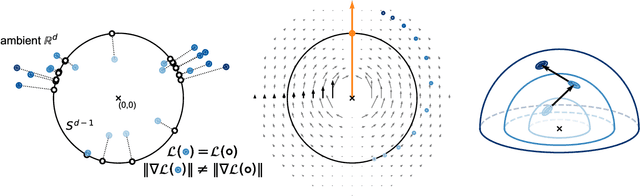
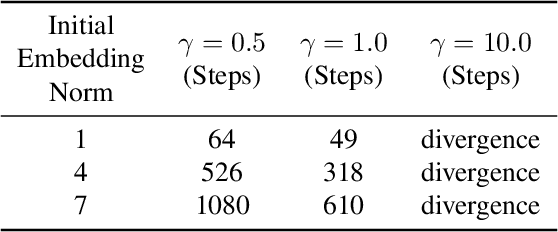
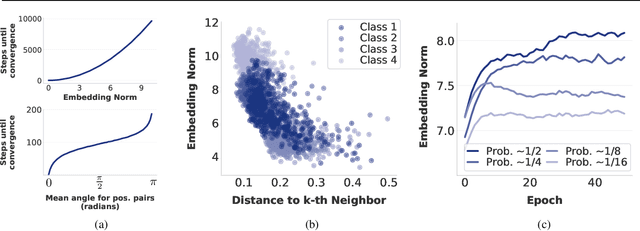
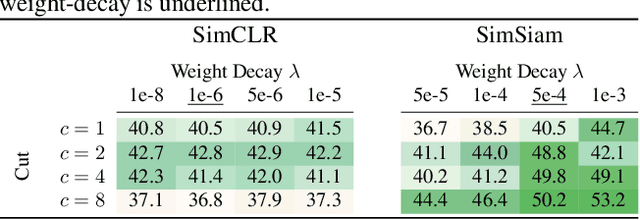
Self-supervised learning (SSL) allows training data representations without a supervised signal and has become an important paradigm in machine learning. Most SSL methods employ the cosine similarity between embedding vectors and hence effectively embed data on a hypersphere. While this seemingly implies that embedding norms cannot play any role in SSL, a few recent works have suggested that embedding norms have properties related to network convergence and confidence. In this paper, we resolve this apparent contradiction and systematically establish the embedding norm's role in SSL training. Using theoretical analysis, simulations, and experiments, we show that embedding norms (i) govern SSL convergence rates and (ii) encode network confidence, with smaller norms corresponding to unexpected samples. Additionally, we show that manipulating embedding norms can have large effects on convergence speed. Our findings demonstrate that SSL embedding norms are integral to understanding and optimizing network behavior.
Understanding Adam Requires Better Rotation Dependent Assumptions
Oct 25, 2024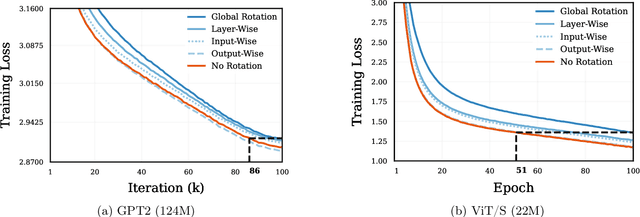
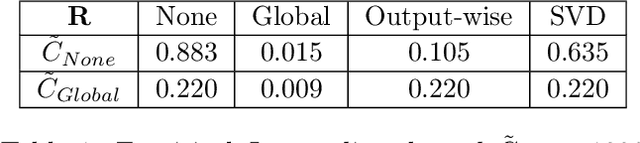
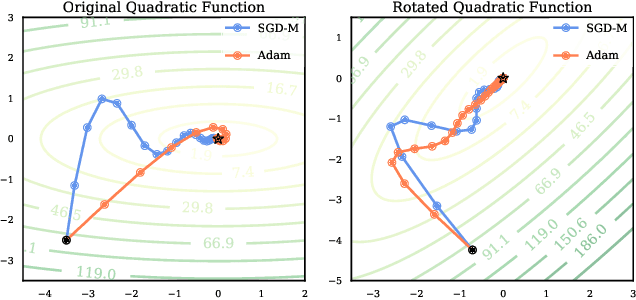
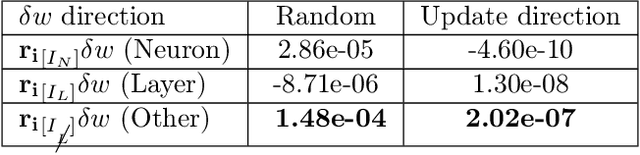
Despite its widespread adoption, Adam's advantage over Stochastic Gradient Descent (SGD) lacks a comprehensive theoretical explanation. This paper investigates Adam's sensitivity to rotations of the parameter space. We demonstrate that Adam's performance in training transformers degrades under random rotations of the parameter space, indicating a crucial sensitivity to the choice of basis. This reveals that conventional rotation-invariant assumptions are insufficient to capture Adam's advantages theoretically. To better understand the rotation-dependent properties that benefit Adam, we also identify structured rotations that preserve or even enhance its empirical performance. We then examine the rotation-dependent assumptions in the literature, evaluating their adequacy in explaining Adam's behavior across various rotation types. This work highlights the need for new, rotation-dependent theoretical frameworks to fully understand Adam's empirical success in modern machine learning tasks.