 Add to Chrome
 Add to Firefox
 Add to Edge
BenCSSmark: Making the Social Sciences Count in LLM Research
May 06, 2026
This position paper argues that the under-representation of social science tasks in contemporary LLM benchmarks limits advances in both LLM evaluation and social scientific inquiry. Benchmarks -- standardized tools for assessing computational systems -- are pivotal in the development of artificial intelligence (AI), including large language models (LLMs). Benchmarks do more than measure progress -- they actively structure it, shaping reputations, research agendas, and commercial outcomes. Despite this central role, the social sciences are largely absent from mainstream evaluation frameworks, even though scholars in these fields generate dozens of rigorously annotated, context-sensitive datasets each year. Integrating this work into benchmark design could significantly improve the generalization and robustness of AI models. In turn, models trained on social scientific tasks would likely yield better performance on classic and contemporary tasks in disciplines as diverse as history, sociology, political science or economics. This is all the more pressing as these disciplines are quickly turning to LLMs for assistance. To address this gap, we introduce BenCSSmark, a benchmark composed of datasets annotated by computational social scientists. By integrating social scientific perspectives into benchmarking, BenCSSmark seeks to promote more robust, transparent, and socially relevant AI systems and to foster efficient collaboration.

Is Biomedical Specialization Still Worth It? Insights from Domain-Adaptive Language Modelling with a New French Health Corpus
Apr 08, 2026Large language models (LLMs) have demonstrated remarkable capabilities across diverse domains, yet their adaptation to specialized fields remains challenging, particularly for non-English languages. This study investigates domain-adaptive pre-training (DAPT) as a strategy for specializing small to mid-sized LLMs in the French biomedical domain through continued pre-training. We address two key research questions: the viability of specialized continued pre-training for domain adaptation and the relationship between domain-specific performance gains and general capability degradation. Our contributions include the release of a fully open-licensed French biomedical corpus suitable for commercial and open-source applications, the training and release of specialized French biomedical LLMs, and novel insights for DAPT implementation. Our methodology encompasses the collection and refinement of high-quality French biomedical texts, the exploration of causal language modeling approaches using DAPT, and conducting extensive comparative evaluations. Our results cast doubt on the efficacy of DAPT, in contrast to previous works, but we highlight its viability in smaller-scale, resource-constrained scenarios under the right conditions. Findings in this paper further suggest that model merging post-DAPT is essential to mitigate generalization trade-offs, and in some cases even improves performance on specialized tasks at which the DAPT was directed.
Pantagruel: Unified Self-Supervised Encoders for French Text and Speech
Jan 09, 2026We release Pantagruel models, a new family of self-supervised encoder models for French text and speech. Instead of predicting modality-tailored targets such as textual tokens or speech units, Pantagruel learns contextualized target representations in the feature space, allowing modality-specific encoders to capture linguistic and acoustic regularities more effectively. Separate models are pre-trained on large-scale French corpora, including Wikipedia, OSCAR and CroissantLLM for text, together with MultilingualLibriSpeech, LeBenchmark, and INA-100k for speech. INA-100k is a newly introduced 100,000-hour corpus of French audio derived from the archives of the Institut National de l'Audiovisuel (INA), the national repository of French radio and television broadcasts, providing highly diverse audio data. We evaluate Pantagruel across a broad range of downstream tasks spanning both modalities, including those from the standard French benchmarks such as FLUE or LeBenchmark. Across these tasks, Pantagruel models show competitive or superior performance compared to strong French baselines such as CamemBERT, FlauBERT, and LeBenchmark2.0, while maintaining a shared architecture that can seamlessly handle either speech or text inputs. These results confirm the effectiveness of feature-space self-supervised objectives for French representation learning and highlight Pantagruel as a robust foundation for multimodal speech-text understanding.
LongEval at CLEF 2025: Longitudinal Evaluation of IR Model Performance
Mar 11, 2025
This paper presents the third edition of the LongEval Lab, part of the CLEF 2025 conference, which continues to explore the challenges of temporal persistence in Information Retrieval (IR). The lab features two tasks designed to provide researchers with test data that reflect the evolving nature of user queries and document relevance over time. By evaluating how model performance degrades as test data diverge temporally from training data, LongEval seeks to advance the understanding of temporal dynamics in IR systems. The 2025 edition aims to engage the IR and NLP communities in addressing the development of adaptive models that can maintain retrieval quality over time in the domains of web search and scientific retrieval.
LongEval-Retrieval: French-English Dynamic Test Collection for Continuous Web Search Evaluation
Mar 06, 2023
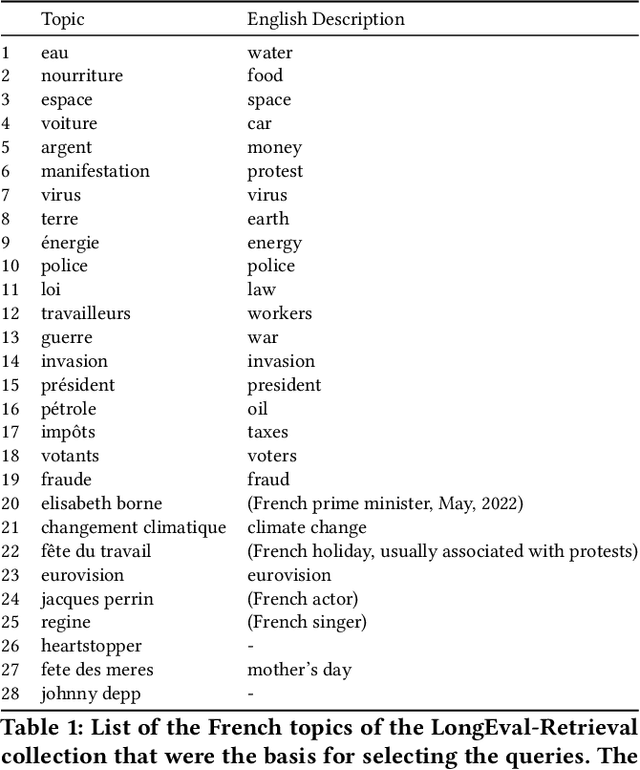
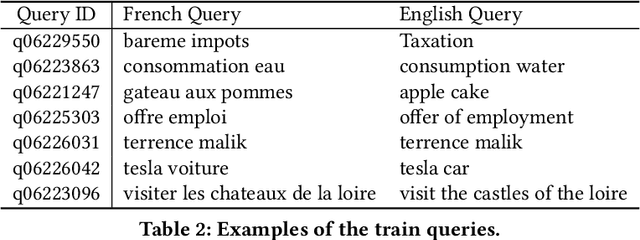
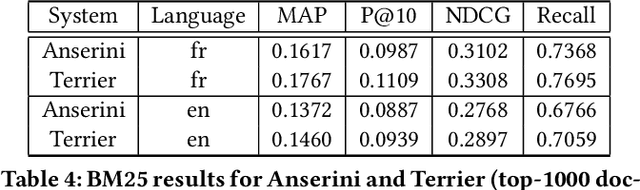
LongEval-Retrieval is a Web document retrieval benchmark that focuses on continuous retrieval evaluation. This test collection is intended to be used to study the temporal persistence of Information Retrieval systems and will be used as the test collection in the Longitudinal Evaluation of Model Performance Track (LongEval) at CLEF 2023. This benchmark simulates an evolving information system environment - such as the one a Web search engine operates in - where the document collection, the query distribution, and relevance all move continuously, while following the Cranfield paradigm for offline evaluation. To do that, we introduce the concept of a dynamic test collection that is composed of successive sub-collections each representing the state of an information system at a given time step. In LongEval-Retrieval, each sub-collection contains a set of queries, documents, and soft relevance assessments built from click models. The data comes from Qwant, a privacy-preserving Web search engine that primarily focuses on the French market. LongEval-Retrieval also provides a 'mirror' collection: it is initially constructed in the French language to benefit from the majority of Qwant's traffic, before being translated to English. This paper presents the creation process of LongEval-Retrieval and provides baseline runs and analysis.