 Add to Chrome
 Add to Firefox
 Add to Edge
Towards Label-Free Single-Cell Phenotyping Using Multi-Task Learning
May 14, 2026
Label-free single-cell imaging offers a scalable, non-invasive alternative to fluorescence-based cytometry, yet inferring molecular phenotypes directly from bright-field morphology remains challenging. We present a unified Deep Learning (DL) framework that jointly performs White Blood Cell (WBC) classification and continuous protein-expression regression from label-free Differential Phase Contrast (DPC) images. Our model employs a Hybrid architecture that fuses convolutional fine-grained texture features with transformer-based global representations through a learnable cross-branch gating module, enabling robust morpho-molecular inference from DPC images. To support downstream interpretability, we further incorporate a Large Language Model (LLM) that generates concise, biologically grounded summaries of the predicted cell states. Experiments on the Berkeley Single Cell Computational Microscopy (BSCCM) and Blood Cells Image benchmarks demonstrate strong performance, achieving a 91.3% WBC classification accuracy and a 0.72 Pearson correlation for CD16 expression regression on BSCCM. These results underscore the promise of label-free single-cell imaging for cost-effective hematological profiling, enabling simultaneous phenotype identification and quantitative biomarker estimation without fluorescent staining. The source code is available at https://github.com/saqibnaziir/Single-Cell-Phenotyping.

Depth Estimation and Image Restoration by Deep Learning from Defocused Images
Feb 21, 2023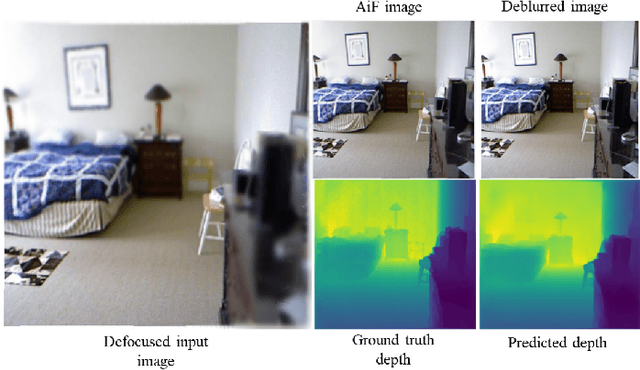
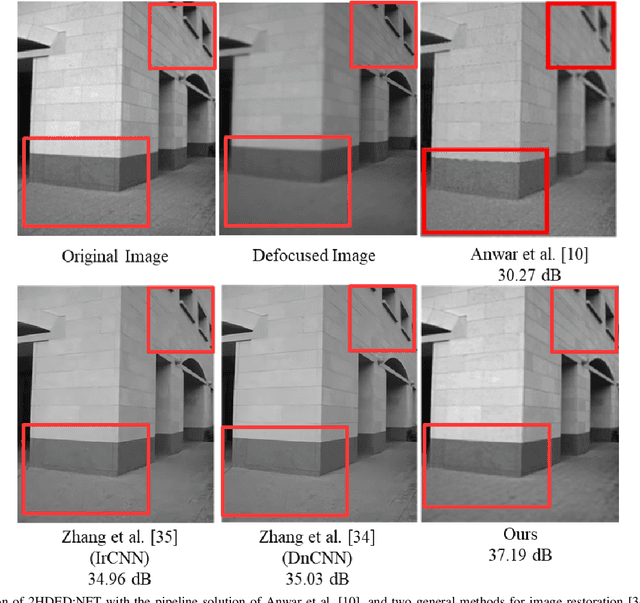
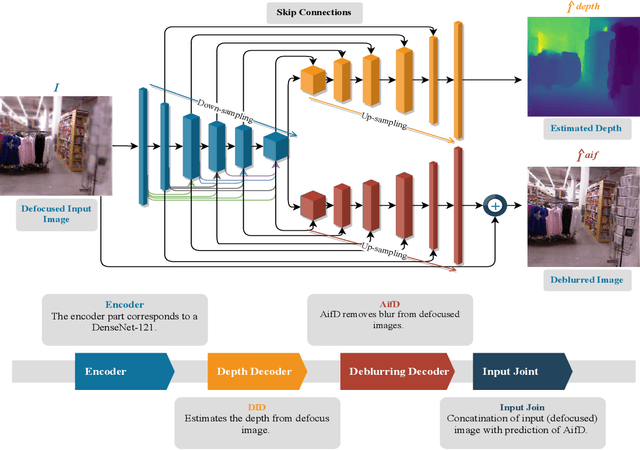
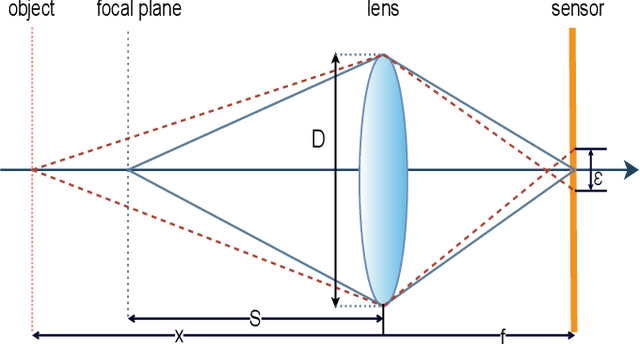
Monocular depth estimation and image deblurring are two fundamental tasks in computer vision, given their crucial role in understanding 3D scenes. Performing any of them by relying on a single image is an ill-posed problem. The recent advances in the field of deep convolutional neural networks (DNNs) have revolutionized many tasks in computer vision, including depth estimation and image deblurring. When it comes to using defocused images, the depth estimation and the recovery of the All-in-Focus (Aif) image become related problems due to defocus physics. In spite of this, most of the existing models treat them separately. There are, however, recent models that solve these problems simultaneously by concatenating two networks in a sequence to first estimate the depth or defocus map and then reconstruct the focused image based on it. We propose a DNN that solves the depth estimation and image deblurring in parallel. Our Two-headed Depth Estimation and Deblurring Network (2HDED:NET) extends a conventional Depth from Defocus (DFD) network with a deblurring branch that shares the same encoder as the depth branch. The proposed method has been successfully tested on two benchmarks, one for indoor and the other for outdoor scenes: NYU-v2 and Make3D. Extensive experiments with 2HDED:NET on these benchmarks have demonstrated superior or close performances to those of the state-of-the-art models for depth estimation and image deblurring.