 Add to Chrome
 Add to Firefox
 Add to Edge
RayViT: Ray-Conditioned Visual Representations for Viewpoint-Robust Imitation Learning
Jul 31, 2026
Visual imitation learning enables robots to acquire visuomotor skills directly from images, yet RGB observations lack explicit geometric cues, making learned policies brittle to camera perturbations. To address this, we propose \textbf{Ray-conditioned Vision Transformer Encoder (RayViT)}, a lightweight architecture that injects camera geometry into pretrained ViT backbones. RayViT represents camera geometry as a Plücker ray map, patchifies it into ray features, and uses gated cross-attention to produce a ray-conditioned class token. These ray features are added as dense positional embeddings, while the ray class token replaces the original ViT class token to provide a geometry-aware summary representation. We combine this approach with an auxiliary cosine similarity loss to consistently improve the performance and robustness for geometry-aware tokens. Experiments on sim- and real-robot tasks demonstrate that RayViT improves robustness by approximately 13 percentage points under camera perturbations in multi-task RoboCasa benchmark and by 1.78 average completed stages in real-world multi-task success rate compared to baselines.

A High Fidelity Simulation Framework for Potential Safety Benefits Estimation of Cooperative Pedestrian Perception
Oct 18, 2022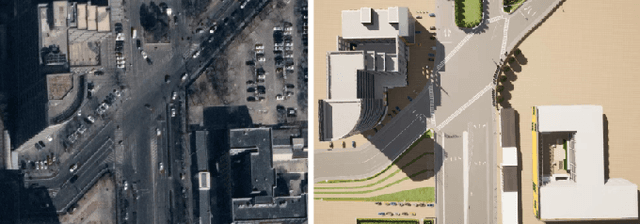
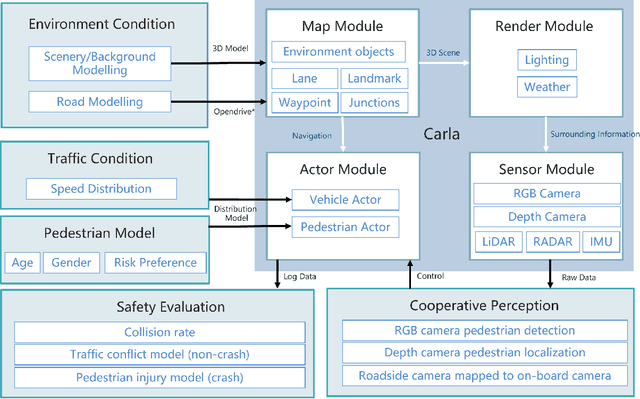
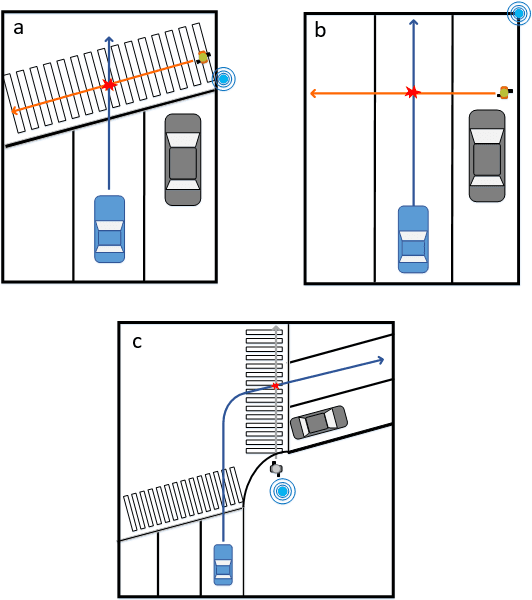
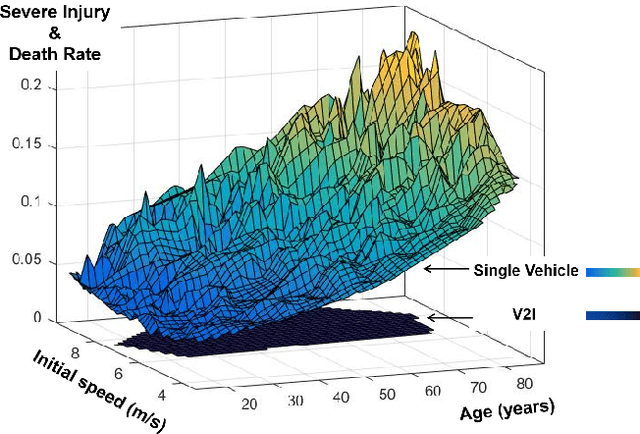
This paper proposes a high-fidelity simulation framework that can estimate the potential safety benefits of vehicle-to-infrastructure (V2I) pedestrian safety strategies. This simulator can support cooperative perception algorithms in the loop by simulating the environmental conditions, traffic conditions, and pedestrian characteristics at the same time. Besides, the benefit estimation model applied in our framework can systematically quantify both the risk conflict (non-crash condition) and the severity of the pedestrian's injuries (crash condition). An experiment was conducted in this paper that built a digital twin of a crowded urban intersection in China. The result shows that our framework is efficient for safety benefit estimation of V2I pedestrian safety strategies.