 Add to Chrome
 Add to Firefox
 Add to Edge
Determinants and Limits of LLM Security-Tool Orchestration: A Study with HexStrike-AI
Jul 03, 2026
Large language model agents driving security tool suites over the Model Context Protocol are increasingly common. Yet the factors that bound their capability remain poorly characterized: how much depends on the model versus the client that drives it, whether constraining the agent to the orchestrator's own tools helps, and where capability is limited by reasoning rather than by missing tools. Using HexStrikeAI, an open-source orchestrator that exposes 150+ tools, as a testbed, we follow a methodology that evaluates the system, diagnoses its failures, and applies targeted improvements. We run 86 picoCTF challenges across seven categories and three difficulty tiers, under three tool-access regimes and three model/client configurations (774 trials). We then apply corrections to existing tools, agent-behavior changes, and eleven new capability tools, and re-run the previously-unsuccessful trials. The diagnosis isolates the driving client as a first-order factor for a fixed model (a 2.1 * gap between two DeepSeek clients) and a monotonic difficulty gradient, with the largest gains in the mid tier. The overall solve rate rises from 55.4% to 72.0%, and every configuration improves significantly (paired McNemar p < 0.001, non-overlapping 95% confidence intervals). The residual failures are reasoning- or environment-bound rather than missing-tool. A 60-run stability sub-study finds single-run verdicts reproducible (17/20 unanimous). We discuss what the results imply for how such orchestrators should be evaluated, and we are explicit about the limits: the study uses a single benchmark, the fixes were tuned on the same challenges they were evaluated on, and the client effect is demonstrated for one model only, so its generality to other models remains a hypothesis.

Decoupling Reconnaissance and Exploitation: Measuring the Capability Boundaries of LLM-Based Web Penetration Testing
Jun 24, 2026Large Language Models (LLMs) have shown promise for automated penetration testing, yet existing end-to-end black-box evaluations are highly susceptible to error cascading: failures in early reconnaissance can mask an agent's actual ability to exploit vulnerabilities. To more accurately characterize these capabilities, we propose a two-stage decoupled evaluation framework that separates exploit execution from reconnaissance. Using ground-truth injection and knowledge-driven ablation across 70 high-fidelity web vulnerability testbeds, our framework isolates exploitation performance from reconnaissance noise. We empirically evaluate five open-source penetration-testing agents, covering multiagent, monolithic, and graph-driven architectures, on a strictly aligned subset of 50 representative vulnerabilities. The results reveal a substantial capability gap. With accurate vulnerability context, agents achieve a functional success rate of up to 90.0%, whereas autonomous reconnaissance, measured by targeted vulnerability recall, plateaus at approximately 50.0%, primarily due to failures in parsing unstructured telemetry. Cross-architectural analysis further reveals distinct capability niches: multi-agent isolation is more effective for long-sequence interactions such as de-serialization, while monolithic and graph-driven designs perform better on short-chain injections and cross-session access-control vulnerabilities, respectively. This decoupled evaluation work provides a fine-grained benchmarking protocol and an empirical basis for designing next-generation automated offensive security agents.
SemGeoNav:A Safety-Guided Visual Navigation Approach with Semantic Reasoning and Geometric Planning
Jun 15, 2026Learning-based visual navigation has enhanced semantic goal-reaching capabilities. However, due to their black-box nature, purely end-to-end models often lack explicit geometric constraints, leading to unpredictable and unreliable obstacle avoidance in open environments. Conversely, traditional geometric planners ensure safety but struggle with high-dimensional visual targets. To address these limitations, we propose SemGeoNav, a novel hierarchical visual navigation framework.It tightly integrates the high-level semantic reasoning of end-to-end models with the reliable local planning ability of geometry-based methods, achieving robust image-based navigation while significantly improving obstacle avoidance. Furthermore, we introduce a temporal trajectory smoothing mechanism to ensure continuous and stable robot motion. We evaluated SemGeoNav on a Unitree Go2 quadruped robot in real-world environments. The results demonstrate that SemGeoNav outperforms existing representative methods, including ViNT and NoMaD, achieving higher success rates and shorter navigation times.
Accelerating Vision Transformers on Brain Processing Unit
Feb 06, 2026With the advancement of deep learning technologies, specialized neural processing hardware such as Brain Processing Units (BPUs) have emerged as dedicated platforms for CNN acceleration, offering optimized INT8 computation capabilities for convolutional operations. Meanwhile, Vision Transformer (ViT) models, such as the Data-efficient Image Transformer (DeiT), have demonstrated superior performance and play increasingly crucial roles in computer vision tasks. However, due to the architectural mismatch between CNN-optimized hardware and Vision Transformer computation characteristics--namely, that linear layers in Transformers operate on three-dimensional data while BPU acceleration is designed for four-dimensional convolution operations-it is difficult or even impossible to leverage BPU's advantages when deploying Vision Transformers. To address this challenge, we propose a novel approach that restructures the Vision Transformer by replacing linear layers and layer normalization operations with carefully designed convolutional operators. This enables DeiT to fully utilize the acceleration capabilities of BPUs, while allowing the original weight parameters to be inherited by the restructured models without retraining or fine-tuning. To the best of our knowledge, this is the first successful deployment of Vision Transformers that fully leverages BPU classification datasets demonstrate the effectiveness of our approach. Specifically, the quantized DeiT-Base model achieves 80.4% accuracy on ImageNet, compared to the original 81.8%, while obtaining up to a 3.8* inference speedup. Our finetuned DeiT model on the flower classification dataset also achieves excellent performance, with only a 0.5% accuracy drop for the DeiT-Base model, further demonstrating the effectiveness of our method.
EdgeNAT: Transformer for Efficient Edge Detection
Aug 20, 2024


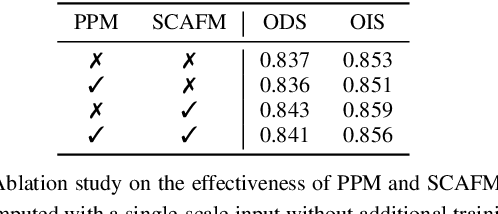
Transformers, renowned for their powerful feature extraction capabilities, have played an increasingly prominent role in various vision tasks. Especially, recent advancements present transformer with hierarchical structures such as Dilated Neighborhood Attention Transformer (DiNAT), demonstrating outstanding ability to efficiently capture both global and local features. However, transformers' application in edge detection has not been fully exploited. In this paper, we propose EdgeNAT, a one-stage transformer-based edge detector with DiNAT as the encoder, capable of extracting object boundaries and meaningful edges both accurately and efficiently. On the one hand, EdgeNAT captures global contextual information and detailed local cues with DiNAT, on the other hand, it enhances feature representation with a novel SCAF-MLA decoder by utilizing both inter-spatial and inter-channel relationships of feature maps. Extensive experiments on multiple datasets show that our method achieves state-of-the-art performance on both RGB and depth images. Notably, on the widely used BSDS500 dataset, our L model achieves impressive performances, with ODS F-measure and OIS F-measure of 86.0%, 87.6% for multi-scale input,and 84.9%, and 86.3% for single-scale input, surpassing the current state-of-the-art EDTER by 1.2%, 1.1%, 1.7%, and 1.6%, respectively. Moreover, as for throughput, our approach runs at 20.87 FPS on RTX 4090 GPU with single-scale input. The code for our method will be released soon.
DrugLLM: Open Large Language Model for Few-shot Molecule Generation
May 07, 2024


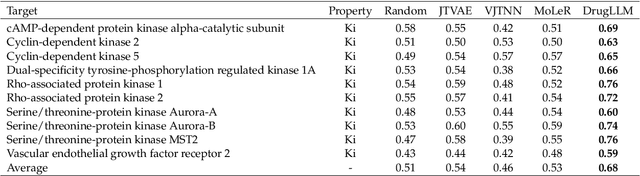
Large Language Models (LLMs) have made great strides in areas such as language processing and computer vision. Despite the emergence of diverse techniques to improve few-shot learning capacity, current LLMs fall short in handling the languages in biology and chemistry. For example, they are struggling to capture the relationship between molecule structure and pharmacochemical properties. Consequently, the few-shot learning capacity of small-molecule drug modification remains impeded. In this work, we introduced DrugLLM, a LLM tailored for drug design. During the training process, we employed Group-based Molecular Representation (GMR) to represent molecules, arranging them in sequences that reflect modifications aimed at enhancing specific molecular properties. DrugLLM learns how to modify molecules in drug discovery by predicting the next molecule based on past modifications. Extensive computational experiments demonstrate that DrugLLM can generate new molecules with expected properties based on limited examples, presenting a powerful few-shot molecule generation capacity.
Neural Implicit Field Editing Considering Object-environment Interaction
Nov 01, 2023

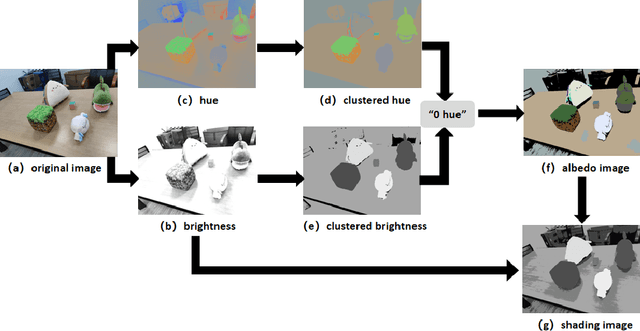

The 3D scene editing method based on neural implicit field has gained wide attention. It has achieved excellent results in 3D editing tasks. However, existing methods often blend the interaction between objects and scene environment. The change of scene appearance like shadows is failed to be displayed in the rendering view. In this paper, we propose an Object and Scene environment Interaction aware (OSI-aware) system, which is a novel two-stream neural rendering system considering object and scene environment interaction. To obtain illuminating conditions from the mixture soup, the system successfully separates the interaction between objects and scene environment by intrinsic decomposition method. To study the corresponding changes to the scene appearance from object-level editing tasks, we introduce a depth map guided scene inpainting method and shadow rendering method by point matching strategy. Extensive experiments demonstrate that our novel pipeline produce reasonable appearance changes in scene editing tasks. It also achieve competitive performance for the rendering quality in novel-view synthesis tasks.
Identification of diffracted vortex beams at different propagation distances using deep learning
Mar 30, 2022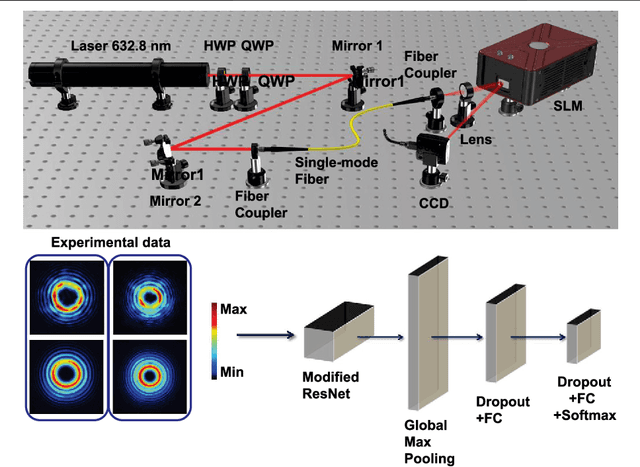
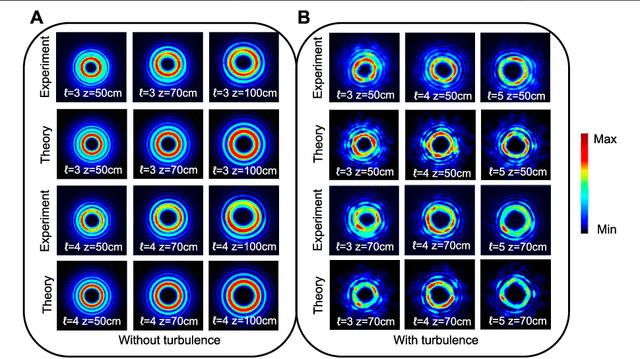
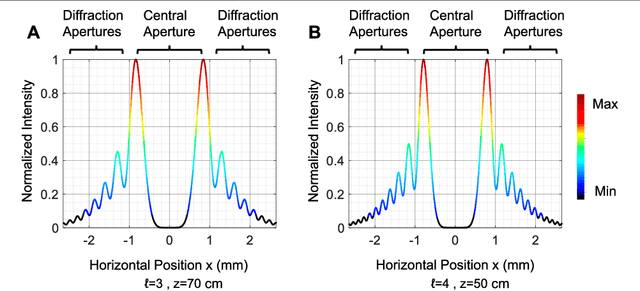
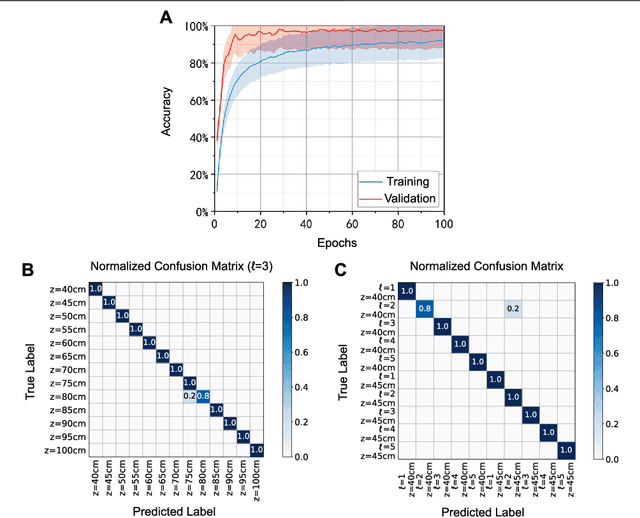
Orbital angular momentum of light is regarded as a valuable resource in quantum technology, especially in quantum communication and quantum sensing and ranging. However, the OAM state of light is susceptible to undesirable experimental conditions such as propagation distance and phase distortions, which hinders the potential for the realistic implementation of relevant technologies. In this article, we exploit an enhanced deep learning neural network to identify different OAM modes of light at multiple propagation distances with phase distortions. Specifically, our trained deep learning neural network can efficiently identify the vortex beam's topological charge and propagation distance with 97% accuracy. Our technique has important implications for OAM based communication and sensing protocols.
* 9 pages, 4 figures