 Add to Chrome
 Add to Firefox
 Add to Edge
SynSFX: Multi-Model Sound Effects Synthesis Dataset for Deepfake Detection and Evaluation
Jul 06, 2026
While audio deepfake detection has advanced significantly, representative detectors show limited generalization to synthetic sound effects. Existing environmental audio datasets such as EnvSDD provide important initial resources, but remain limited in scale and generation provenance for studying isolated sound-effect deepfakes. To support this direction, we present SynSFX, a large-scale corpus of 43374 clips (26452 synthetic, 16922 real) spanning 7 popular text-to-audio models.

USV: Towards Understanding the User-generated Short-form Videos
May 20, 2026Several large-scale video datasets have been published these years and have advanced the area of video understanding. However, the newly emerged user-generated short-form videos have rarely been studied. This paper presents USV, the User-generated Short-form Video dataset for high-level semantic video understanding. The dataset contains around 224K videos collected from UGC platforms by label queries without extra manual verification and trimming. Although video understanding has achieved plausible improvement these years, most works focus on instance-level recognition, which is not sufficient for learning the representation of the high-level semantic information of videos. Therefore, we further establish two tasks: topic recognition and video-text retrieval on USV. We propose two unified and effective baseline methods Multi-Modality Fusion Network (MMF-Net) and Video-Text Contrastive Learning (VTCL), to tackle the topic recognition task and video-text retrieval respectively, and carry out comprehensive benchmarks to facilitate future research. Our project page is https://usvdataset.github.io.
CompSpoof: A Dataset and Joint Learning Framework for Component-Level Audio Anti-spoofing Countermeasures
Sep 19, 2025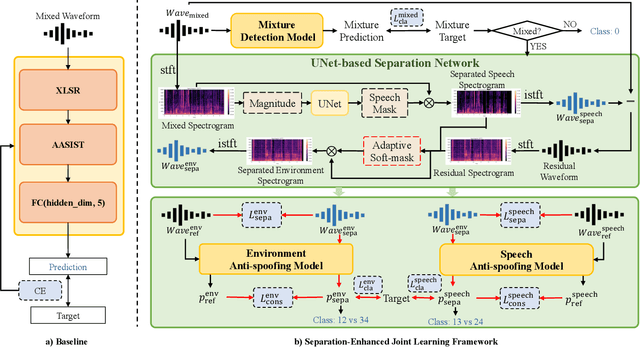

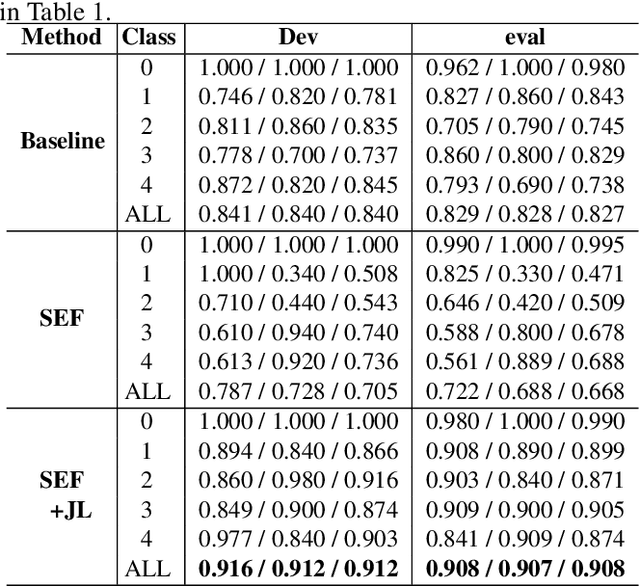
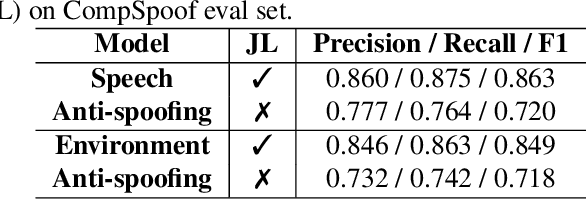
Component-level audio Spoofing (Comp-Spoof) targets a new form of audio manipulation where only specific components of a signal, such as speech or environmental sound, are forged or substituted while other components remain genuine. Existing anti-spoofing datasets and methods treat an utterance or a segment as entirely bona fide or entirely spoofed, and thus cannot accurately detect component-level spoofing. To address this, we construct a new dataset, CompSpoof, covering multiple combinations of bona fide and spoofed speech and environmental sound. We further propose a separation-enhanced joint learning framework that separates audio components apart and applies anti-spoofing models to each one. Joint learning is employed, preserving information relevant for detection. Extensive experiments demonstrate that our method outperforms the baseline, highlighting the necessity of separate components and the importance of detecting spoofing for each component separately. Datasets and code are available at: https://github.com/XuepingZhang/CompSpoof.