 Add to Chrome
 Add to Firefox
 Add to Edge
HEad and neCK TumOR (HECKTOR) 2025: Benchmark of Segmentation, Diagnosis, and Prognosis in Multimodal PET/CT
Jun 18, 2026
Head and neck cancers (HNC) represent a significant global health burden, with accurate tumor delineation being essential for effective radiotherapy planning. The complexity of the oropharyngeal anatomy, combined with the heterogeneous appearance of tumors on imaging, makes manual segmentation time-intensive and subject to inter-observer variability. Beyond segmentation, predicting long-term clinical outcomes, such as recurrence-free survival (RFS), and determining human papillomavirus (HPV) status from noninvasive imaging, remain challenging yet clinically valuable goals. The HECKTOR 2025 challenge addresses these needs by establishing a comprehensive benchmark for automated HNC analysis using multimodal PET/CT imaging and electronic health records. Building on previous editions (2020-2022), this challenge features an expanded multi-institutional dataset comprising over 1,100 patients from 10 centers worldwide. Participants were tasked with three complementary objectives: (1) segmenting primary gross tumor volumes (GTVp) and metastatic lymph nodes (GTVn), (2) predicting recurrence-free survival, and (3) classifying HPV status. The challenge attracted 35 registered teams, with 15 final submissions evaluated on a held-out test set. Top-performing algorithms achieved a mean Dice similarity coefficient of 0.75 for segmentation, a concordance index of 0.66 for survival prediction, and a balanced accuracy of 0.56 for HPV classification. This paper presents a comprehensive analysis of the submitted methodologies, evaluates their performance across different lesion characteristics, and discusses their implications for clinical translation in automated oncology workflows and decision support systems.

Anomaly-Driven Approach for Enhanced Prostate Cancer Segmentation
Apr 30, 2025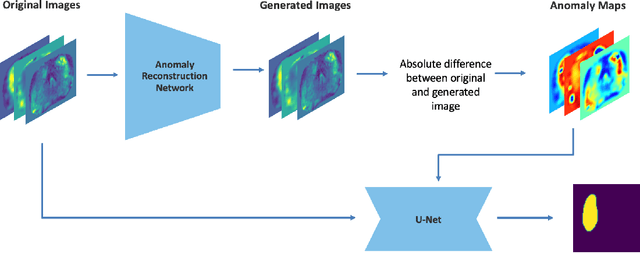

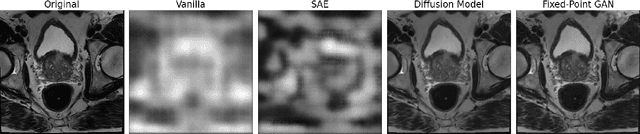
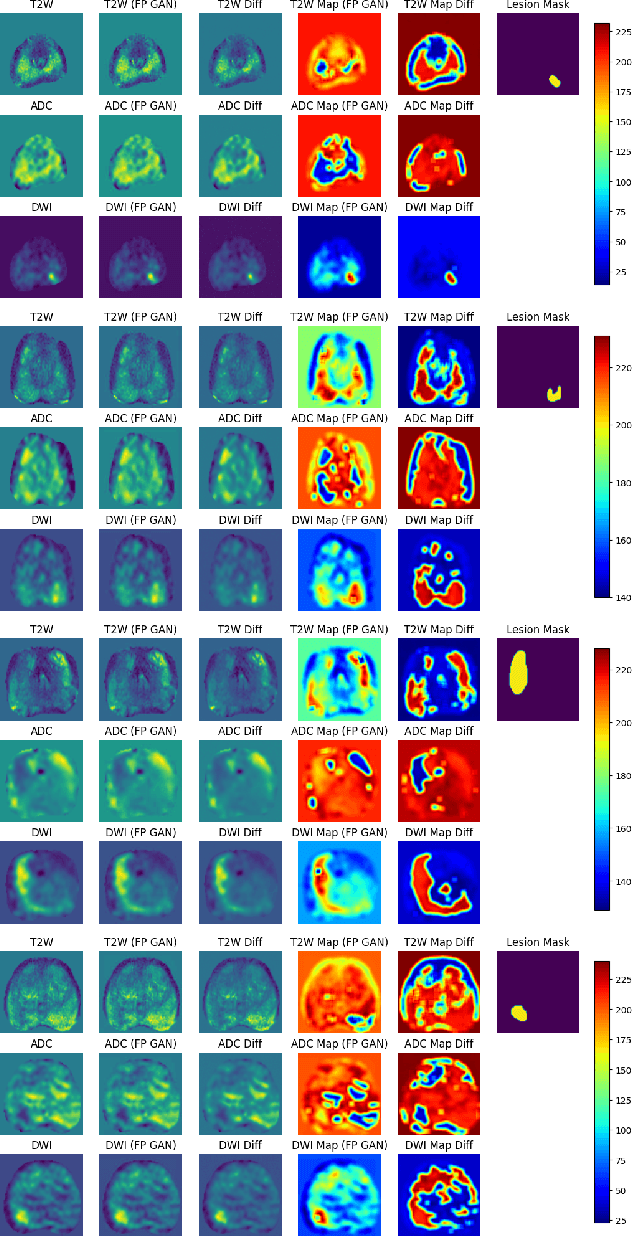
Magnetic Resonance Imaging (MRI) plays an important role in identifying clinically significant prostate cancer (csPCa), yet automated methods face challenges such as data imbalance, variable tumor sizes, and a lack of annotated data. This study introduces Anomaly-Driven U-Net (adU-Net), which incorporates anomaly maps derived from biparametric MRI sequences into a deep learning-based segmentation framework to improve csPCa identification. We conduct a comparative analysis of anomaly detection methods and evaluate the integration of anomaly maps into the segmentation pipeline. Anomaly maps, generated using Fixed-Point GAN reconstruction, highlight deviations from normal prostate tissue, guiding the segmentation model to potential cancerous regions. We compare the performance by using the average score, computed as the mean of the AUROC and Average Precision (AP). On the external test set, adU-Net achieves the best average score of 0.618, outperforming the baseline nnU-Net model (0.605). The results demonstrate that incorporating anomaly detection into segmentation improves generalization and performance, particularly with ADC-based anomaly maps, offering a promising direction for automated csPCa identification.