 Add to Chrome
 Add to Firefox
 Add to Edge
$R_\text{dm}$: Re-conceptualizing Distribution Matching as a Reward for Diffusion Distillation
Mar 31, 2026
Diffusion models achieve state-of-the-art generative performance but are fundamentally bottlenecked by their slow, iterative sampling process. While diffusion distillation techniques enable high-fidelity, few-step generation, traditional objectives often restrict the student's performance by anchoring it solely to the teacher. Recent approaches have attempted to break this ceiling by integrating Reinforcement Learning (RL), typically through a simple summation of distillation and RL objectives. In this work, we propose a novel paradigm by re-conceptualizing distribution matching as a reward, denoted as $R_\text{dm}$. This unified perspective bridges the algorithmic gap between Diffusion Matching Distillation (DMD) and RL, providing several primary benefits. (1) Enhanced Optimization Stability: We introduce Group Normalized Distribution Matching (GNDM), which adapts standard RL group normalization to stabilize $R_\text{dm}$ estimation. By leveraging group-mean statistics, GNDM establishes a more robust and effective optimization direction. (2) Seamless Reward Integration: Our reward-centric formulation inherently supports adaptive weighting mechanisms, allowing for the fluid combination of DMD with external reward models. (3) Improved Sampling Efficiency: By aligning with RL principles, the framework readily incorporates Importance Sampling (IS), leading to a significant boost in sampling efficiency. Extensive experiments demonstrate that GNDM outperforms vanilla DMD, reducing the FID by 1.87. Furthermore, our multi-reward variant, GNDMR, surpasses existing baselines by striking an optimal balance between aesthetic quality and fidelity, achieving a peak HPS of 30.37 and a low FID-SD of 12.21. Ultimately, $R_\text{dm}$ provides a flexible, stable, and efficient framework for real-time, high-fidelity synthesis. Codes are coming soon.

DiffCLIP: Leveraging Stable Diffusion for Language Grounded 3D Classification
May 25, 2023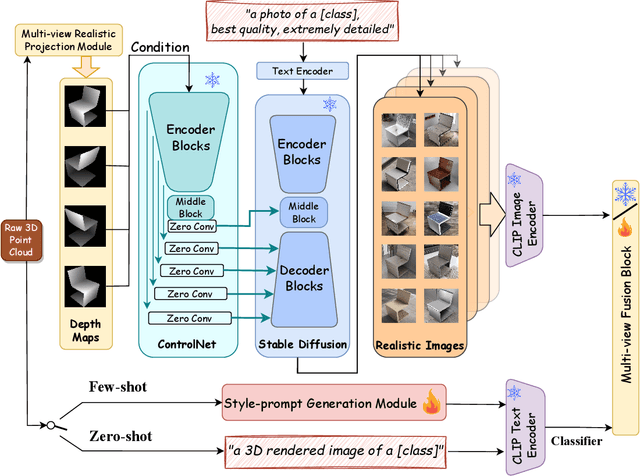
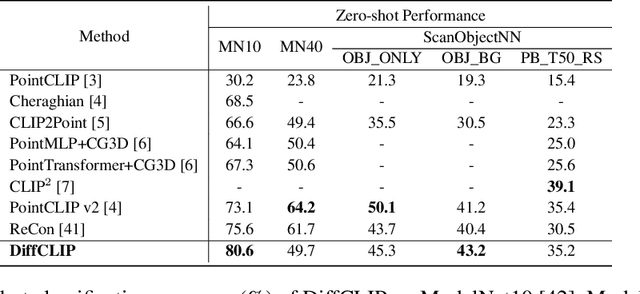
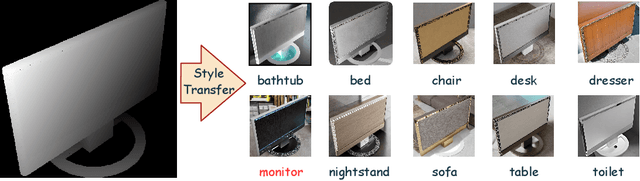

Large pre-trained models have had a significant impact on computer vision by enabling multi-modal learning, where the CLIP model has achieved impressive results in image classification, object detection, and semantic segmentation. However, the model's performance on 3D point cloud processing tasks is limited due to the domain gap between depth maps from 3D projection and training images of CLIP. This paper proposes DiffCLIP, a new pre-training framework that incorporates stable diffusion with ControlNet to minimize the domain gap in the visual branch. Additionally, a style-prompt generation module is introduced for few-shot tasks in the textual branch. Extensive experiments on the ModelNet10, ModelNet40, and ScanObjectNN datasets show that DiffCLIP has strong abilities for 3D understanding. By using stable diffusion and style-prompt generation, DiffCLIP achieves an accuracy of 43.2\% for zero-shot classification on OBJ\_BG of ScanObjectNN, which is state-of-the-art performance, and an accuracy of 80.6\% for zero-shot classification on ModelNet10, which is comparable to state-of-the-art performance.