 Add to Chrome
 Add to Firefox
 Add to Edge
HiMe: Real-Time Self-Hosted Personal Agent Platform for Health Insights with Wearable Devices
Jul 23, 2026
Traditional approaches to wearable health signal analysis, such as smartwatches, are constrained by rigid analytical frameworks and limited personalisation. The emergence of LLM agents creates a new opportunity for Personal Health Agentic Analysis, where health insights can be generated adaptively and in context. However, currently there is no open-source locally deployable platform capable of processing personal health data in real time while preserving privacy. We present HiMe, a locally deployable, privacy-first agent platform that is fully compatible with real-time health data ecosystems across a wide range of wearable devices. HiMe is guided by three design principles. The database is treated as a first-class component. Effectiveness and efficiency are jointly optimised to achieve a low-cost Pareto-optimal balance. Data are processed in real time while the user is modelled over the long term. Together, these principles make it practical for individuals to harness Personal Health Agents for continuous, personalised health monitoring for better wellbeing.

EDIT: Evidence-Diagnosed Intervention Training for Rule-Faithful LLM Grading
Jun 04, 2026Reliable rubric grading requires more than accurate score prediction. Each judgement must be grounded in the mark scheme and evidence from the student answer. Existing credit-assignment and intervention methods, primarily designed for self-contained reasoning tasks such as mathematics reasoning, struggle in this setting because they do not identify where grading reasoning goes wrong or how the model's belief about the final mark changes during reasoning. We propose Evidence-Diagnosed Intervention Training (EDIT), a two-phase framework for training more rubric-faithful LLM graders. First, EDIT-SFT locates problematic reasoning steps using internal model signals: posterior belief over the final mark and input-grounding scores. It then revises only these local steps with help from a rubric checklist. Second, EDIT-RL calibrates the grader with belief-guided reward shaping, penalising large harmful belief drifts while still allowing helpful exploration. Experiments on two real-world, multi-subject grading benchmarks demonstrate that EDIT consistently outperforms strong supervised fine-tuning and reinforcement learning baselines on both in-domain and out-of-domain splits, with ablation studies confirming that internal-state diagnostics drive these gains.
MA$^{2}$P: A Meta-Cognitive Autonomous Intelligent Agents Framework for Complex Persuasion
May 18, 2026Persuasive dialogue generation plays a vital role in decision-making, negotiation, counseling, and behavior change, yet it remains a challenging problem. In complex persuasion where the persuadee's internal states are not expressed clearly, the persuader must interpret responses, infer the persuadee's latent mental states (e.g., beliefs and desires), and translate them into targeted, strategy-consistent actions; however, current approaches often produce generic or weakly grounded responses even when such cues are identified. Moreover, although large language models (LLMs) can generate persuasive content, their performance varies substantially across domains due to uneven knowledge coverage and limited reasoning generalization. To address these challenges, we propose MA$^{2}$P, a meta-cognitive autonomous intelligent agent framework for complex persuasion. Specifically, we develop an autonomous multi-agent architecture that coordinates perception management, mental-state inference, strategy execution, memory maintenance, and performance evaluation. To mitigate cross-domain performance variation, we further design a meta-cognitive configurator that selects an appropriate meta-strategy from a structured knowledge base at the outset, thereby guiding subsequent reasoning and planning. Experimental results show that our approach achieves a higher persuasion success rate than baselines.
Beyond Meta-Reasoning: Metacognitive Consolidation for Self-Improving LLM Reasoning
Apr 19, 2026Large language models (LLMs) have demonstrated strong reasoning capabilities, and as existing approaches for enhancing LLM reasoning continue to mature, increasing attention has shifted toward meta-reasoning as a promising direction for further improvement. However, most existing meta-reasoning methods remain episodic: they focus on executing complex meta-reasoning routines within individual instances, but ignore the accumulation of reusable meta-reasoning skills across instances, leading to recurring failure modes and repeatedly high metacognitive effort. In this paper, we introduce Metacognitive Consolidation, a novel framework in which a model consolidates metacognitive experience from past reasoning episodes into reusable knowledge that improves future meta-reasoning. We instantiate this framework by structuring instance-level problem solving into distinct roles for reasoning, monitoring, and control to generate rich, attributable meta-level traces. These traces are then consolidated through a hierarchical, multi-timescale update mechanism that gradually forms evolving meta-knowledge. Experimental results demonstrate consistent performance gains across benchmarks and backbone models, and show that performance improves as metacognitive experience accumulates over time.
SynGraph: A Dynamic Graph-LLM Synthesis Framework for Sparse Streaming User Sentiment Modeling
Mar 06, 2025User reviews on e-commerce platforms exhibit dynamic sentiment patterns driven by temporal and contextual factors. Traditional sentiment analysis methods focus on static reviews, failing to capture the evolving temporal relationship between user sentiment rating and textual content. Sentiment analysis on streaming reviews addresses this limitation by modeling and predicting the temporal evolution of user sentiments. However, it suffers from data sparsity, manifesting in temporal, spatial, and combined forms. In this paper, we introduce SynGraph, a novel framework designed to address data sparsity in sentiment analysis on streaming reviews. SynGraph alleviates data sparsity by categorizing users into mid-tail, long-tail, and extreme scenarios and incorporating LLM-augmented enhancements within a dynamic graph-based structure. Experiments on real-world datasets demonstrate its effectiveness in addressing sparsity and improving sentiment modeling in streaming reviews.
PROPER: A Progressive Learning Framework for Personalized Large Language Models with Group-Level Adaptation
Mar 03, 2025Personalized large language models (LLMs) aim to tailor their outputs to user preferences. Recent advances in parameter-efficient fine-tuning (PEFT) methods have highlighted the effectiveness of adapting population-level LLMs to personalized LLMs by fine-tuning user-specific parameters with user history. However, user data is typically sparse, making it challenging to adapt LLMs to specific user patterns. To address this challenge, we propose PROgressive PERsonalization (PROPER), a novel progressive learning framework inspired by meso-level theory in social science. PROPER bridges population-level and user-level models by grouping users based on preferences and adapting LLMs in stages. It combines a Mixture-of-Experts (MoE) structure with Low Ranked Adaptation (LoRA), using a user-aware router to assign users to appropriate groups automatically. Additionally, a LoRA-aware router is proposed to facilitate the integration of individual user LoRAs with group-level LoRAs. Experimental results show that PROPER significantly outperforms SOTA models across multiple tasks, demonstrating the effectiveness of our approach.
Explainable Depression Detection in Clinical Interviews with Personalized Retrieval-Augmented Generation
Mar 03, 2025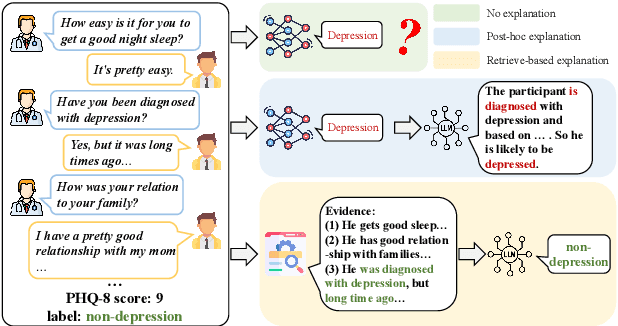
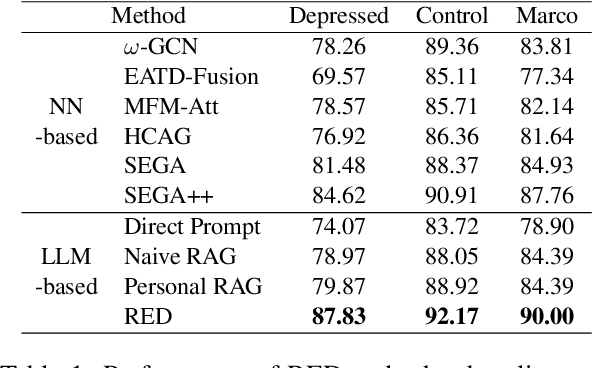
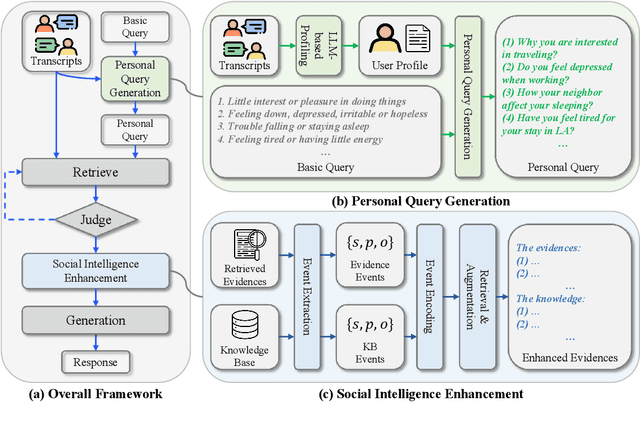

Depression is a widespread mental health disorder, and clinical interviews are the gold standard for assessment. However, their reliance on scarce professionals highlights the need for automated detection. Current systems mainly employ black-box neural networks, which lack interpretability, which is crucial in mental health contexts. Some attempts to improve interpretability use post-hoc LLM generation but suffer from hallucination. To address these limitations, we propose RED, a Retrieval-augmented generation framework for Explainable depression Detection. RED retrieves evidence from clinical interview transcripts, providing explanations for predictions. Traditional query-based retrieval systems use a one-size-fits-all approach, which may not be optimal for depression detection, as user backgrounds and situations vary. We introduce a personalized query generation module that combines standard queries with user-specific background inferred by LLMs, tailoring retrieval to individual contexts. Additionally, to enhance LLM performance in social intelligence, we augment LLMs by retrieving relevant knowledge from a social intelligence datastore using an event-centric retriever. Experimental results on the real-world benchmark demonstrate RED's effectiveness compared to neural networks and LLM-based baselines.
CODI: Compressing Chain-of-Thought into Continuous Space via Self-Distillation
Feb 28, 2025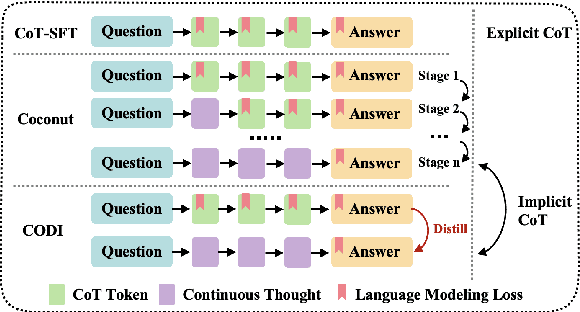
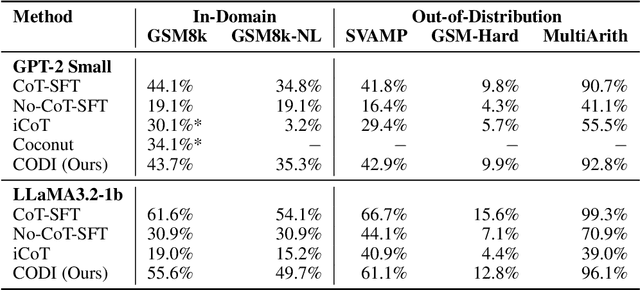
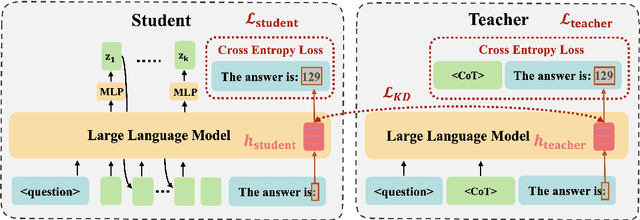
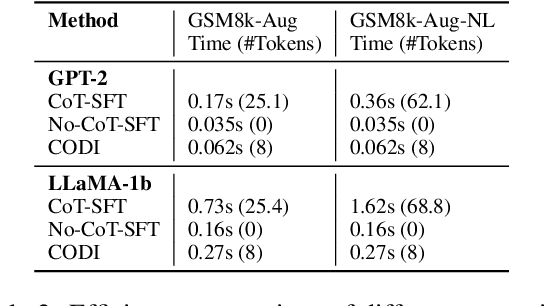
Chain-of-Thought (CoT) enhances Large Language Models (LLMs) by enabling step-by-step reasoning in natural language. However, the language space may be suboptimal for reasoning. While implicit CoT methods attempt to enable reasoning without explicit CoT tokens, they have consistently lagged behind explicit CoT method in task performance. We propose CODI (Continuous Chain-of-Thought via Self-Distillation), a novel framework that distills CoT into a continuous space, where a shared model acts as both teacher and student, jointly learning explicit and implicit CoT while aligning their hidden activation on the token generating the final answer. CODI is the first implicit CoT method to match explicit CoT's performance on GSM8k while achieving 3.1x compression, surpassing the previous state-of-the-art by 28.2% in accuracy. Furthermore, CODI demonstrates scalability, robustness, and generalizability to more complex CoT datasets. Additionally, CODI retains interpretability by decoding its continuous thoughts, making its reasoning process transparent. Our findings establish implicit CoT as not only a more efficient but a powerful alternative to explicit CoT.
RGAR: Recurrence Generation-augmented Retrieval for Factual-aware Medical Question Answering
Feb 19, 2025
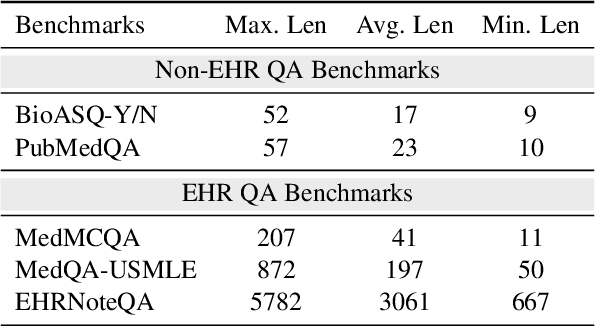
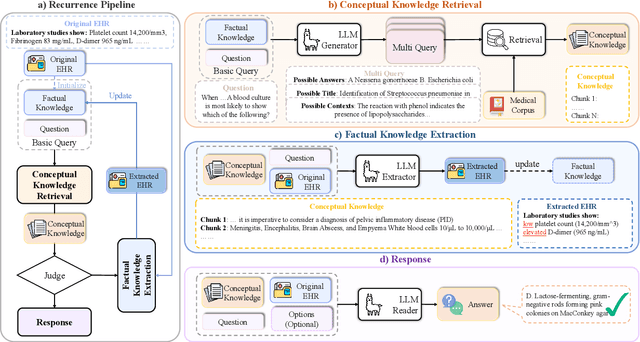
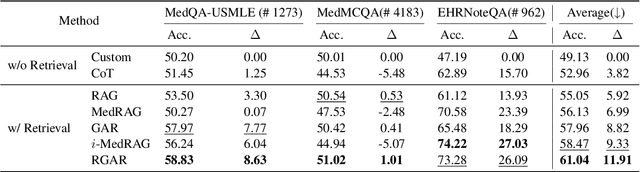
Medical question answering requires extensive access to specialized conceptual knowledge. The current paradigm, Retrieval-Augmented Generation (RAG), acquires expertise medical knowledge through large-scale corpus retrieval and uses this knowledge to guide a general-purpose large language model (LLM) for generating answers. However, existing retrieval approaches often overlook the importance of factual knowledge, which limits the relevance of retrieved conceptual knowledge and restricts its applicability in real-world scenarios, such as clinical decision-making based on Electronic Health Records (EHRs). This paper introduces RGAR, a recurrence generation-augmented retrieval framework that retrieves both relevant factual and conceptual knowledge from dual sources (i.e., EHRs and the corpus), allowing them to interact and refine each another. Through extensive evaluation across three factual-aware medical question answering benchmarks, RGAR establishes a new state-of-the-art performance among medical RAG systems. Notably, the Llama-3.1-8B-Instruct model with RGAR surpasses the considerably larger, RAG-enhanced GPT-3.5. Our findings demonstrate the benefit of extracting factual knowledge for retrieval, which consistently yields improved generation quality.
WebWalker: Benchmarking LLMs in Web Traversal
Jan 14, 2025
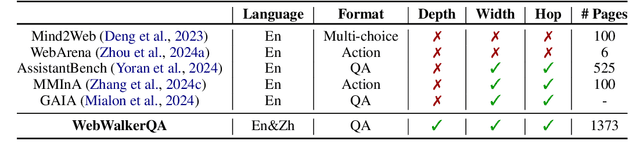


Retrieval-augmented generation (RAG) demonstrates remarkable performance across tasks in open-domain question-answering. However, traditional search engines may retrieve shallow content, limiting the ability of LLMs to handle complex, multi-layered information. To address it, we introduce WebWalkerQA, a benchmark designed to assess the ability of LLMs to perform web traversal. It evaluates the capacity of LLMs to traverse a website's subpages to extract high-quality data systematically. We propose WebWalker, which is a multi-agent framework that mimics human-like web navigation through an explore-critic paradigm. Extensive experimental results show that WebWalkerQA is challenging and demonstrates the effectiveness of RAG combined with WebWalker, through the horizontal and vertical integration in real-world scenarios.