 Add to Chrome
 Add to Firefox
 Add to Edge
DiCoR: Decoupled Referent Disambiguation and Contour Recalibration for Efficient Referring Remote Sensing Image Segmentation
Aug 13, 2026
Referring remote sensing image segmentation (RRSIS) aims to delineate targets specified by natural language expressions in remote sensing imagery. Existing methods mainly follow joint fusion segmentation (JFS) or decoupled prompt segmentation (DPS). JFS is efficient but often suffers from limited accuracy because referent localization and mask delineation are optimized under a unified objective, whereas DPS separates localization from mask generation using spatial prompts and foundation segmenters at the cost of higher memory consumption and inference latency. To bridge this gap, we propose DiCoR, a decoupled referent disambiguation and contour recalibration framework built on an efficient JFS pipeline. DiCoR addresses two key challenges: distinguishing the correct referent from ambiguous candidates and refining coarse masks after localization. A disambiguation-aware localization guidance strategy ranks salient candidate regions with adaptive linguistic cues and injects the resulting localization prior into fused features. A lightweight contour recalibration module further predicts residual corrections to coarse logits under localized contour supervision, improving mask quality with limited computational overhead. Experiments on RefSegRS, RRSIS-D, and RISBench show that DiCoR achieves the best segmentation accuracy across all three benchmarks. On RefSegRS, it improves mIoU and gIoU by 5.28% and 2.87% over a competitive JFS method while running 4.7% faster than a representative DPS method, demonstrating a favorable accuracy-efficiency trade-off. Code is available at https://github.com/zyGao1126/DiCoR.

MA$^{2}$P: A Meta-Cognitive Autonomous Intelligent Agents Framework for Complex Persuasion
May 18, 2026Persuasive dialogue generation plays a vital role in decision-making, negotiation, counseling, and behavior change, yet it remains a challenging problem. In complex persuasion where the persuadee's internal states are not expressed clearly, the persuader must interpret responses, infer the persuadee's latent mental states (e.g., beliefs and desires), and translate them into targeted, strategy-consistent actions; however, current approaches often produce generic or weakly grounded responses even when such cues are identified. Moreover, although large language models (LLMs) can generate persuasive content, their performance varies substantially across domains due to uneven knowledge coverage and limited reasoning generalization. To address these challenges, we propose MA$^{2}$P, a meta-cognitive autonomous intelligent agent framework for complex persuasion. Specifically, we develop an autonomous multi-agent architecture that coordinates perception management, mental-state inference, strategy execution, memory maintenance, and performance evaluation. To mitigate cross-domain performance variation, we further design a meta-cognitive configurator that selects an appropriate meta-strategy from a structured knowledge base at the outset, thereby guiding subsequent reasoning and planning. Experimental results show that our approach achieves a higher persuasion success rate than baselines.
GastroDL-Fusion: A Dual-Modal Deep Learning Framework Integrating Protein-Ligand Complexes and Gene Sequences for Gastrointestinal Disease Drug Discovery
Nov 07, 2025Accurate prediction of protein-ligand binding affinity plays a pivotal role in accelerating the discovery of novel drugs and vaccines, particularly for gastrointestinal (GI) diseases such as gastric ulcers, Crohn's disease, and ulcerative colitis. Traditional computational models often rely on structural information alone and thus fail to capture the genetic determinants that influence disease mechanisms and therapeutic responses. To address this gap, we propose GastroDL-Fusion, a dual-modal deep learning framework that integrates protein-ligand complex data with disease-associated gene sequence information for drug and vaccine development. In our approach, protein-ligand complexes are represented as molecular graphs and modeled using a Graph Isomorphism Network (GIN), while gene sequences are encoded into biologically meaningful embeddings via a pre-trained Transformer (ProtBERT/ESM). These complementary modalities are fused through a multi-layer perceptron to enable robust cross-modal interaction learning. We evaluate the model on benchmark datasets of GI disease-related targets, demonstrating that GastroDL-Fusion significantly improves predictive performance over conventional methods. Specifically, the model achieves a mean absolute error (MAE) of 1.12 and a root mean square error (RMSE) of 1.75, outperforming CNN, BiLSTM, GIN, and Transformer-only baselines. These results confirm that incorporating both structural and genetic features yields more accurate predictions of binding affinities, providing a reliable computational tool for accelerating the design of targeted therapies and vaccines in the context of gastrointestinal diseases.
Explainable Depression Detection in Clinical Interviews with Personalized Retrieval-Augmented Generation
Mar 03, 2025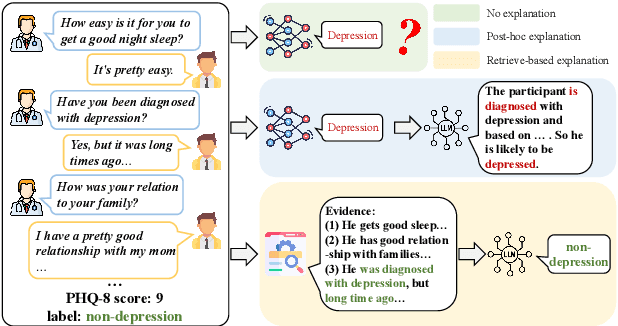
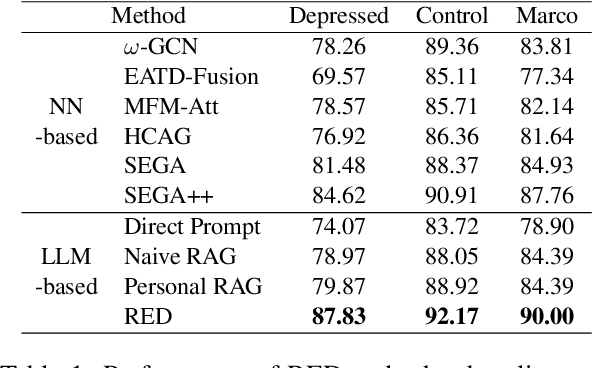
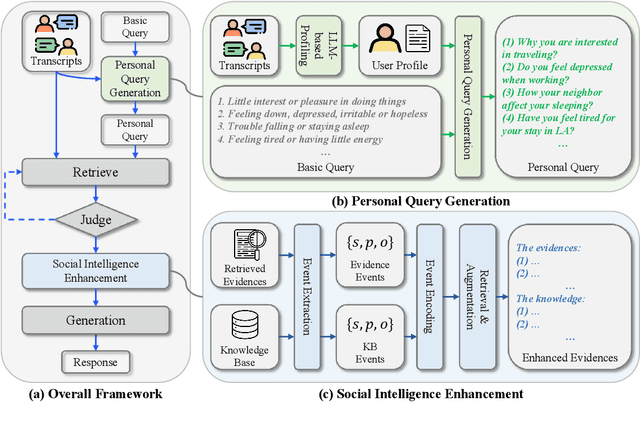

Depression is a widespread mental health disorder, and clinical interviews are the gold standard for assessment. However, their reliance on scarce professionals highlights the need for automated detection. Current systems mainly employ black-box neural networks, which lack interpretability, which is crucial in mental health contexts. Some attempts to improve interpretability use post-hoc LLM generation but suffer from hallucination. To address these limitations, we propose RED, a Retrieval-augmented generation framework for Explainable depression Detection. RED retrieves evidence from clinical interview transcripts, providing explanations for predictions. Traditional query-based retrieval systems use a one-size-fits-all approach, which may not be optimal for depression detection, as user backgrounds and situations vary. We introduce a personalized query generation module that combines standard queries with user-specific background inferred by LLMs, tailoring retrieval to individual contexts. Additionally, to enhance LLM performance in social intelligence, we augment LLMs by retrieving relevant knowledge from a social intelligence datastore using an event-centric retriever. Experimental results on the real-world benchmark demonstrate RED's effectiveness compared to neural networks and LLM-based baselines.
A CT Image Classification Network Framework for Lung Tumors Based on Pre-trained MobileNetV2 Model and Transfer learning, And Its Application and Market Analysis in the Medical field
Jan 09, 2025In the medical field, accurate diagnosis of lung cancer is crucial for treatment. Traditional manual analysis methods have significant limitations in terms of accuracy and efficiency. To address this issue, this paper proposes a deep learning network framework based on the pre-trained MobileNetV2 model, initialized with weights from the ImageNet-1K dataset (version 2). The last layer of the model (the fully connected layer) is replaced with a new fully connected layer, and a softmax activation function is added to efficiently classify three types of lung cancer CT scan images. Experimental results show that the model achieves an accuracy of 99.6% on the test set, with significant improvements in feature extraction compared to traditional models.With the rapid development of artificial intelligence technologies, deep learning applications in medical image processing are bringing revolutionary changes to the healthcare industry. AI-based lung cancer detection systems can significantly improve diagnostic efficiency, reduce the workload of doctors, and occupy an important position in the global healthcare market. The potential of AI to improve diagnostic accuracy, reduce medical costs, and promote precision medicine will have a profound impact on the future development of the healthcare industry.