 Add to Chrome
 Add to Firefox
 Add to Edge
MA$^{2}$P: A Meta-Cognitive Autonomous Intelligent Agents Framework for Complex Persuasion
May 18, 2026
Persuasive dialogue generation plays a vital role in decision-making, negotiation, counseling, and behavior change, yet it remains a challenging problem. In complex persuasion where the persuadee's internal states are not expressed clearly, the persuader must interpret responses, infer the persuadee's latent mental states (e.g., beliefs and desires), and translate them into targeted, strategy-consistent actions; however, current approaches often produce generic or weakly grounded responses even when such cues are identified. Moreover, although large language models (LLMs) can generate persuasive content, their performance varies substantially across domains due to uneven knowledge coverage and limited reasoning generalization. To address these challenges, we propose MA$^{2}$P, a meta-cognitive autonomous intelligent agent framework for complex persuasion. Specifically, we develop an autonomous multi-agent architecture that coordinates perception management, mental-state inference, strategy execution, memory maintenance, and performance evaluation. To mitigate cross-domain performance variation, we further design a meta-cognitive configurator that selects an appropriate meta-strategy from a structured knowledge base at the outset, thereby guiding subsequent reasoning and planning. Experimental results show that our approach achieves a higher persuasion success rate than baselines.

Beyond Meta-Reasoning: Metacognitive Consolidation for Self-Improving LLM Reasoning
Apr 19, 2026Large language models (LLMs) have demonstrated strong reasoning capabilities, and as existing approaches for enhancing LLM reasoning continue to mature, increasing attention has shifted toward meta-reasoning as a promising direction for further improvement. However, most existing meta-reasoning methods remain episodic: they focus on executing complex meta-reasoning routines within individual instances, but ignore the accumulation of reusable meta-reasoning skills across instances, leading to recurring failure modes and repeatedly high metacognitive effort. In this paper, we introduce Metacognitive Consolidation, a novel framework in which a model consolidates metacognitive experience from past reasoning episodes into reusable knowledge that improves future meta-reasoning. We instantiate this framework by structuring instance-level problem solving into distinct roles for reasoning, monitoring, and control to generate rich, attributable meta-level traces. These traces are then consolidated through a hierarchical, multi-timescale update mechanism that gradually forms evolving meta-knowledge. Experimental results demonstrate consistent performance gains across benchmarks and backbone models, and show that performance improves as metacognitive experience accumulates over time.
Novel Smart N95 Filtering Facepiece Respirator with Real-time Adaptive Fit Functionality and Wireless Humidity Monitoring for Enhanced Wearable Comfort
Sep 09, 2023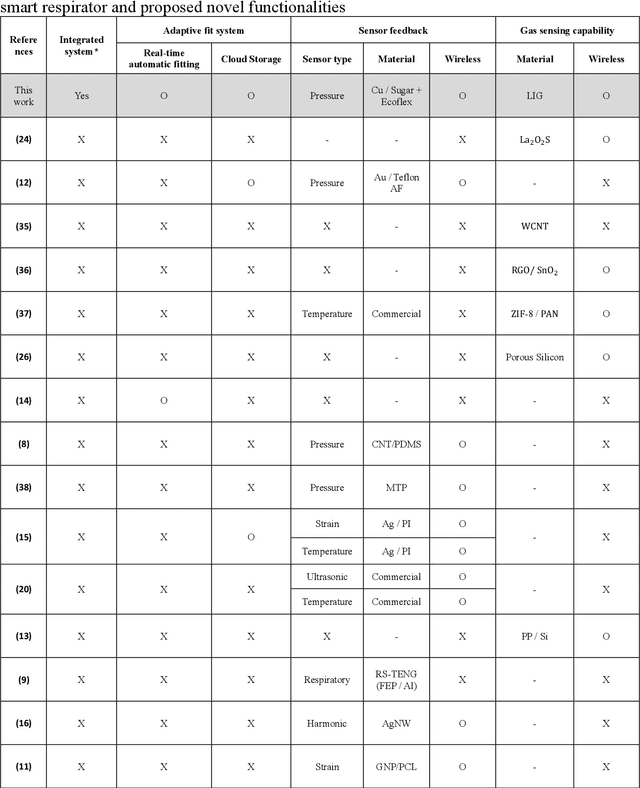
The widespread emergence of the COVID-19 pandemic has transformed our lifestyle, and facial respirators have become an essential part of daily life. Nevertheless, the current respirators possess several limitations such as poor respirator fit because they are incapable of covering diverse human facial sizes and shapes, potentially diminishing the effect of wearing respirators. In addition, the current facial respirators do not inform the user of the air quality within the smart facepiece respirator in case of continuous long-term use. Here, we demonstrate the novel smart N-95 filtering facepiece respirator that incorporates the humidity sensor and pressure sensory feedback-enabled self-fit adjusting functionality for the effective performance of the facial respirator to prevent the transmission of airborne pathogens. The laser-induced graphene (LIG) constitutes the humidity sensor, and the pressure sensor array based on the dielectric elastomeric sponge monitors the respirator contact on the face of the user, providing the sensory information for a closed-loop feedback mechanism. As a result of the self-fit adjusting mode along with elastomeric lining, the fit factor is increased by 3.20 and 5 times at average and maximum respectively. We expect that the experimental proof-of-concept of this work will offer viable solutions to the current commercial respirators to address the limitations.