 Add to Chrome
 Add to Firefox
 Add to Edge
TrajGenAgent: A Hierarchical LLM Agent for Human Mobility Trajectory Generation
Jun 10, 2026
Human mobility data is important for transportation, urban planning, and epidemic control, but large-scale trajectory collection is often costly and privacy-constrained, motivating realistic synthetic trajectory generation. Existing LLM-based generators typically rely on either prompt engineering, which preserves zero-shot reasoning but lacks fine-grained spatiotemporal grounding, or trajectory-level fine-tuning, which improves statistical precision but incurs substantial computational cost and may weaken general reasoning. We propose TrajGenAgent, a semantic-aware hierarchical LLM-agent framework for human mobility trajectory generation without model fine-tuning. TrajGenAgent uses a two-stage orchestrator-worker design: an LLM first synthesizes an individual- and weekday-conditioned activity chain from historical evidence via in-context learning, and a deterministic workflow then grounds each activity into a complete visit using personalized POI retrieval, distance-aware location selection, kinematics-aware travel-time propagation, and LLM-based duration estimation. To evaluate realism beyond aggregate spatiotemporal statistics, we introduce an anomaly-detection-based evaluation framework using two complementary detectors to assess behavioral and semantic plausibility. Experiments on benchmark and large-scale simulation datasets show that TrajGenAgent improves spatiotemporal fidelity, semantic coherence, and individual-specific behavioral realism over representative neural and LLM-based baselines, while avoiding parameter updates.

NARA: Anchor-Conditioned Relation-Aware Contextualization of Heterogeneous Geoentities
May 12, 2026Geospatial foundation models have primarily focused on raster data such as satellite imagery, where self-supervised learning has been widely studied. Vector geospatial data instead represent the world as discrete geoentities with explicit geometry, semantics, and structured spatial relations, including metric proximity and topological relationships. These relations jointly determine how entities interact within space, yet existing representation learning methods remain fragmented, often restricted to specific geometry types or partial spatial relations, limiting their ability to capture unified spatial context across heterogeneous geoentities. We propose NARA (Neural Anchor-conditioned Relation-Aware representation learning), a self-supervised framework for vector geoentities. NARA learns context-dependent representations by jointly modeling semantics, geometry, and spatial relations within a unified framework and captures relational spatial structure beyond proximity alone, enabling rich contextualized representations across heterogeneous geoentities of points, polylines, and polygons. Evaluation on building function classification, traffic speed prediction, and next point-of-interest recommendation shows consistent improvements over prior methods, highlighting the benefit of unified relational modeling for vector geospatial data.
Back to Bayesics: Uncovering Human Mobility Distributions and Anomalies with an Integrated Statistical and Neural Framework
Oct 01, 2024Existing methods for anomaly detection often fall short due to their inability to handle the complexity, heterogeneity, and high dimensionality inherent in real-world mobility data. In this paper, we propose DeepBayesic, a novel framework that integrates Bayesian principles with deep neural networks to model the underlying multivariate distributions from sparse and complex datasets. Unlike traditional models, DeepBayesic is designed to manage heterogeneous inputs, accommodating both continuous and categorical data to provide a more comprehensive understanding of mobility patterns. The framework features customized neural density estimators and hybrid architectures, allowing for flexibility in modeling diverse feature distributions and enabling the use of specialized neural networks tailored to different data types. Our approach also leverages agent embeddings for personalized anomaly detection, enhancing its ability to distinguish between normal and anomalous behaviors for individual agents. We evaluate our approach on several mobility datasets, demonstrating significant improvements over state-of-the-art anomaly detection methods. Our results indicate that incorporating personalization and advanced sequence modeling techniques can substantially enhance the ability to detect subtle and complex anomalies in spatiotemporal event sequences.
NUMOSIM: A Synthetic Mobility Dataset with Anomaly Detection Benchmarks
Sep 04, 2024
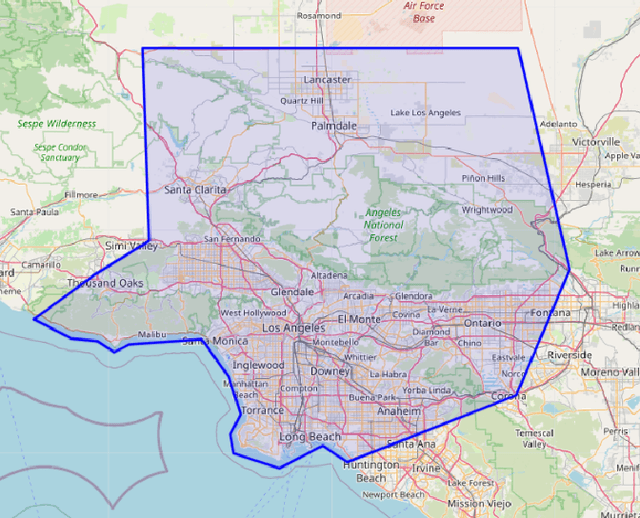
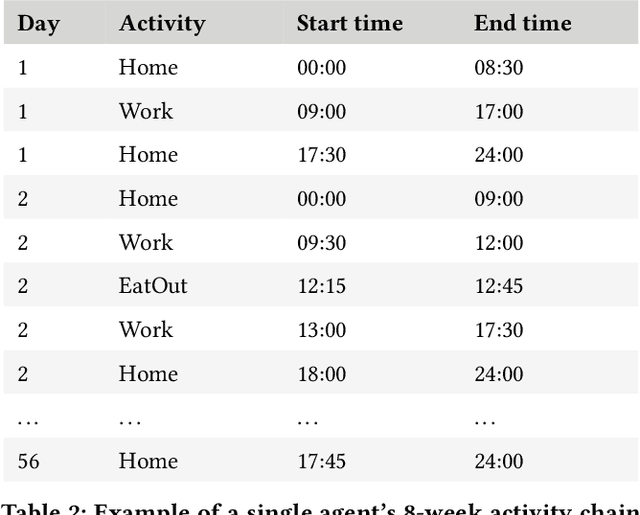
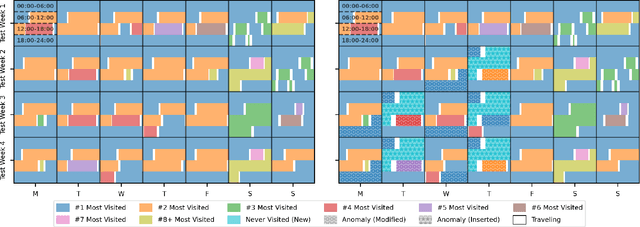
Collecting real-world mobility data is challenging. It is often fraught with privacy concerns, logistical difficulties, and inherent biases. Moreover, accurately annotating anomalies in large-scale data is nearly impossible, as it demands meticulous effort to distinguish subtle and complex patterns. These challenges significantly impede progress in geospatial anomaly detection research by restricting access to reliable data and complicating the rigorous evaluation, comparison, and benchmarking of methodologies. To address these limitations, we introduce a synthetic mobility dataset, NUMOSIM, that provides a controlled, ethical, and diverse environment for benchmarking anomaly detection techniques. NUMOSIM simulates a wide array of realistic mobility scenarios, encompassing both typical and anomalous behaviours, generated through advanced deep learning models trained on real mobility data. This approach allows NUMOSIM to accurately replicate the complexities of real-world movement patterns while strategically injecting anomalies to challenge and evaluate detection algorithms based on how effectively they capture the interplay between demographic, geospatial, and temporal factors. Our goal is to advance geospatial mobility analysis by offering a realistic benchmark for improving anomaly detection and mobility modeling techniques. To support this, we provide open access to the NUMOSIM dataset, along with comprehensive documentation, evaluation metrics, and benchmark results.