 Add to Chrome
 Add to Firefox
 Add to Edge
DocPure: Prompt-Free Unified Document Restoration via Degradation-Aware Structure-Guided Wavelet Modulation
Aug 10, 2026
High-quality document images are pivotal for information archiving and downstream automatic processing. However, they are frequently compromised by diverse degradations during uncontrolled acquisition and transmission. While unified document restoration techniques have been proposed to restore images from multiple degradations, they often struggle with training multiple degradation-specific models, reliance on manual task-specific prompts, or cross-task data pairing. To address these limitations, we propose DocPure, a prompt-free unified framework that achieves degradation-aware document restoration. We design a degradation-aware structure auto-encoder with degradation-informed routing regularization to predict clean structural priors from degraded inputs. The model is prompt-free at inference, and degradation labels are only used as auxiliary supervision for the routing regularization during training. Furthermore, we introduce a structure-guided wavelet interaction mechanism to bridge frequency-domain features and spatial semantics. Within the structure-guided wavelet interaction mechanism, a cross-frequency adaptive modulation utilizes low-frequency sub-bands to modulate high-frequency recovery, ensuring structural consistency. Extensive experiments demonstrate that DocPure achieves strong performance compared with state-of-the-art methods across various tasks, including deblurring, denoising, compression artifact reduction, and deshadowing.

Tuning-Free Latent Diffusion Models for Ultrahigh-Resolution Image Editing
Jul 07, 2026Recent diffusion-based generative models have shown impressive performance in image generation and editing. However, due to memory limitations and the high cost of collecting high-resolution training images, existing methods are typically restricted to inputs with linear resolutions below 1K. In contrast, photos captured by modern mobile devices often reach linear resolutions up to 8K, revealing a significant gap between current capabilities and real-world demands. Simply upscaling low-resolution edited results often results in visually enlarged but blurry images that lack fine details. This paper introduces UltraDiffEdit, a novel, tuning-free image editing framework that extends off-the-shelf latent diffusion models (LDMs) to ultrahigh resolutions. UltraDiffEdit employs a multi-scale progressive editing strategy, iteratively blending high-resolution edited content with unedited areas in a coarse-to-fine manner. We employ multi-patch encoding to preserve both edited and unedited visual details within the latent space. To mitigate editing artifacts, our global-local consistency denoising technique consistently integrates edited and unedited latent features, ensuring smooth transition at editing boundaries from the latent representation to the final image. We also introduce a patch-based hybrid sampling approach that captures local, intermediate, and global features, ensuring semantic coherence and enhancing fine detail during denoising. We conduct extensive experiments demonstrating UltraDiffEdit's superior editing quality and flexibility: it can handle image resolutions up to 8K using only a single NVIDIA GeForce RTX 3090 GPU. The source code is publicly available at https://github.com/LonglongaaaGo/UltraDiffEdit.
* 29 pages, 29 figures. Published in IEEE Transactions on Neural Networks and Learning Systems
TextDoctor: Unified Document Image Inpainting via Patch Pyramid Diffusion Models
Mar 06, 2025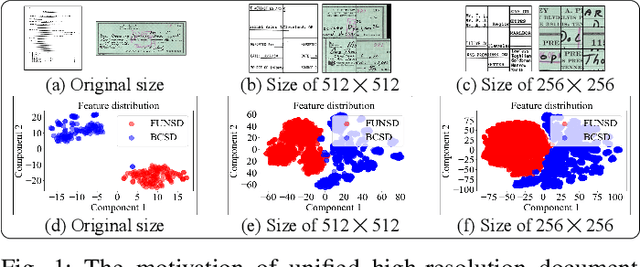
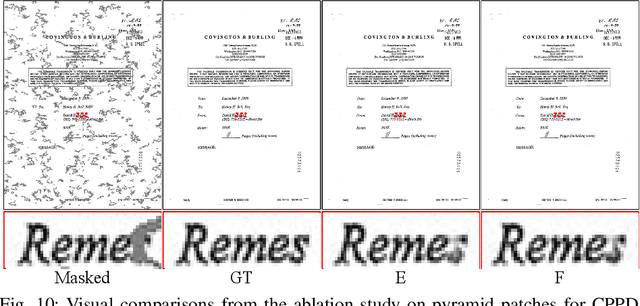
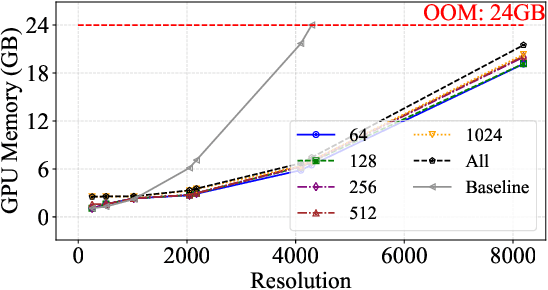
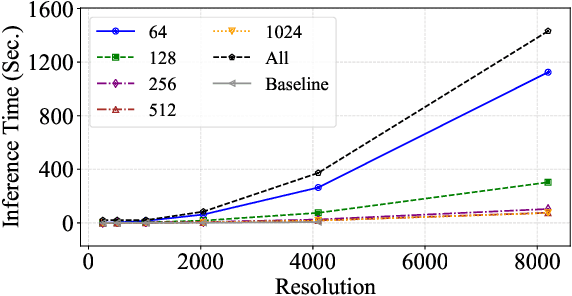
Digital versions of real-world text documents often suffer from issues like environmental corrosion of the original document, low-quality scanning, or human interference. Existing document restoration and inpainting methods typically struggle with generalizing to unseen document styles and handling high-resolution images. To address these challenges, we introduce TextDoctor, a novel unified document image inpainting method. Inspired by human reading behavior, TextDoctor restores fundamental text elements from patches and then applies diffusion models to entire document images instead of training models on specific document types. To handle varying text sizes and avoid out-of-memory issues, common in high-resolution documents, we propose using structure pyramid prediction and patch pyramid diffusion models. These techniques leverage multiscale inputs and pyramid patches to enhance the quality of inpainting both globally and locally. Extensive qualitative and quantitative experiments on seven public datasets validated that TextDoctor outperforms state-of-the-art methods in restoring various types of high-resolution document images.