 Add to Chrome
 Add to Firefox
 Add to Edge
DSETA: A Dual-Stage Continual Learning Framework for Travel Time Prediction in Dynamic Traffic Environments
Aug 01, 2026
Estimated Time of Arrival (ETA) prediction is a core component of intelligent transportation systems. As traffic congestion patterns become increasingly dynamic in large cities, maintaining high prediction accuracy poses a major challenge for ride-hailing platforms. Existing methods either fail to adapt to irregular traffic patterns and sudden congestion, or suffer from new distributions without disentangling long-term trends from short-term fluctuations, thereby degrading model performance in real-world scenarios. To address this challenge, we propose DSETA, an incrementally updated Dual-Stage ETA prediction framework. Specifically, the continual learning process is divided into \textit{inter-day} and \textit{intra-day} stages. We first design the \textit{intra-day} learning stage, which relies entirely on real-time data to enable dynamic adaptation to short-term traffic patterns caused by events like holidays or accidents. Next, we develop the \textit{inter-day} learning stage, which leverages aggregated historical data from a short time window to capture knowledge of long-term distribution shifts, such as seasonal trends and traffic network evolution. Subsequently, to prevent catastrophic forgetting and preserve knowledge of regular patterns, we explore a \textit{Historical Traffic Knowledge Consolidation} module. Finally, we validate DSETA's effectiveness and robustness through extensive offline and online experiments conducted on real-world datasets from DiDi's platform. Online A/B tests across three major cities including Beijing, Wuhan, and Xi'an consistently demonstrated performance gains, achieving MAE reductions of 6.62\%, 0.73\%, and 2.40\% respectively. This framework has been successfully deployed in DiDi's production environment, processing hundreds of millions of daily requests and validating its strong performance in industrial applications.

Is Your NPU Ready for LLMs? Dissecting the Hidden Efficiency Bottlenecks in Mobile LLM Inference
Jul 06, 2026Deploying Large Language Models (LLMs) on mobile devices enhances privacy and reduces latency, but is severely bottlenecked by hardware inefficiency. We present the first comprehensive, cross-layer measurement study of mobile LLM inference, uniquely spanning five mainstream frameworks (e.g., llama.cpp, GENIE) and three hardware backends (CPU, GPU, NPU). To enable this analysis, we develop PowerBench, a fine-grained profiling tool that provides the first backend-specific energy attribution, moving beyond traditional device-level measurements. Our study yields three critical insights: (1) Framework-induced performance gaps are substantially amplified on NPUs, reaching up to 10x using custom operators due to divergent offloading and quantization strategies. (2) We identify a distinct phase split where NPUs excel at compute-bound prefilling, while CPUs outperform all other backends in memory-bound decoding. This is driven by the NPU's preference for large, fixed-shape workloads, which conflicts with the small-kernel, dynamic nature of decoding. (3) Backend-specific profiling uncovers substantial scheduling headroom missed by prior work. Suboptimal thread configurations, uncoordinated NPU sleep latencies, and CPU polling intervals result in up to 40% energy waste. Leveraging these findings, we present an energy-oriented best-practice configuration for mobile LLM inference. We estimate that this configuration could reduce energy consumption by up to 54.8% on the NPU backend across three datasets.
NEC: Speaker Selective Cancellation via Neural Enhanced Ultrasound Shadowing
Jul 12, 2022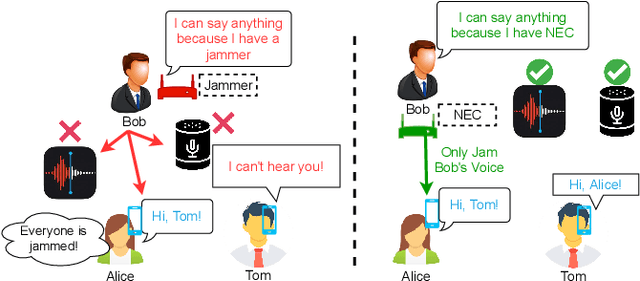
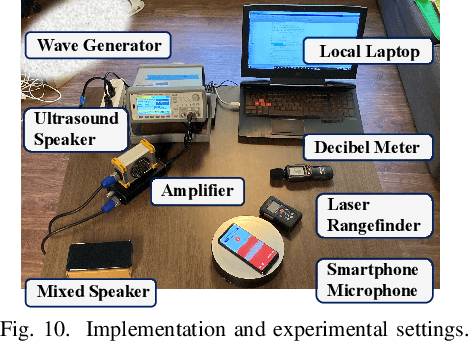

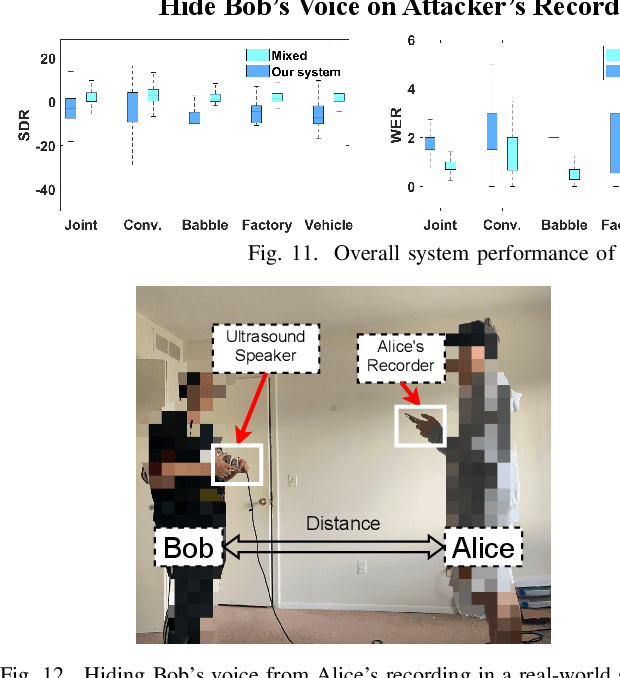
In this paper, we propose NEC (Neural Enhanced Cancellation), a defense mechanism, which prevents unauthorized microphones from capturing a target speaker's voice. Compared with the existing scrambling-based audio cancellation approaches, NEC can selectively remove a target speaker's voice from a mixed speech without causing interference to others. Specifically, for a target speaker, we design a Deep Neural Network (DNN) model to extract high-level speaker-specific but utterance-independent vocal features from his/her reference audios. When the microphone is recording, the DNN generates a shadow sound to cancel the target voice in real-time. Moreover, we modulate the audible shadow sound onto an ultrasound frequency, making it inaudible for humans. By leveraging the non-linearity of the microphone circuit, the microphone can accurately decode the shadow sound for target voice cancellation. We implement and evaluate NEC comprehensively with 8 smartphone microphones in different settings. The results show that NEC effectively mutes the target speaker at a microphone without interfering with other users' normal conversations.