 Add to Chrome
 Add to Firefox
 Add to Edge
Is Your NPU Ready for LLMs? Dissecting the Hidden Efficiency Bottlenecks in Mobile LLM Inference
Jul 06, 2026
Deploying Large Language Models (LLMs) on mobile devices enhances privacy and reduces latency, but is severely bottlenecked by hardware inefficiency. We present the first comprehensive, cross-layer measurement study of mobile LLM inference, uniquely spanning five mainstream frameworks (e.g., llama.cpp, GENIE) and three hardware backends (CPU, GPU, NPU). To enable this analysis, we develop PowerBench, a fine-grained profiling tool that provides the first backend-specific energy attribution, moving beyond traditional device-level measurements. Our study yields three critical insights: (1) Framework-induced performance gaps are substantially amplified on NPUs, reaching up to 10x using custom operators due to divergent offloading and quantization strategies. (2) We identify a distinct phase split where NPUs excel at compute-bound prefilling, while CPUs outperform all other backends in memory-bound decoding. This is driven by the NPU's preference for large, fixed-shape workloads, which conflicts with the small-kernel, dynamic nature of decoding. (3) Backend-specific profiling uncovers substantial scheduling headroom missed by prior work. Suboptimal thread configurations, uncoordinated NPU sleep latencies, and CPU polling intervals result in up to 40% energy waste. Leveraging these findings, we present an energy-oriented best-practice configuration for mobile LLM inference. We estimate that this configuration could reduce energy consumption by up to 54.8% on the NPU backend across three datasets.

Research on Dead Reckoning Algorithm for Self-Propelled Pipeline Robots in Three-Dimensional Complex Pipelines
Dec 19, 2025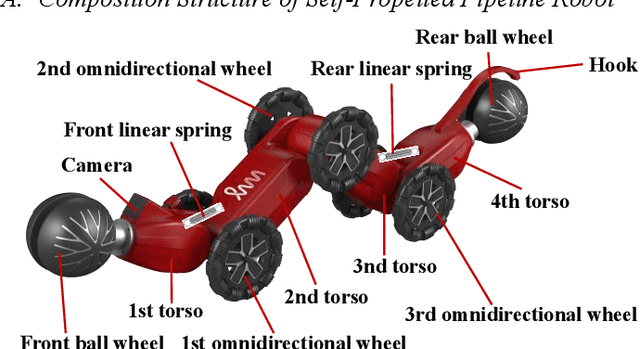
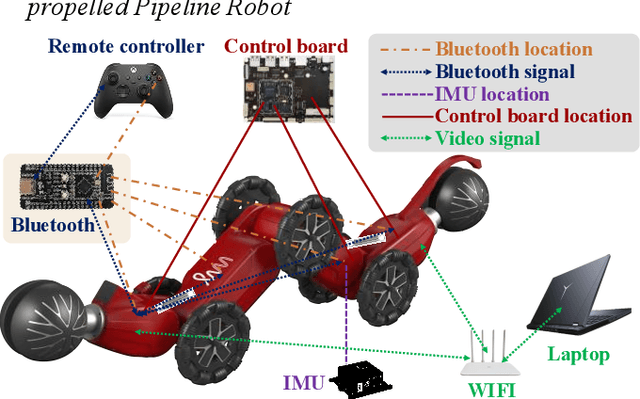
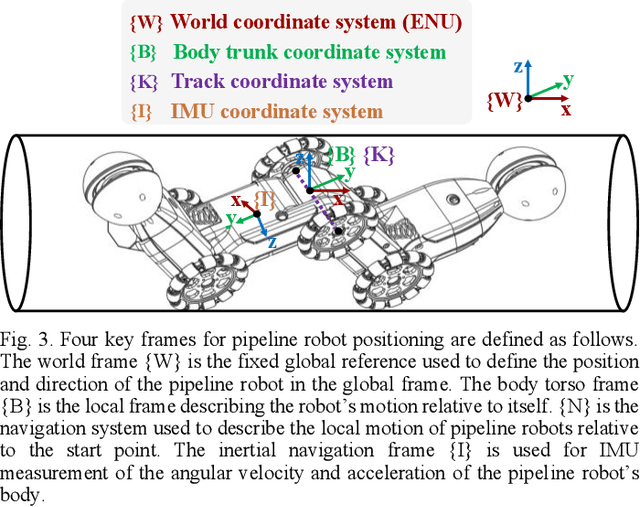
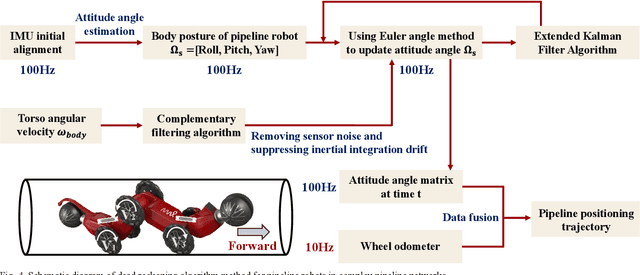
In the field of gas pipeline location, existing pipeline location methods mostly rely on pipeline location instruments. However, when faced with complex and curved pipeline scenarios, these methods often fail due to problems such as cable entanglement and insufficient equipment flexibility. To address this pain point, we designed a self-propelled pipeline robot. This robot can autonomously complete the location work of complex and curved pipelines in complex pipe networks without external dragging. In terms of pipeline mapping technology, traditional visual mapping and laser mapping methods are easily affected by lighting conditions and insufficient features in the confined space of pipelines, resulting in mapping drift and divergence problems. In contrast, the pipeline location method that integrates inertial navigation and wheel odometers is less affected by pipeline environmental factors. Based on this, this paper proposes a pipeline robot location method based on extended Kalman filtering (EKF). Firstly, the body attitude angle is initially obtained through an inertial measurement unit (IMU). Then, the extended Kalman filtering algorithm is used to improve the accuracy of attitude angle estimation. Finally, high-precision pipeline location is achieved by combining wheel odometers. During the testing phase, the roll wheels of the pipeline robot needed to fit tightly against the pipe wall to reduce slippage. However, excessive tightness would reduce the flexibility of motion control due to excessive friction. Therefore, a balance needed to be struck between the robot's motion capability and positioning accuracy. Experiments were conducted using the self-propelled pipeline robot in a rectangular loop pipeline, and the results verified the effectiveness of the proposed dead reckoning algorithm.
Design and Research of a Self-Propelled Pipeline Robot Based on Force Analysis and Dynamic Simulation
Dec 19, 2025In pipeline inspection, traditional tethered inspection robots are severely constrained by cable length and weight, which greatly limit their travel range and accessibility. To address these issues, this paper proposes a self-propelled pipeline robot design based on force analysis and dynamic simulation, with a specific focus on solving core challenges including vertical climbing failure and poor passability in T-branch pipes. Adopting a wheeled configuration and modular design, the robot prioritizes the core demand of body motion control. Specifically, 3D modeling of the robot was first completed using SolidWorks. Subsequently, the model was imported into ADAMS for dynamic simulation, which provided a basis for optimizing the drive module and motion control strategy.To verify the robot's dynamic performance, an experimental platform with acrylic pipes was constructed. Through adjusting its body posture to surmount obstacles and select directions, the robot has demonstrated its ability to stably traverse various complex pipeline scenarios. Notably, this work offers a technical feasibility reference for the application of pipeline robots in the inspection of medium and low-pressure urban gas pipelines.