 Add to Chrome
 Add to Firefox
 Add to Edge
OmniMech: All-in-one Multimodal Mechanical Benchmark for 3D Reconstruction
Aug 06, 2026
Recent vision-language models (VLMs) can generate executable CAD programs from images, but existing methods mainly target coarse, general-purpose 3D objects and rarely address the fine-grained geometry and millimeter-level tolerances required in industrial mechanical design. We introduce OmniMech, the first million-scale benchmark for evaluating VLMs on executable CAD generation from industrial manufacturing data. OmniMech contains more than 251,000 fully dimensioned and toleranced 2D orthographic drawings, paired with native CAD models, multi-view renderings, mesh, STEP and B-rep representations, and rich semantic annotations. The benchmark includes four tasks: (1) parametric CAD program synthesis from engineering drawings; (2) diagram-to-3D reasoning for geometrically and structurally consistent reconstruction; (3) annotation-grounded reasoning over dimensions, symbols, feature callouts, and manufacturing constraints; and (4) tool-augmented agentic reasoning using visualization, measurement, CAD execution, and verification tools. Experiments show that current VLMs and CAD-specialized models still struggle with executable program synthesis, fine-grained 3D reconstruction, and reliable enforcement of dimensions and tolerances. We will release the benchmark data, evaluation code, and tool interfaces to support future research.

OmniRouting: A Semantic-Coupled Multimodal Benchmark for Constraint-Aware Spatial Reasoning in PCB Routing
Aug 05, 2026Recent large language models (LLMs) have demonstrated remarkable progress in constraint-aware navigation, maze reasoning, and graph reasoning. However, their ability to reason about complex routing problems under strict geometric, topological, and electrical constraints remains largely unexplored, despite routing being one of the most challenging and critical stages of electronic design automation (EDA). To bridge this gap, we introduce OmniRouting, the first large-scale benchmark designed to evaluate LLMs on printed-circuit-board (PCB) routing reasoning under real-world industrial design-rule, manufacturability, and connectivity constraints. OmniRouting contains 1,681 industrial-grade schematic-coupled PCB designs, including board geometries, routable component placements by human engineers, footprints, pad locations, netlists, stackup information, and routing constraints. The benchmark comprises four tasks: (1) geometric routing reasoning, generating physically valid copper traces, vias, and layer assignments to connect circuit nets within constrained board regions; (2) design-rule-aware routing reasoning, producing routable layouts that satisfy clearance, trace-width, via, obstacle-avoidance, and board-boundary constraints; (3) electrical functionality reasoning, preserving schematic-specified connectivity while reasoning over net names and functional roles to produce electrically correct routing; and (4) tool-augmented agentic routing, leveraging external tools for tasks (1)-(3). Our results reveal substantial limitations of current LMMs in PCB routing, including weak path-planning capabilities, poor adherence to design-rule constraints, and inconsistent preservation of electrical functionality. We will open-source all benchmark data, evaluation code, and tool interfaces to facilitate future research.
AMA-GCN: Adaptive Multi-layer Aggregation Graph Convolutional Network for Disease Prediction
Jun 16, 2021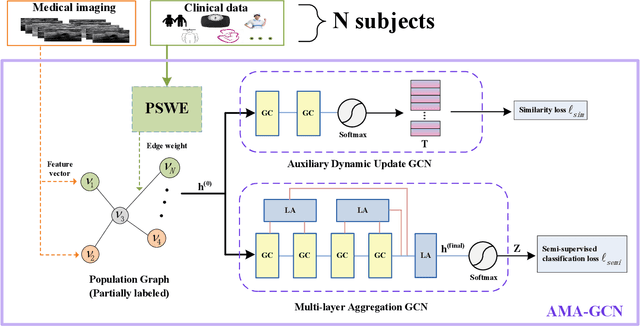
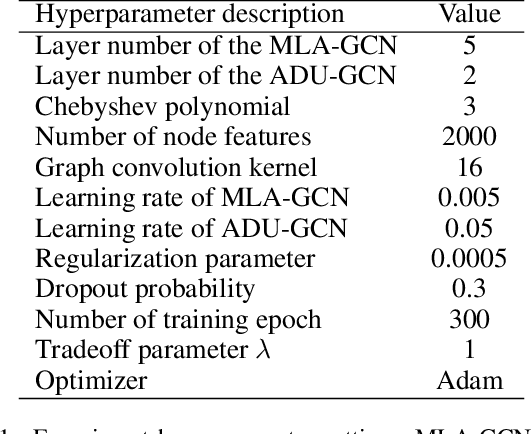
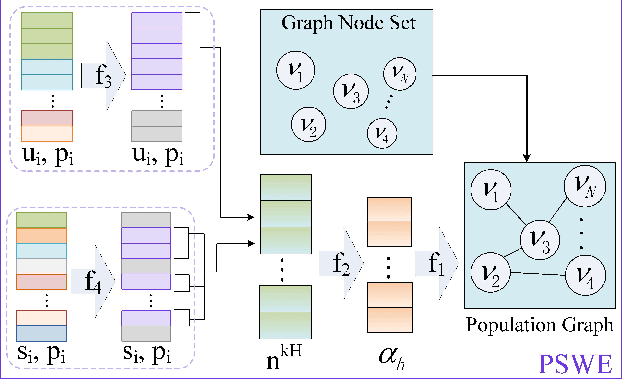
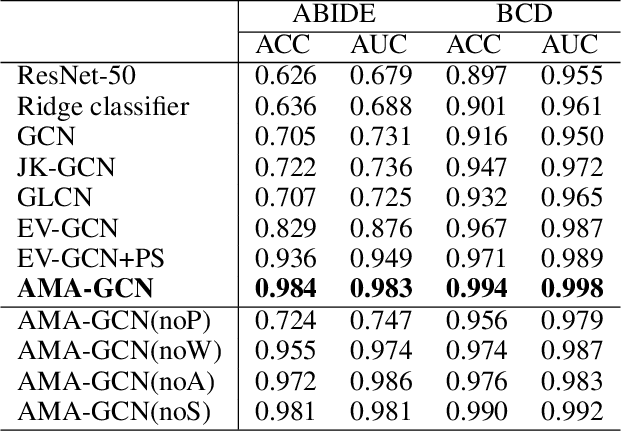
Recently, Graph Convolutional Networks (GCNs) have proven to be a powerful mean for Computer Aided Diagnosis (CADx). This approach requires building a population graph to aggregate structural information, where the graph adjacency matrix represents the relationship between nodes. Until now, this adjacency matrix is usually defined manually based on phenotypic information. In this paper, we propose an encoder that automatically selects the appropriate phenotypic measures according to their spatial distribution, and uses the text similarity awareness mechanism to calculate the edge weights between nodes. The encoder can automatically construct the population graph using phenotypic measures which have a positive impact on the final results, and further realizes the fusion of multimodal information. In addition, a novel graph convolution network architecture using multi-layer aggregation mechanism is proposed. The structure can obtain deep structure information while suppressing over-smooth, and increase the similarity between the same type of nodes. Experimental results on two databases show that our method can significantly improve the diagnostic accuracy for Autism spectrum disorder and breast cancer, indicating its universality in leveraging multimodal data for disease prediction.
Contraction Mapping of Feature Norms for Classifier Learning on the Data with Different Quality
Jul 28, 2020
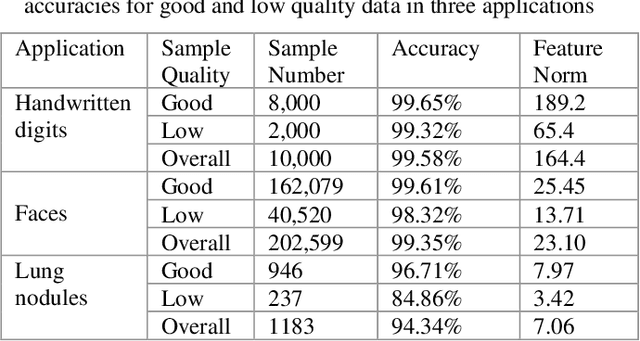
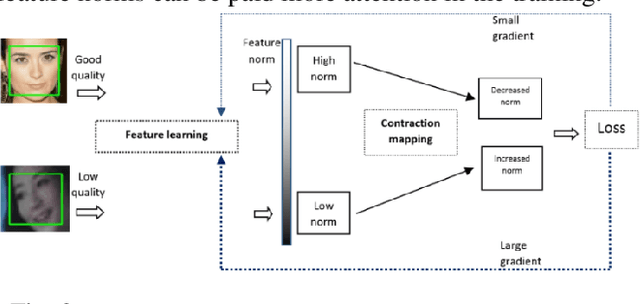
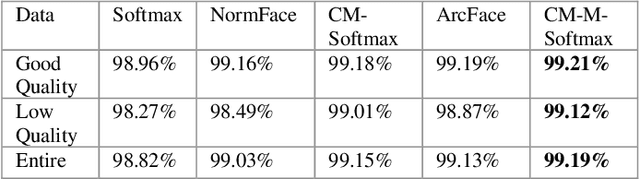
The popular softmax loss and its recent extensions have achieved great success in the deep learning-based image classification. However, the data for training image classifiers usually has different quality. Ignoring such problem, the correct classification of low quality data is hard to be solved. In this paper, we discover the positive correlation between the feature norm of an image and its quality through careful experiments on various applications and various deep neural networks. Based on this finding, we propose a contraction mapping function to compress the range of feature norms of training images according to their quality and embed this contraction mapping function into softmax loss or its extensions to produce novel learning objectives. The experiments on various classification applications, including handwritten digit recognition, lung nodule classification, face verification and face recognition, demonstrate that the proposed approach is promising to effectively deal with the problem of learning on the data with different quality and leads to the significant and stable improvements in the classification accuracy.