 Add to Chrome
 Add to Firefox
 Add to Edge
Are LLM-Generated GPU Kernels Production-Ready? A Trace-Driven Benchmark and Optimization Agent
Jul 16, 2026
Existing GPU kernel generation benchmarks draw problems from synthetic or curated sources that diverge from deployed workloads. We present Atrex-Bench, a benchmark whose 30 operators and 440 shapes are sampled directly from full-cluster production inference traces of compute-limited, memory-rich GPUs. Each problem carries an importance weight derived from its share of observed GPU time, weighted by application card-hours and computed separately for the serving phases in which it runs, together with a per-problem roofline ceiling, so the aggregate score emphasizes the kernels that consume the most serving time. Evaluating six frontier coding agents on Atrex-Bench shows that even the best vanilla model reaches only ${\sim}10\%$ of the hardware roofline on production operators; and correctness alone overstates capability, since much of the apparent pass rate comes from PyTorch fallbacks rather than kernels the model wrote. To close this gap, we co-release Atrex-Kernel-Agent (AKA), a profile-driven kernel-optimization agent that combines iterative measure-revise search, optimization dropout for escaping stalled search contexts, and a layered GPU-optimization knowledge base (298 reference-kernel files and 244 optimization-knowledge documents, plus external upstream reference projects for API/ISA lookup). In a controlled case study, the agent converts zero-FlyDSL fallbacks into real kernels that match or exceed hand-tuned production baselines.

Sequence to Point Learning Based on Bidirectional Dilated Residual Network for Non Intrusive Load Monitoring
May 30, 2020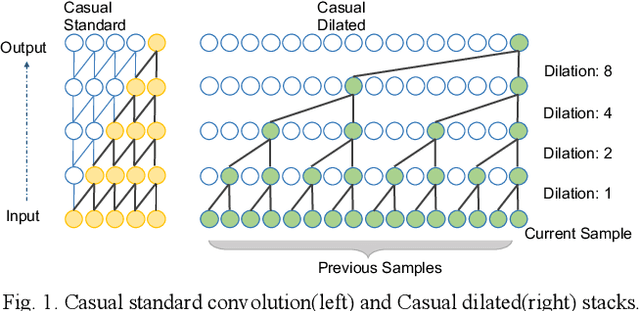
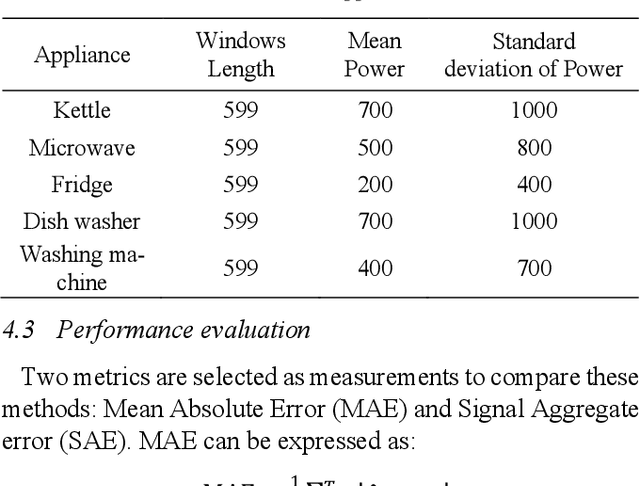
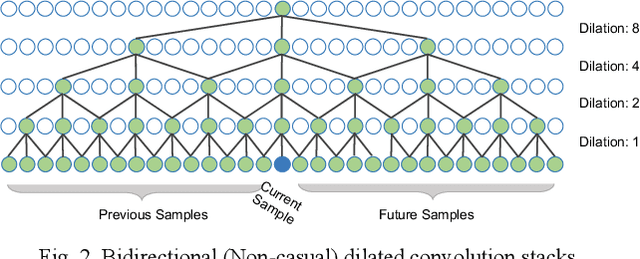
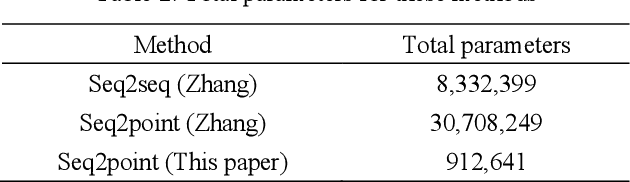
Non Intrusive Load Monitoring (NILM) or Energy Disaggregation (ED), seeks to save energy by decomposing corresponding appliances power reading from an aggregate power reading of the whole house. It is a single channel blind source separation problem (SCBSS) and difficult prediction problem because it is unidentifiable. Recent research shows that deep learning has become a growing popularity for NILM problem. The ability of neural networks to extract load features is closely related to its depth. However, deep neural network is difficult to train because of exploding gradient, vanishing gradient and network degradation. To solve these problems, we propose a sequence to point learning framework based on bidirectional (non-casual) dilated convolution for NILM. To be more convincing, we compare our method with the state of art method, Seq2point (Zhang) directly and compare with existing algorithms indirectly via two same datasets and metrics. Experiments based on REDD and UK-DALE data sets show that our proposed approach is far superior to existing approaches in all appliances.
Low-Dose CT via Deep CNN with Skip Connection and Network in Network
Nov 26, 2018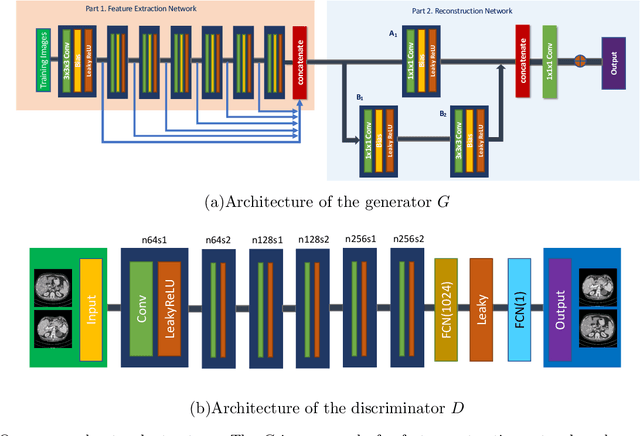
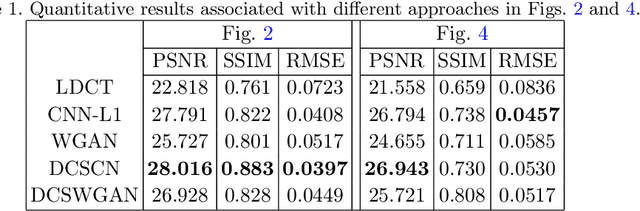
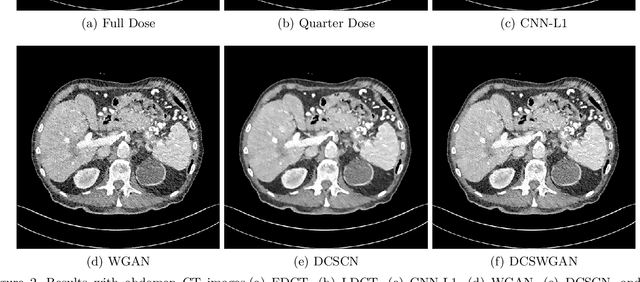
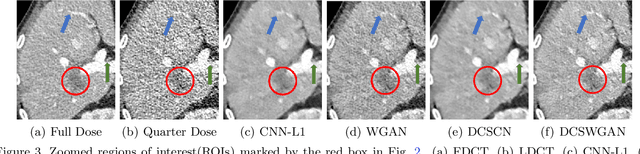
A major challenge in computed tomography (CT) is how to minimize patient radiation exposure without compromising image quality and diagnostic performance. The use of deep convolutional (Conv) neural networks for noise reduction in Low-Dose CT (LDCT) images has recently shown a great potential in this important application. In this paper, we present a highly efficient and effective neural network model for LDCT image noise reduction. Specifically, to capture local anatomical features we integrate Deep Convolutional Neural Networks (CNNs) and Skip connection layers for feature extraction. Also, we introduce parallelized $1\times 1$ CNN, called Network in Network, to lower the dimensionality of the output from the previous layer, achieving faster computational speed at less feature loss. To optimize the performance of the network, we adopt a Wasserstein generative adversarial network (WGAN) framework. Quantitative and qualitative comparisons demonstrate that our proposed network model can produce images with lower noise and more structural details than state-of-the-art noise-reduction methods.