 Add to Chrome
 Add to Firefox
 Add to Edge
Evaluating the Effect of Linguistic Relatedness on Cross-Lingual Transfer in Large Multilingual Automatic Speech Recognition
Jul 06, 2026
Extending automatic speech recognition (ASR) to low-resource African languages is constrained by the prohibitive demands of data collection at scale. A promising direction is to leverage linguistic relatedness to enhance cross-lingual transfer from a related auxiliary language to the low-resource target by sequentially adapting on both. Although this strategy has shown meaningful improvements in small ASR models, its effectiveness in large ASR remains unclear. We extend this framework to large multilingual ASR through a systematic controlled experimental design spanning six factors, two Africa-centric corpora, and four large ASR models, isolating whether linguistic relatedness reliably predicts cross-lingual transfer gains in this setting. Across all conditions, pre-adaptation on related auxiliary languages yields no practically meaningful transfer improvements given minimal target-language data, suggesting that linguistic relatedness alone may not reliably predict cross-lingual transfer gains in large multilingual ASR, or constitute an effective strategy for extending such models to low-resource languages.

BRIGHTER: BRIdging the Gap in Human-Annotated Textual Emotion Recognition Datasets for 28 Languages
Feb 17, 2025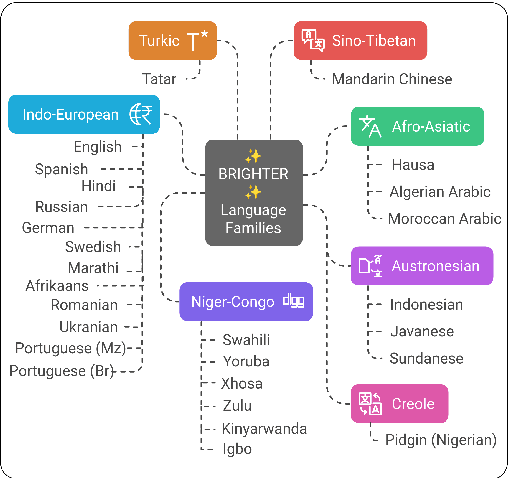
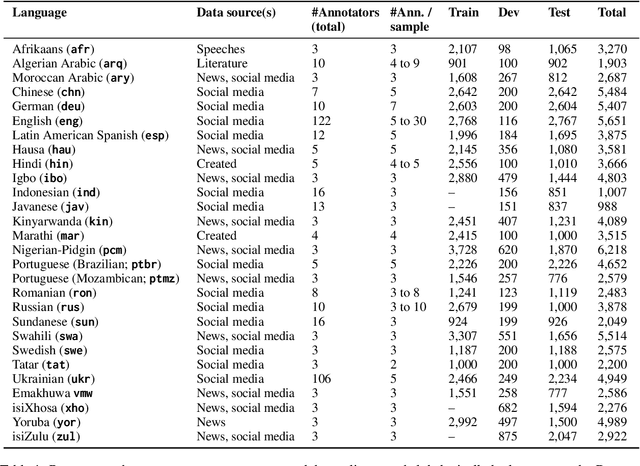
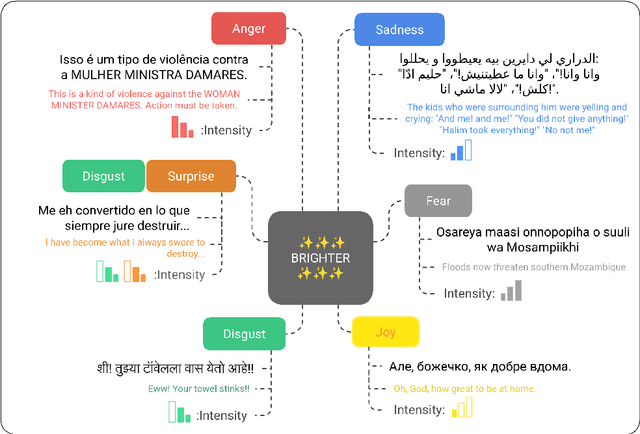
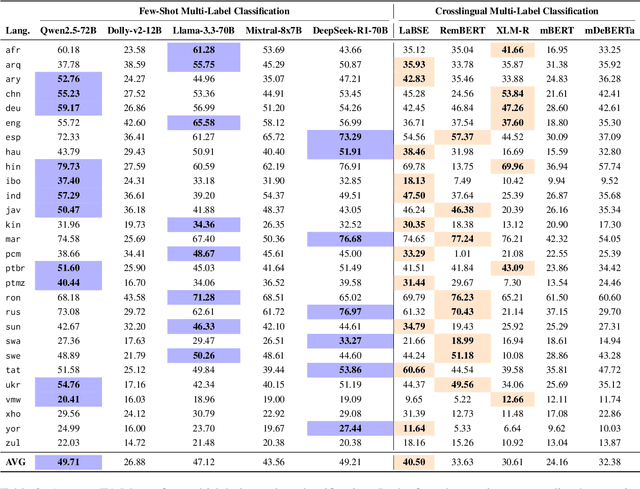
People worldwide use language in subtle and complex ways to express emotions. While emotion recognition -- an umbrella term for several NLP tasks -- significantly impacts different applications in NLP and other fields, most work in the area is focused on high-resource languages. Therefore, this has led to major disparities in research and proposed solutions, especially for low-resource languages that suffer from the lack of high-quality datasets. In this paper, we present BRIGHTER-- a collection of multilabeled emotion-annotated datasets in 28 different languages. BRIGHTER covers predominantly low-resource languages from Africa, Asia, Eastern Europe, and Latin America, with instances from various domains annotated by fluent speakers. We describe the data collection and annotation processes and the challenges of building these datasets. Then, we report different experimental results for monolingual and crosslingual multi-label emotion identification, as well as intensity-level emotion recognition. We investigate results with and without using LLMs and analyse the large variability in performance across languages and text domains. We show that BRIGHTER datasets are a step towards bridging the gap in text-based emotion recognition and discuss their impact and utility.