 Add to Chrome
 Add to Firefox
 Add to Edge
ReMiX-MAE: Learning Missing-Channel Cross-Modal Representations from RGB-Only Clinical Facial Videos for Sympathetic-Mediated Pain Assessment
Aug 03, 2026
Automated pain assessment in real clinics is limited by scarce clinically grounded facial video data with weak labels (often sequence-level self-report) and by the fact that pain cues can be subtle or near-neutral in RGB, while thermal and depth signals are informative yet impractical to deploy routinely. To address these challenges, we propose ReMiX-MAE (Reconstructing Missing Channel Cross-Modal Masked Autoencoder), a self-supervised multimodal masked pretraining framework that learns transferable facial representations from synchronized RGB, thermal, and depth videos and explicitly trains robustness to missing modalities, enabling RGB-only deployment. To fill the gap of clinically grounded facial pain data with video-level self-report and longitudinal treatment trajectories, we collect the Sympathetic Mediated Pain (SMP) dataset with paired pre- and post-recordings across multiple visits. Under RGB-only deployment, we evaluate ReMiX-MAE using both direct feature extraction and pseudo-multimodal features decoded from RGB. ReMiX-MAE consistently outperforms an RGB-only masked autoencoder baseline on SMP, with pseudo-multimodal features providing additional gains in the challenging five-class setting. Across external datasets, ReMiX-MAE further shows more robust and label-efficient transfer than RGB-only baselines, highlighting its advantage in data-limited clinical settings.

Toward High-Fidelity 3D Point-Cloud Learning for Brain Folding Morphology Prediction Using Trans-Unet
Jul 23, 2026Learning high-fidelity point-cloud features in the 3D space poses significant challenges, including permutation invariance, lack of local context, difficulty in fine-grained surface reconstruction, and high computational cost. In this article, we propose Trans-Unet, a novel framework that addresses these issues by first tansforming 3D point-cloud data into a 2D grid domain and then employing a U-shaped hybrid model that integrates Convolutional Neural Networks, and self-attention mechanisms. The proposed Trans-Unet effectively learns and reconstructs precise features from high-resolution 3D point-cloud data (with 40,401 points in surface and 2,382 points in fiber) derived from a predefined finite element brain patch growth model, enabling accurate prediction of brain folding patterns. By combining multiple techniques, Trans-Unet leverages the complementary strengths: the 3D-to-2D transformation preserves fine-grained structural information while significantly reducing computational cost and the curse of dimensionality; convolutional blocks capture hierarchical, low-level local representations; and the self-attention mechanism models global, high-level semantics and long-range dependencies. The dataset consists of 3D point-clouds containing both brain surface patches and fiber information generated by a large-scale finite element model. Trans-Unet is applied to predict brain surface folding from the initial state (state 0 or states 0-2) to the final state (state 3). Experimental results demonstrate that Trans-Unet achieves high-resolution predictions of brain patch growth, surpassing existing methods in both fidelity and accuracy.
MindAU: EEG-Conditioned Facial Action Unit Editing via Dual-Stream Manifold Alignment
Jul 01, 2026Recent brain decoding studies have made substantial progress in reconstructing externally perceived visual content from neural signals. However, using electroencephalography (EEG) recordings to guide facial expression editing remains largely unexplored and poses a distinct challenge: rather than recovering what a subject sees, it requires identifying facial-action related patterns from noisy EEG signals and grounding them in localized, identity-preserving expression edits. In this paper, we investigate EEG-conditioned facial image editing for fine-grained facial action unit (AU) control and propose MindAU, a unified framework for controlling facial AU edits from EEG signals. MindAU first learns noise-robust and AU-discriminative EEG representations through temporal masked reconstruction and AU classification supervision. It then bridges the modality gap via Dual-Stream Manifold Alignment, aligning EEG features with AU-level text semantics and identity-reduced visual displacement trajectories in the multimodal space of Qwen2.5-VL. Finally, MindAU incorporates EEG-aware Multimodal Rotary Positional Embeddings, landmark-guided reference masking, and AU-aware region supervision into a multimodal diffusion-based editor for high-fidelity identity-preserving editing. We also introduce E-CAFE, a curated benchmark for EEG-Conditioned Action-Unit Facial Editing with paired EEG-face editing samples and standardized evaluation protocols. Extensive experiments demonstrate the effectiveness of MindAU and suggest its potential as a step towards future assistive expression technologies for individuals with facial neuromuscular disorders.
PRISM: Prioritized Channel Importance with Semi-supervised Domain Adaptation for Cross-Subject EEG Emotion Recognition
Jul 01, 2026Electroencephalogram (EEG) captures endogenous brain activity with high temporal fidelity and holds substantial promise for precise emotion decoding. However, channel redundancy and pronounced inter-subject variability remain key obstacles to scalable generalization. To address these limitations, we propose a novel framework termed PRioritized channel Importance with Semi-supervised doMain adaptation (PRISM), enabling label-efficient cross-subject emotion decoding. On the channel side, PRISM assigns differentiable, data-dependent channel weights via a lightweight expert ensemble, amplifying reliable electrodes while suppressing distractors. On the domain side, PRISM leverages unlabeled data through confidence-filtered pseudo-labels to drive consistency regularization and domain alignment, mitigating subject-specific heterogeneity. Extensive experiments show that PRISM surpasses state-of-the-art methods on DEAP, DREAMER, and SEED datasets, achieving robust cross-subject generalization given limited annotations.
Inter-Stance: A Dyadic Multimodal Corpus for Conversational Stance Analysis
Apr 24, 2026Social interactions dominate our perceptions of the world and shape our daily behavior by attaching social meaning to acts as simple and spontaneous as gestures, facial expressions, voice, and speech. People mimic and otherwise respond to each other's postures, facial expressions, mannerisms, and other verbal and nonverbal behavior, and form appraisals or evaluations in the process. Yet, no publicly-available dataset includes multimodal recordings and self-report measures of multiple persons in social interaction. Dyadic recordings and annotation are lacking. We present a new data corpus of multimodal dyadic interaction (45 dyads, 90 persons) that includes synchronized multi-modality behavior (2D face video, 3D face geometry, thermal spectrum dynamics, voice and speech behavior, physiology (PPG, EDA, heart-rate, blood pressure, and respiration), and self-reported affect of all participants in a communicative interaction scenario. Two types of dyads are included: persons with shared past history and strangers. Annotations include social signals, agreement, disagreement, and neutral stance. With a potent emotion induction, these multimodal data will enable novel modeling of multimodal interpersonal behavior. We present extensive experiments to evaluate multimodal dyadic communication of dyads with and without interpersonal history, and their affect. This new database will make multimodal modeling of social interaction never possible before. The dataset includes 20TB of multimodal data to share with the research community.
You Only Need One Stage: Novel-View Synthesis From A Single Blind Face Image
Mar 01, 2026We propose a novel one-stage method, NVB-Face, for generating consistent Novel-View images directly from a single Blind Face image. Existing approaches to novel-view synthesis for objects or faces typically require a high-resolution RGB image as input. When dealing with degraded images, the conventional pipeline follows a two-stage process: first restoring the image to high resolution, then synthesizing novel views from the restored result. However, this approach is highly dependent on the quality of the restored image, often leading to inaccuracies and inconsistencies in the final output. To address this limitation, we extract single-view features directly from the blind face image and introduce a feature manipulator that transforms these features into 3D-aware, multi-view latent representations. Leveraging the powerful generative capacity of a diffusion model, our framework synthesizes high-quality, consistent novel-view face images. Experimental results show that our method significantly outperforms traditional two-stage approaches in both consistency and fidelity.
Weakly-Supervised Text-driven Contrastive Learning for Facial Behavior Understanding
Mar 31, 2023Contrastive learning has shown promising potential for learning robust representations by utilizing unlabeled data. However, constructing effective positive-negative pairs for contrastive learning on facial behavior datasets remains challenging. This is because such pairs inevitably encode the subject-ID information, and the randomly constructed pairs may push similar facial images away due to the limited number of subjects in facial behavior datasets. To address this issue, we propose to utilize activity descriptions, coarse-grained information provided in some datasets, which can provide high-level semantic information about the image sequences but is often neglected in previous studies. More specifically, we introduce a two-stage Contrastive Learning with Text-Embeded framework for Facial behavior understanding (CLEF). The first stage is a weakly-supervised contrastive learning method that learns representations from positive-negative pairs constructed using coarse-grained activity information. The second stage aims to train the recognition of facial expressions or facial action units by maximizing the similarity between image and the corresponding text label names. The proposed CLEF achieves state-of-the-art performance on three in-the-lab datasets for AU recognition and three in-the-wild datasets for facial expression recognition.
A Transformer-based Deep Learning Algorithm to Auto-record Undocumented Clinical One-Lung Ventilation Events
Feb 16, 2023As a team studying the predictors of complications after lung surgery, we have encountered high missingness of data on one-lung ventilation (OLV) start and end times due to high clinical workload and cognitive overload during surgery. Such missing data limit the precision and clinical applicability of our findings. We hypothesized that available intraoperative mechanical ventilation and physiological time-series data combined with other clinical events could be used to accurately predict missing start and end times of OLV. Such a predictive model can recover existing miss-documented records and relieves the documentation burden by deploying it in clinical settings. To this end, we develop a deep learning model to predict the occurrence and timing of OLV based on routinely collected intraoperative data. Our approach combines the variables' spatial and frequency domain features, using Transformer encoders to model the temporal evolution and convolutional neural network to abstract frequency-of-interest from wavelet spectrum images. The performance of the proposed method is evaluated on a benchmark dataset curated from Massachusetts General Hospital (MGH) and Brigham and Women's Hospital (BWH). Experiments show our approach outperforms baseline methods significantly and produces a satisfactory accuracy for clinical use.
Multimodal Learning with Channel-Mixing and Masked Autoencoder on Facial Action Unit Detection
Sep 25, 2022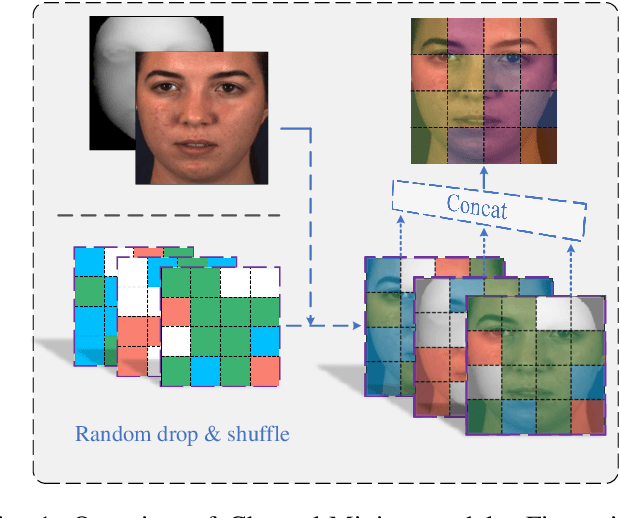
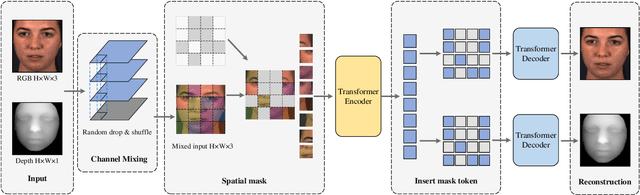
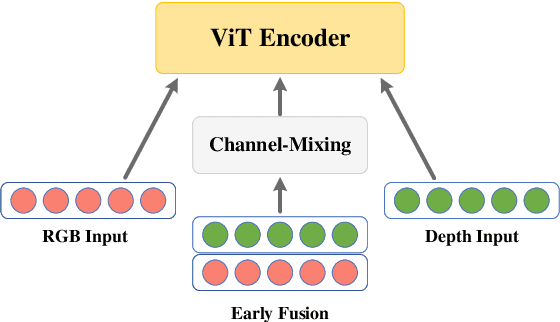
Recent studies utilizing multi-modal data aimed at building a robust model for facial Action Unit (AU) detection. However, due to the heterogeneity of multi-modal data, multi-modal representation learning becomes one of the main challenges. On one hand, it is difficult to extract the relevant features from multi-modalities by only one feature extractor, on the other hand, previous studies have not fully explored the potential of multi-modal fusion strategies. For example, early fusion usually required all modalities to be present during inference, while late fusion and middle fusion increased the network size for feature learning. In contrast to a large amount of work on late fusion, there are few works on early fusion to explore the channel information. This paper presents a novel multi-modal network called Multi-modal Channel-Mixing (MCM), as a pre-trained model to learn a robust representation in order to facilitate the multi-modal fusion. We evaluate the learned representation on a downstream task of automatic facial action units detection. Specifically, it is a single stream encoder network that uses a channel-mixing module in early fusion, requiring only one modality in the downstream detection task. We also utilize the masked ViT encoder to learn features from the fusion image and reconstruct back two modalities with two ViT decoders. We have conducted extensive experiments on two public datasets, known as BP4D and DISFA, to evaluate the effectiveness and robustness of the proposed multimodal framework. The results show our approach is comparable or superior to the state-of-the-art baseline methods.
Knowledge-Spreader: Learning Facial Action Unit Dynamics with Extremely Limited Labels
Mar 30, 2022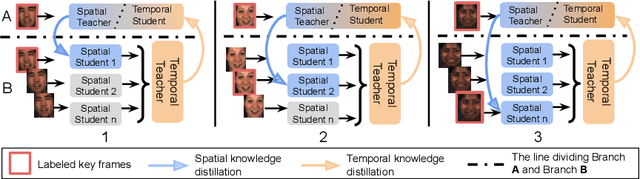
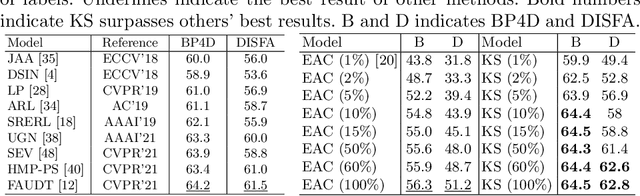
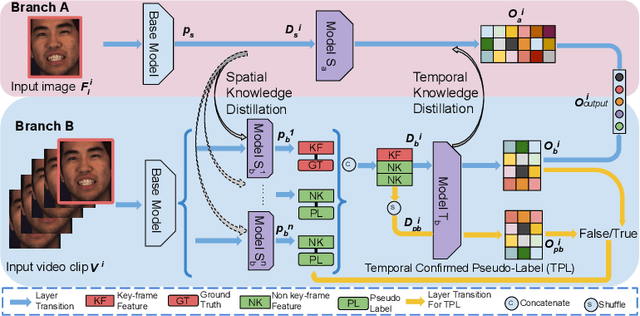
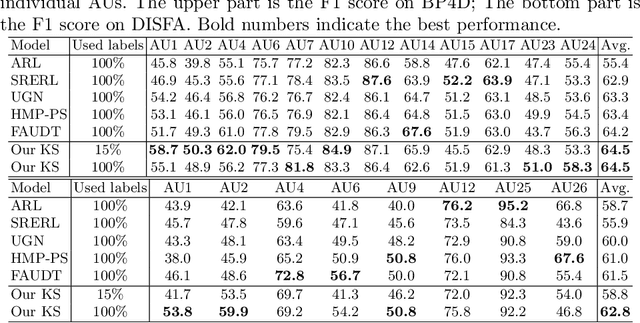
Recent studies on the automatic detection of facial action unit (AU) have extensively relied on large-sized annotations. However, manually AU labeling is difficult, time-consuming, and costly. Most existing semi-supervised works ignore the informative cues from the temporal domain, and are highly dependent on densely annotated videos, making the learning process less efficient. To alleviate these problems, we propose a deep semi-supervised framework Knowledge-Spreader (KS), which differs from conventional methods in two aspects. First, rather than only encoding human knowledge as constraints, KS also learns the Spatial-Temporal AU correlation knowledge in order to strengthen its out-of-distribution generalization ability. Second, we approach KS by applying consistency regularization and pseudo-labeling in multiple student networks alternately and dynamically. It spreads the spatial knowledge from labeled frames to unlabeled data, and completes the temporal information of partially labeled video clips. Thus, the design allows KS to learn AU dynamics from video clips with only one label allocated, which significantly reduce the requirements of using annotations. Extensive experiments demonstrate that the proposed KS achieves competitive performance as compared to the state of the arts under the circumstances of using only 2% labels on BP4D and 5% labels on DISFA. In addition, we test it on our newly developed large-scale comprehensive emotion database, which contains considerable samples across well-synchronized and aligned sensor modalities for easing the scarcity issue of annotations and identities in human affective computing. The new database will be released to the research community.