 Add to Chrome
 Add to Firefox
 Add to Edge
Interpretable AI predicts a 2026 summer dry anomaly in central China
Aug 19, 2026
Seasonal precipitation anomalies are largely regulated by atmospheric circulation, which dynamical models predict with greater reliability than precipitation itself. Here, we employ a deep learning model that translates dynamical circulation predictions into precipitation estimates. Predictions initialized from March to May consistently indicate a dry anomaly over central China in summer 2026. Retrospective evaluations revealed higher predictive skill in the analogue years, which also tended to feature central equatorial Pacific warming persisting from the preceding winter into summer. This warming favors an anomalous cyclonic circulation over the western North Pacific-South China Sea-South China region, which induces northerly winds and moisture divergence that jointly suppress rainfall over central China. Supporting this mechanism, layer-wise relevance propagation (LRP) independently identifies these northerly winds as the dominant driver of the prediction among all model inputs. Perturbation tests supported this attribution: removing LRP-identified features effectively eliminates the dry anomaly. Our framework thus provides physically interpretable explanations for AI-derived regional climate projections, facilitating evidence-based assessment before observational data become available.

Toward the Understanding of Deep Text Matching Models for Information Retrieval
Aug 16, 2021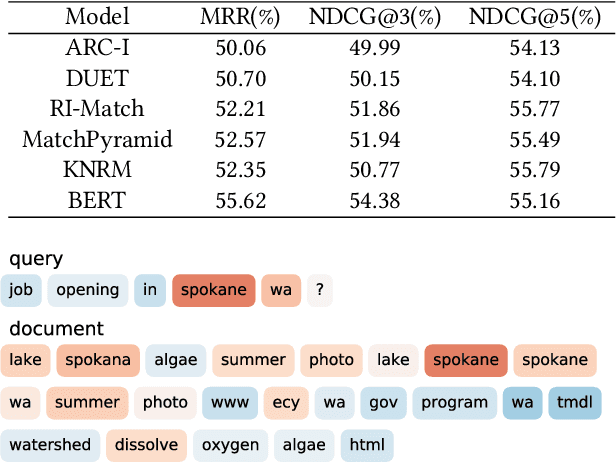
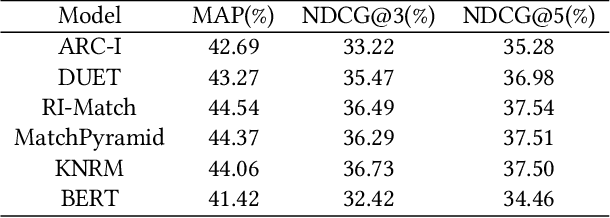
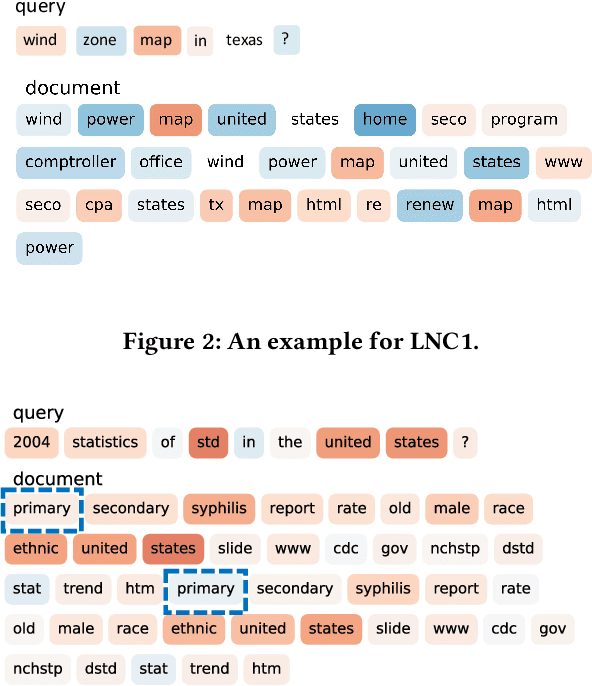
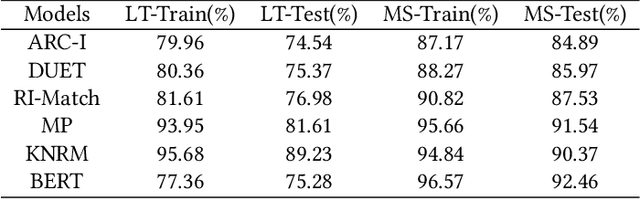
Semantic text matching is a critical problem in information retrieval. Recently, deep learning techniques have been widely used in this area and obtained significant performance improvements. However, most models are black boxes and it is hard to understand what happened in the matching process, due to the poor interpretability of deep learning. This paper aims at tackling this problem. The key idea is to test whether existing deep text matching methods satisfy some fundamental heuristics in information retrieval. Specifically, four heuristics are used in our study, i.e., term frequency constraint, term discrimination constraint, length normalization constraints, and TF-length constraint. Since deep matching models usually contain many parameters, it is difficult to conduct a theoretical study for these complicated functions. In this paper, We propose an empirical testing method. Specifically, We first construct some queries and documents to make them satisfy the assumption in a constraint, and then test to which extend a deep text matching model trained on the original dataset satisfies the corresponding constraint. Besides, a famous attribution based interpretation method, namely integrated gradient, is adopted to conduct detailed analysis and guide for feasible improvement. Experimental results on LETOR 4.0 and MS Marco show that all the investigated deep text matching methods, both representation and interaction based methods, satisfy the above constraints with high probabilities in statistics. We further extend these constraints to the semantic settings, which are shown to be better satisfied for all the deep text matching models. These empirical findings give clear understandings on why deep text matching models usually perform well in information retrieval. We believe the proposed evaluation methodology will be useful for testing future deep text matching models.