 Add to Chrome
 Add to Firefox
 Add to Edge
Interpretable AI predicts a 2026 summer dry anomaly in central China
Aug 19, 2026
Seasonal precipitation anomalies are largely regulated by atmospheric circulation, which dynamical models predict with greater reliability than precipitation itself. Here, we employ a deep learning model that translates dynamical circulation predictions into precipitation estimates. Predictions initialized from March to May consistently indicate a dry anomaly over central China in summer 2026. Retrospective evaluations revealed higher predictive skill in the analogue years, which also tended to feature central equatorial Pacific warming persisting from the preceding winter into summer. This warming favors an anomalous cyclonic circulation over the western North Pacific-South China Sea-South China region, which induces northerly winds and moisture divergence that jointly suppress rainfall over central China. Supporting this mechanism, layer-wise relevance propagation (LRP) independently identifies these northerly winds as the dominant driver of the prediction among all model inputs. Perturbation tests supported this attribution: removing LRP-identified features effectively eliminates the dry anomaly. Our framework thus provides physically interpretable explanations for AI-derived regional climate projections, facilitating evidence-based assessment before observational data become available.

Self-supervised Heterogeneous Graph Pre-training Based on Structural Clustering
Oct 19, 2022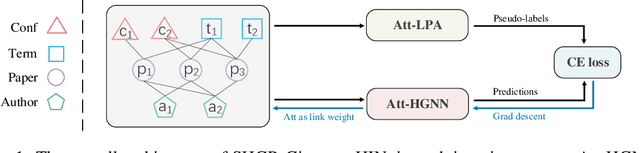
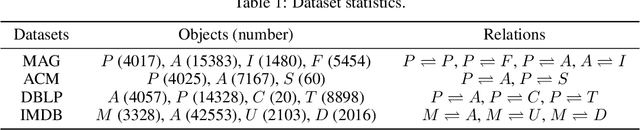
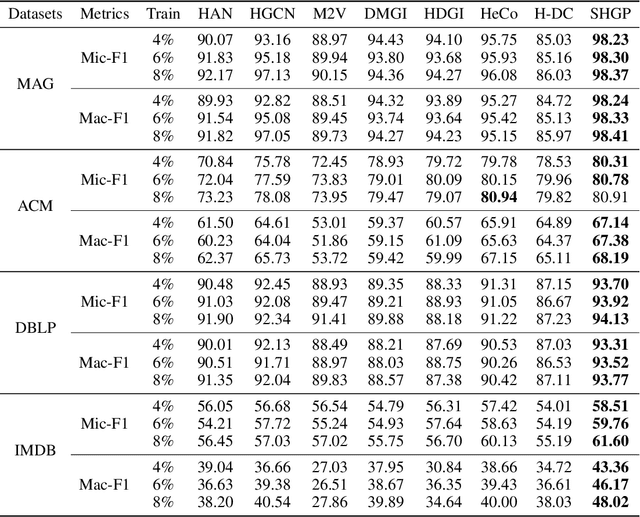
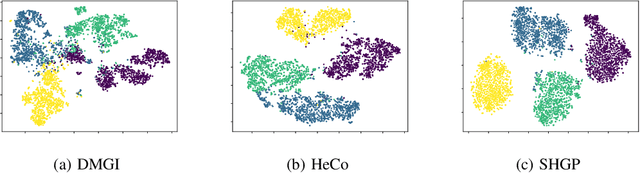
Recent self-supervised pre-training methods on Heterogeneous Information Networks (HINs) have shown promising competitiveness over traditional semi-supervised Heterogeneous Graph Neural Networks (HGNNs). Unfortunately, their performance heavily depends on careful customization of various strategies for generating high-quality positive examples and negative examples, which notably limits their flexibility and generalization ability. In this work, we present SHGP, a novel Self-supervised Heterogeneous Graph Pre-training approach, which does not need to generate any positive examples or negative examples. It consists of two modules that share the same attention-aggregation scheme. In each iteration, the Att-LPA module produces pseudo-labels through structural clustering, which serve as the self-supervision signals to guide the Att-HGNN module to learn object embeddings and attention coefficients. The two modules can effectively utilize and enhance each other, promoting the model to learn discriminative embeddings. Extensive experiments on four real-world datasets demonstrate the superior effectiveness of SHGP against state-of-the-art unsupervised baselines and even semi-supervised baselines. We release our source code at: https://github.com/kepsail/SHGP.
Random Ensemble Reinforcement Learning for Traffic Signal Control
Mar 10, 2022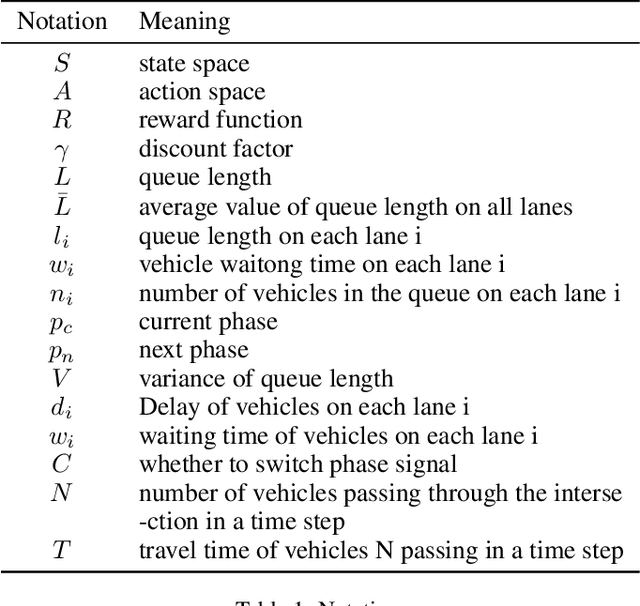
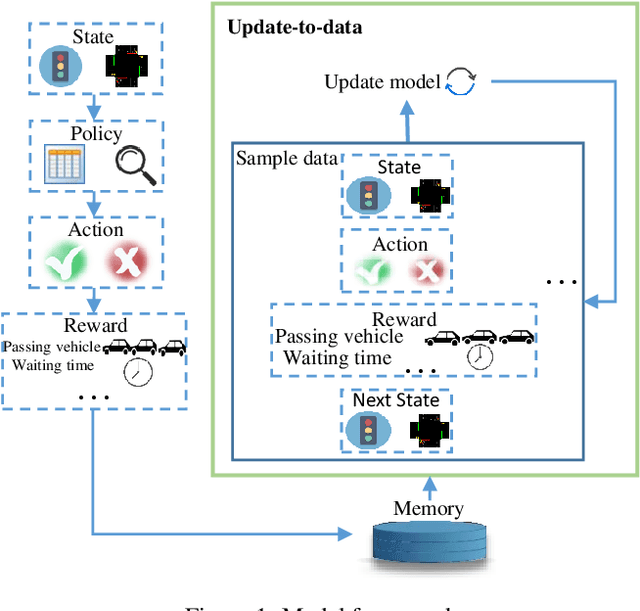
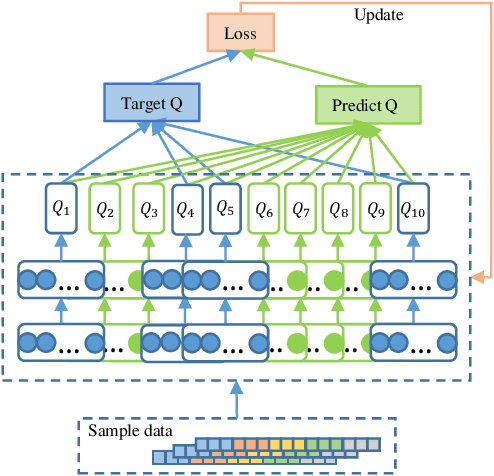
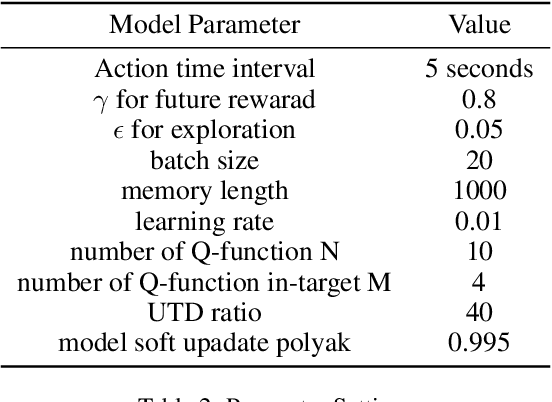
Traffic signal control is a significant part of the construction of intelligent transportation. An efficient traffic signal control strategy can reduce traffic congestion, improve urban road traffic efficiency and facilitate people's lives. Existing reinforcement learning approaches for traffic signal control mainly focus on learning through a separate neural network. Such an independent neural network may fall into the local optimum of the training results. Worse more, the collected data can only be sampled once, so the data utilization rate is low. Therefore, we propose the Random Ensemble Double DQN Light (RELight) model. It can dynamically learn traffic signal control strategies through reinforcement learning and combine random ensemble learning to avoid falling into the local optimum to reach the optimal strategy. Moreover, we introduce the Update-To-Data (UTD) ratio to control the number of data reuses to improve the problem of low data utilization. In addition, we have conducted sufficient experiments on synthetic data and real-world data to prove that our proposed method can achieve better traffic signal control effects than the existing optimal methods.
Multi-View Dynamic Heterogeneous Information Network Embedding
Nov 12, 2020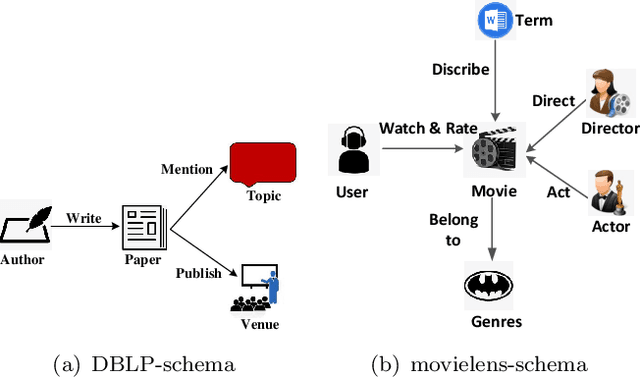
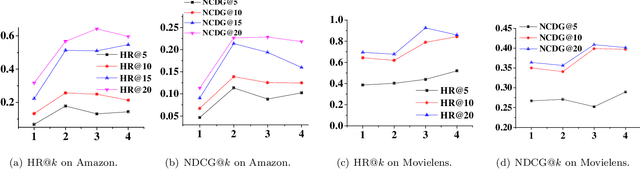
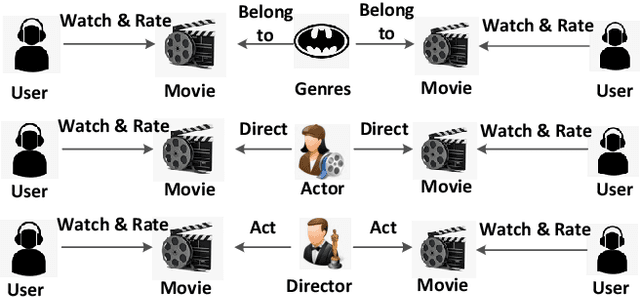
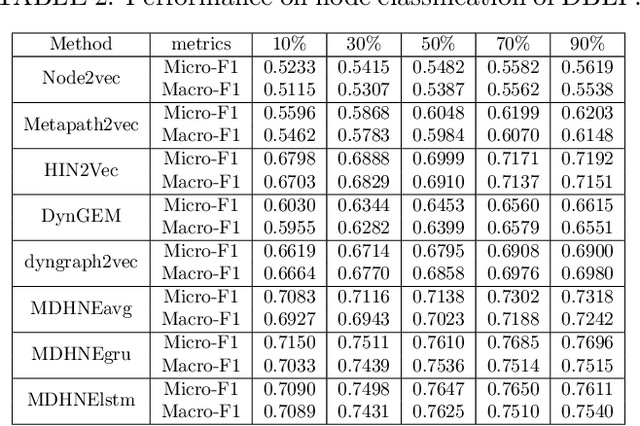
Most existing Heterogeneous Information Network (HIN) embedding methods focus on static environments while neglecting the evolving characteristic of realworld networks. Although several dynamic embedding methods have been proposed, they are merely designed for homogeneous networks and cannot be directly applied in heterogeneous environment. To tackle above challenges, we propose a novel framework for incorporating temporal information into HIN embedding, denoted as Multi-View Dynamic HIN Embedding (MDHNE), which can efficiently preserve evolution patterns of implicit relationships from different views in updating node representations over time. We first transform HIN to a series of homogeneous networks corresponding to different views. Then our proposed MDHNE applies Recurrent Neural Network (RNN) to incorporate evolving pattern of complex network structure and semantic relationships between nodes into latent embedding spaces, and thus the node representations from multiple views can be learned and updated when HIN evolves over time. Moreover, we come up with an attention based fusion mechanism, which can automatically infer weights of latent representations corresponding to different views by minimizing the objective function specific for different mining tasks. Extensive experiments clearly demonstrate that our MDHNE model outperforms state-of-the-art baselines on three real-world dynamic datasets for different network mining tasks.