 Add to Chrome
 Add to Firefox
 Add to Edge
HeadCast: Casting Attention Heads for Efficient Autoregressive Video Generation
Jul 22, 2026
Autoregressive (AR) video diffusion models have become a promising paradigm for long and streaming video synthesis, but the continuously growing Key-Value (KV) cache makes attention the dominant inference cost, especially at high resolution where each frame contributes many tokens. Existing remedies either evict the cache with coarse heuristics that cause inter-frame flickering, or require model re-training. We propose HeadCast, a training-free, plug-and-play acceleration framework built on the observation that a pre-trained AR model's attention heads exhibit stable, heterogeneous behaviors. After a short warm-up, HeadCast performs a one-time classification at the maximum-noise step that sorts every head into one of four archetypes: Sink, Dummy, Spatial, and Global, and restructures the monolithic KV cache into head-specific pathways. Crucially, it retains the Global heads that preserve the long-range temporal consistency aggressive eviction destroys. Because the Spatial pathway operates on a fixed-size grid, its savings grow with resolution: across state-of-the-art AR models, HeadCast accelerates inference by up to 1.62x at 720P and 1.95x at 1080P, while keeping VBench quality on par with full attention and largely flicker-free. Code is available at https://github.com/sjlgaga/HeadCast .

Kling-Omni Technical Report
Dec 18, 2025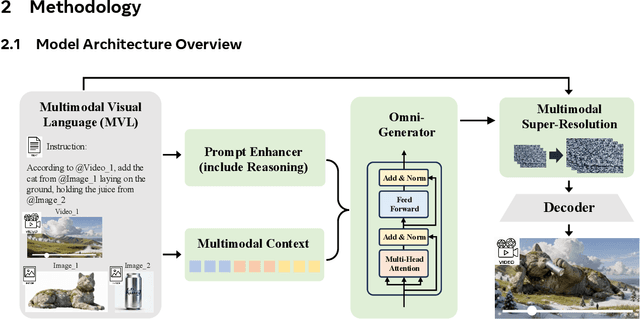
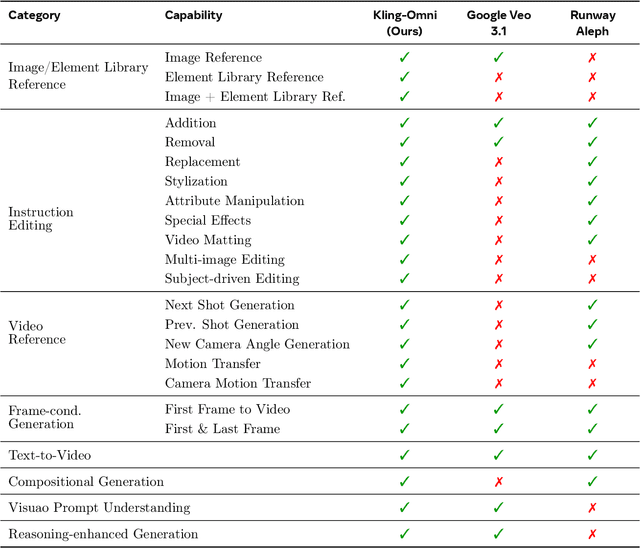
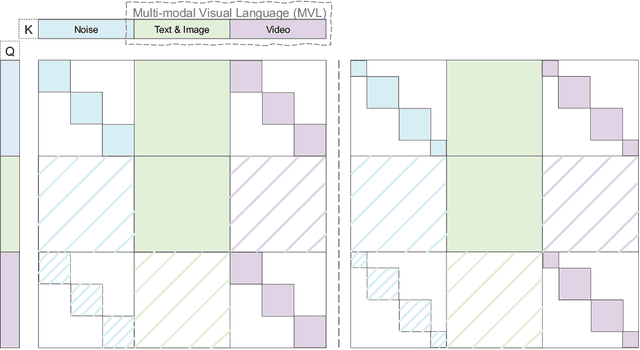
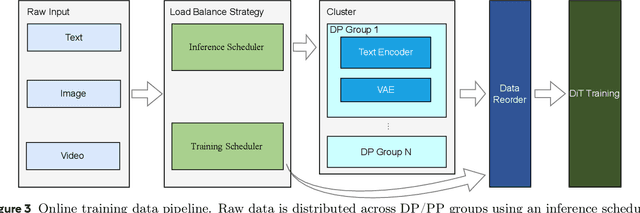
We present Kling-Omni, a generalist generative framework designed to synthesize high-fidelity videos directly from multimodal visual language inputs. Adopting an end-to-end perspective, Kling-Omni bridges the functional separation among diverse video generation, editing, and intelligent reasoning tasks, integrating them into a holistic system. Unlike disjointed pipeline approaches, Kling-Omni supports a diverse range of user inputs, including text instructions, reference images, and video contexts, processing them into a unified multimodal representation to deliver cinematic-quality and highly-intelligent video content creation. To support these capabilities, we constructed a comprehensive data system that serves as the foundation for multimodal video creation. The framework is further empowered by efficient large-scale pre-training strategies and infrastructure optimizations for inference. Comprehensive evaluations reveal that Kling-Omni demonstrates exceptional capabilities in in-context generation, reasoning-based editing, and multimodal instruction following. Moving beyond a content creation tool, we believe Kling-Omni is a pivotal advancement toward multimodal world simulators capable of perceiving, reasoning, generating and interacting with the dynamic and complex worlds.