 Add to Chrome
 Add to Firefox
 Add to Edge
TiRex-2: Generalizing TiRex to Multivariate Data and Streaming
Jul 01, 2026
We introduce TiRex-2, a recurrent xLSTM-based time series foundation model that generalizes the univariate TiRex to multivariate forecasting with both past and future covariates. Real-world forecasting is inherently sequential: observations arrive continuously, variables evolve jointly, and a subset of covariates is known ahead of time. Existing Transformer-based time series foundation models capture cross-variate dependencies but incur quadratic complexity in context length and require full-history recomputation as new observations arrive. TiRex-2 addresses these limitations through a memory-centric recurrent design that operates at constant per-patch cost under streaming. The model combines a bidirectional time mixer with an asymmetric grouped-attention variate mixer, enabling the integration of future-known covariates while preserving strict causality over target variables. To our knowledge, this is the first time series foundation model that achieves this combination of properties. To support scalable multivariate pretraining, we propose a synthetic coupling pipeline that composes diverse multivariate samples on the fly from large univariate corpora. Empirically, TiRex-2 achieves state-of-the-art zero-shot performance on GIFT-Eval and fev-bench, remains stable when streamed to arbitrary context lengths, and maintains constant inference cost per patch. The model uses 38.4M active parameters in univariate mode, with an additional 44.1M parameters activated for multivariate forecasting.

On Subquadratic Architectures: From Applications to Principles
Jun 10, 2026Transformers dominate modern sequence modeling, but their quadratic attention incurs substantial computational cost. Subquadratic architectures offer a scalable alternative. However, it remains unclear which designs yield the most effective sequence models. We compare three leading approaches: xLSTM, Mamba-2, and Gated DeltaNet. We evaluate these models on tasks with complex dependencies: (1) code-model pre-training, (2) distillation of code models from large language models, and (3) pre-training of time-series foundation models. Across these settings, xLSTM delivers the strongest overall performance. To explain xLSTM's advantage, we present a unified formulation and analyze the underlying architectural mechanisms, focusing on state tracking and memory dynamics. Our results show that xLSTM enables more flexible and stable memory correction via its gating scheme. We corroborate these findings on controlled synthetic length-generalization tasks. Overall, our findings indicate that xLSTM's gains on complex tasks stem from robust state tracking and accumulation.
Unified Approaches in Self-Supervised Event Stream Modeling: Progress and Prospects
Feb 07, 2025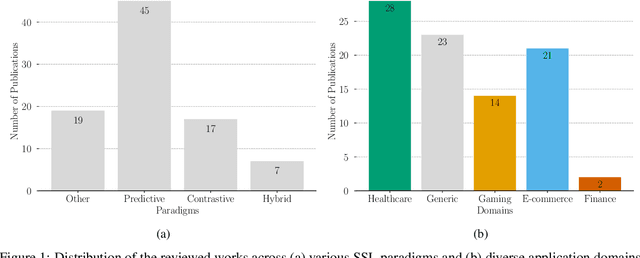
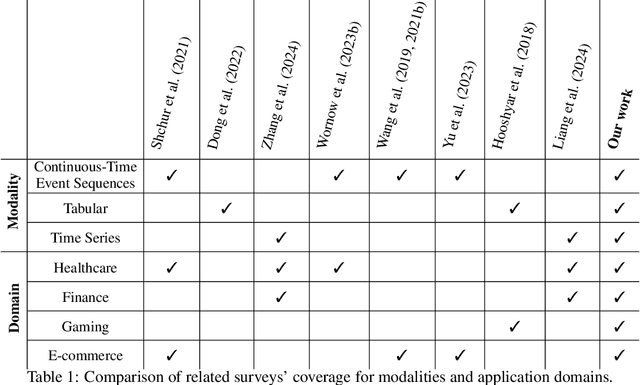
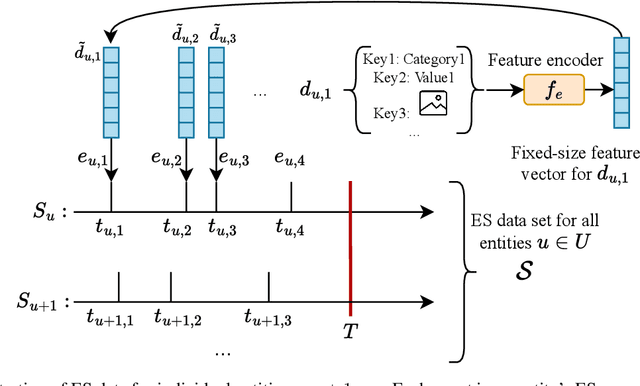
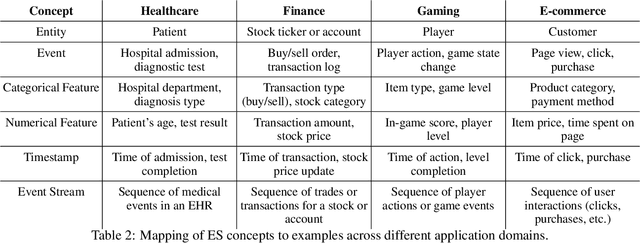
The proliferation of digital interactions across diverse domains, such as healthcare, e-commerce, gaming, and finance, has resulted in the generation of vast volumes of event stream (ES) data. ES data comprises continuous sequences of timestamped events that encapsulate detailed contextual information relevant to each domain. While ES data holds significant potential for extracting actionable insights and enhancing decision-making, its effective utilization is hindered by challenges such as the scarcity of labeled data and the fragmented nature of existing research efforts. Self-Supervised Learning (SSL) has emerged as a promising paradigm to address these challenges by enabling the extraction of meaningful representations from unlabeled ES data. In this survey, we systematically review and synthesize SSL methodologies tailored for ES modeling across multiple domains, bridging the gaps between domain-specific approaches that have traditionally operated in isolation. We present a comprehensive taxonomy of SSL techniques, encompassing both predictive and contrastive paradigms, and analyze their applicability and effectiveness within different application contexts. Furthermore, we identify critical gaps in current research and propose a future research agenda aimed at developing scalable, domain-agnostic SSL frameworks for ES modeling. By unifying disparate research efforts and highlighting cross-domain synergies, this survey aims to accelerate innovation, improve reproducibility, and expand the applicability of SSL to diverse real-world ES challenges.
Expressivity of Representation Learning on Continuous-Time Dynamic Graphs: An Information-Flow Centric Review
Dec 05, 2024Graphs are ubiquitous in real-world applications, ranging from social networks to biological systems, and have inspired the development of Graph Neural Networks (GNNs) for learning expressive representations. While most research has centered on static graphs, many real-world scenarios involve dynamic, temporally evolving graphs, motivating the need for Continuous-Time Dynamic Graph (CTDG) models. This paper provides a comprehensive review of Graph Representation Learning (GRL) on CTDGs with a focus on Self-Supervised Representation Learning (SSRL). We introduce a novel theoretical framework that analyzes the expressivity of CTDG models through an Information-Flow (IF) lens, quantifying their ability to propagate and encode temporal and structural information. Leveraging this framework, we categorize existing CTDG methods based on their suitability for different graph types and application scenarios. Within the same scope, we examine the design of SSRL methods tailored to CTDGs, such as predictive and contrastive approaches, highlighting their potential to mitigate the reliance on labeled data. Empirical evaluations on synthetic and real-world datasets validate our theoretical insights, demonstrating the strengths and limitations of various methods across long-range, bi-partite and community-based graphs. This work offers both a theoretical foundation and practical guidance for selecting and developing CTDG models, advancing the understanding of GRL in dynamic settings.