 Add to Chrome
 Add to Firefox
 Add to Edge
Semantics-Guided Multimodal Masked Autoencoder Pretraining for 3D BEV Object Detection
May 24, 2026
Accurate 3D bird's-eye view (BEV) object detection is essential for autonomous driving, and depends strongly on effective multimodal representations from complementary sensors such as cameras and LiDAR. Multimodal masked autoencoders have shown strong potential for learning such representations for downstream 3D BEV object detection. However, existing methods typically apply uniform random masking to camera and LiDAR inputs, treating all regions equally, and learn representations only through masked reconstruction. We propose a semantics-guided multimodal masked autoencoder framework that introduces semantic information during pretraining through two separate components: (i) semantics-guided LiDAR voxel masking, which preserves semantically important LiDAR regions more strongly, and (ii) an auxiliary point-wise LiDAR semantic decoder branch that injects semantic guidance in addition to reconstruction. On BEVFusion 3D object detection, our semantics-guided pretraining strategy improves performance on the nuScenes mini validation set compared to the standard UniM2AE baseline: semantics-guided LiDAR voxel masking yields +1.49% mean Average Precision (mAP) and +1.66% nuScenes Detection Score (NDS), while decoder-side point semantic supervision yields +1.39% mAP and +3.22% NDS over the baseline.

Resilient Timed Elastic Band Planner for Collision-Free Navigation in Unknown Environments
Dec 04, 2024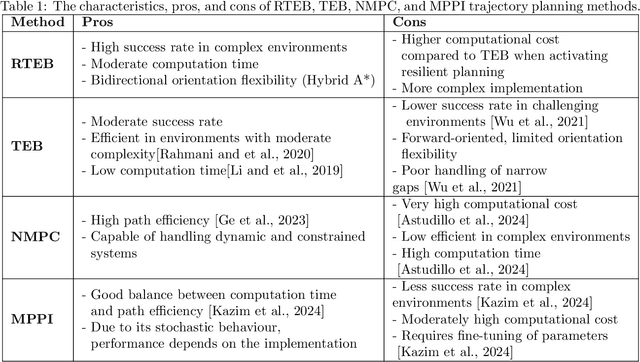
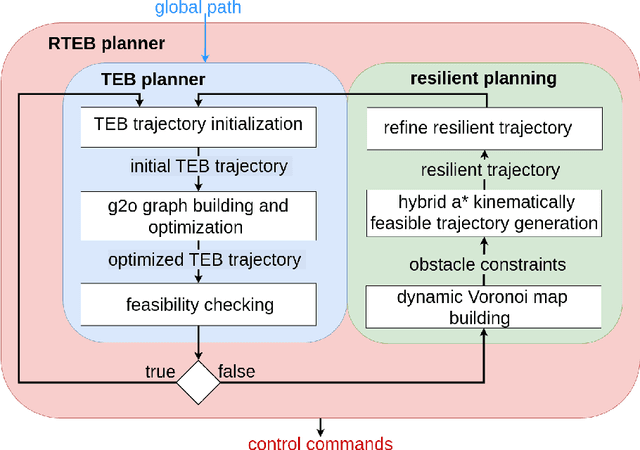
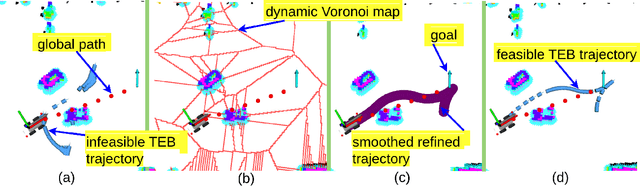
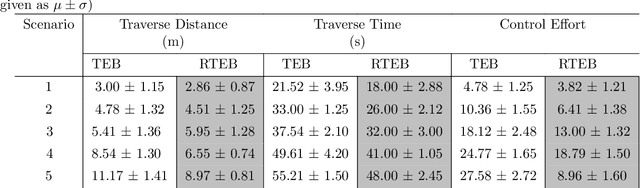
In autonomous navigation, trajectory replanning, refinement, and control command generation are essential for effective motion planning. This paper presents a resilient approach to trajectory replanning addressing scenarios where the initial planner's solution becomes infeasible. The proposed method incorporates a hybrid A* algorithm to generate feasible trajectories when the primary planner fails and applies a soft constraints-based smoothing technique to refine these trajectories, ensuring continuity, obstacle avoidance, and kinematic feasibility. Obstacle constraints are modelled using a dynamic Voronoi map to improve navigation through narrow passages. This approach enhances the consistency of trajectory planning, speeds up convergence, and meets real-time computational requirements. In environments with around 30\% or higher obstacle density, the ratio of free space before and after placing new obstacles, the Resilient Timed Elastic Band (RTEB) planner achieves approximately 20\% reduction in traverse distance, traverse time, and control effort compared to the Timed Elastic Band (TEB) planner and Nonlinear Model Predictive Control (NMPC) planner. These improvements demonstrate the RTEB planner's potential for application in field robotics, particularly in agricultural and industrial environments, where navigating unstructured terrain is crucial for ensuring efficiency and operational resilience.