 Add to Chrome
 Add to Firefox
 Add to Edge
RexDrug: Reliable Multi-Drug Combination Extraction through Reasoning-Enhanced LLMs
Mar 09, 2026
Automated Drug Combination Extraction (DCE) from large-scale biomedical literature is crucial for advancing precision medicine and pharmacological research. However, existing relation extraction methods primarily focus on binary interactions and struggle to model variable-length n-ary drug combinations, where complex compatibility logic and distributed evidence need to be considered. To address these limitations, we propose RexDrug, an end-to-end reasoning-enhanced relation extraction framework for n-ary drug combination extraction based on large language models. RexDrug adopts a two-stage training strategy. First, a multi-agent collaborative mechanism is utilized to automatically generate high-quality expert-like reasoning traces for supervised fine-tuning. Second, reinforcement learning with a multi-dimensional reward function specifically tailored for DCE is applied to further refine reasoning quality and extraction accuracy. Extensive experiments on the DrugComb dataset show that RexDrug consistently outperforms state-of-the-art baselines for n-ary extraction. Additional evaluation on the DDI13 corpus confirms its generalizability to binary drugdrug interaction tasks. Human expert assessment and automatic reasoning metrics further indicates that RexDrug produces coherent medical reasoning while accurately identifying complex therapeutic regimens. These results establish RexDrug as a scalable and reliable solution for complex biomedical relation extraction from unstructured text. The source code and data are available at https://github.com/DUTIR-BioNLP/RexDrug

Taiyi: A Bilingual Fine-Tuned Large Language Model for Diverse Biomedical Tasks
Nov 20, 2023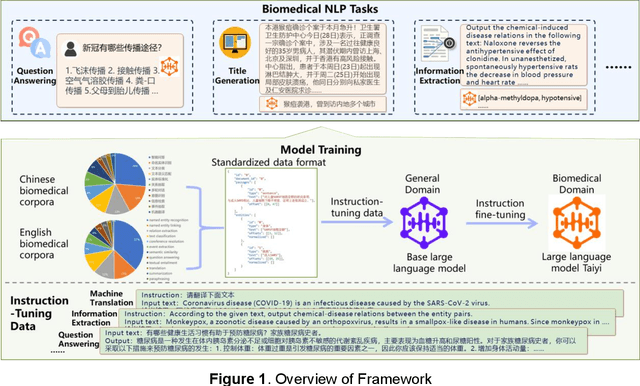
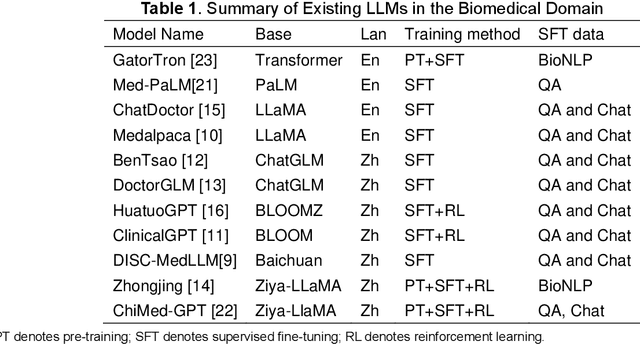
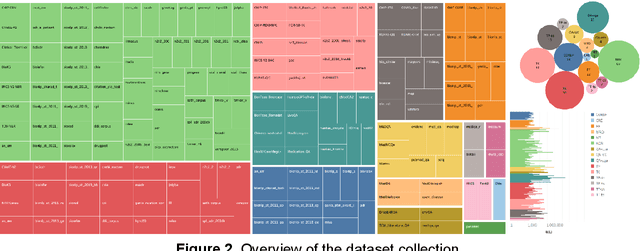
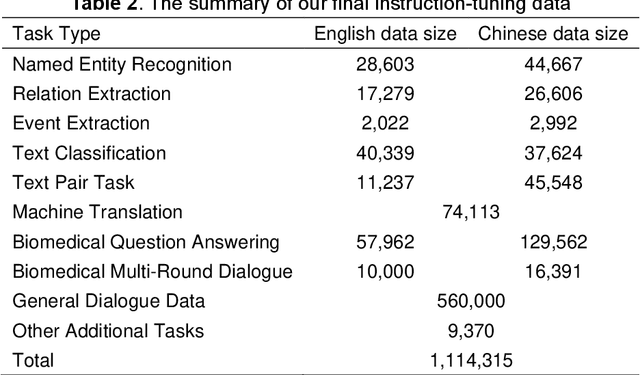
Recent advancements in large language models (LLMs) have shown promising results across a variety of natural language processing (NLP) tasks. The application of LLMs to specific domains, such as biomedicine, has achieved increased attention. However, most biomedical LLMs focus on enhancing performance in monolingual biomedical question answering and conversation tasks. To further investigate the effectiveness of the LLMs on diverse biomedical NLP tasks in different languages, we present Taiyi, a bilingual (English and Chinese) fine-tuned LLM for diverse biomedical tasks. In this work, we first curated a comprehensive collection of 140 existing biomedical text mining datasets across over 10 task types. Subsequently, a two-stage strategy is proposed for supervised fine-tuning to optimize the model performance across varied tasks. Experimental results on 13 test sets covering named entity recognition, relation extraction, text classification, question answering tasks demonstrate Taiyi achieves superior performance compared to general LLMs. The case study involving additional biomedical NLP tasks further shows Taiyi's considerable potential for bilingual biomedical multi-tasking. The source code, datasets, and model for Taiyi are freely available at https://github.com/DUTIR-BioNLP/Taiyi-LLM.