 Add to Chrome
 Add to Firefox
 Add to Edge
Towards Localized and Disentangled Knowledge Editing for Multimodal Large Language Models
May 28, 2026
Existing methods in Multimodal Knowledge Editing (MKE) have advanced the ability to correct outdated or inaccurate knowledge in Multimodal Large Language Models (MLLMs). However, they exhibit a critical limitation: while effectively modifying target factual pairs, they fail to generalize edits to logically related queries and often cause unintended alterations to unrelated but visually or semantically linked information. We identify and formalize two underlying failure modes causing this issue: Causal Misalignment, which confines edits to the specific sample, and Feature Entanglement, which causes unintended alterations to coupled but irrelevant information. To address these issues, we propose Localized and Disentangled Knowledge Editing (LDKE), a new framework that achieves precise and generalized editing by localizing fact-specific model layers and disentangling target-relevant inputs from irrelevant ones. Our approach introduces a Fast Localization module to identify and update critical layers efficiently, along with a Disentanglement Classifier that routes inputs appropriately to preserve unrelated knowledge. Extensive experiments across various benchmarks and MLLMs demonstrate that LDKE achieves superior performance in propagating edits to related contexts while maintaining high locality.

CrossCult-KIBench: A Benchmark for Cross-Cultural Knowledge Insertion in MLLMs
May 07, 2026Multimodal Large Language Models (MLLMs), trained primarily on English-centric data, frequently generate culturally inappropriate or misaligned responses in cross-cultural settings. To mitigate this, we introduce the task of cross-cultural knowledge insertion, which focuses on adapting models to specific cultural contexts while preserving their original behavior in other cultures. To facilitate research in this area, we introduce CrossCult-KIBench, a comprehensive evaluation benchmark for assessing both the effectiveness of knowledge insertion and its unintended side effects on non-target cultures. The benchmark includes 9,800 image-grounded cases covering 49 culturally relevant visual scenarios across English, Chinese, and Arabic language-culture groups. It supports evaluation in both single-insert and sequential-insert settings. We also propose Memory-Conditioned Knowledge Insertion (MCKI) as a baseline method. MCKI retrieves relevant cultural knowledge from an external memory using frozen MLLM representations, prepending matched entries as conditional prompts when applicable. Extensive experiments on CrossCult-KIBench reveal that current approaches struggle to balance effective cultural adaptation with behavioral preservation, highlighting a key challenge in developing culturally-aware MLLMs. Our work thus underscores an important research direction for developing more culturally adaptive and responsible MLLMs.
Visual-Oriented Fine-Grained Knowledge Editing for MultiModal Large Language Models
Nov 19, 2024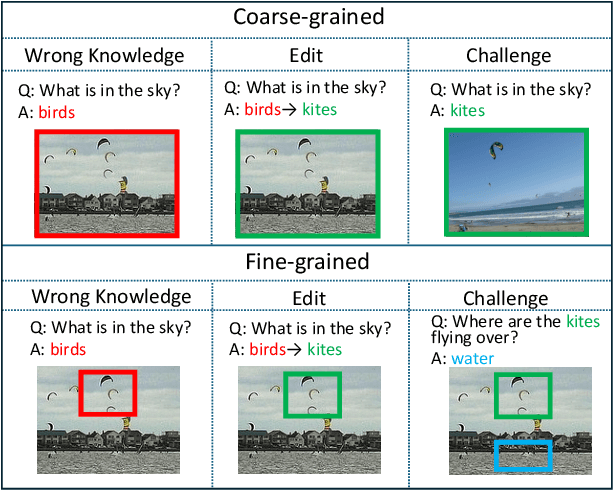
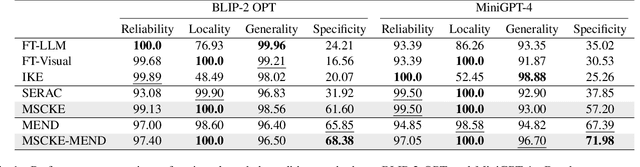
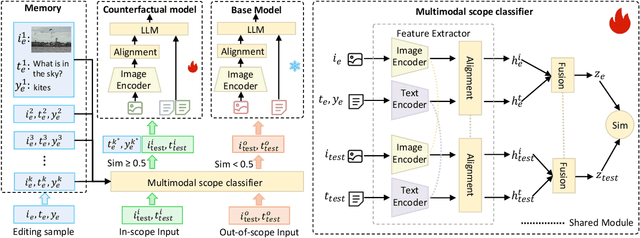
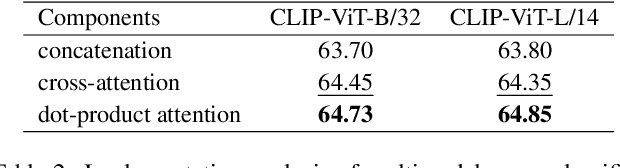
Knowledge editing aims to efficiently and cost-effectively correct inaccuracies and update outdated information. Recently, there has been growing interest in extending knowledge editing from Large Language Models (LLMs) to Multimodal Large Language Models (MLLMs), which integrate both textual and visual information, introducing additional editing complexities. Existing multimodal knowledge editing works primarily focus on text-oriented, coarse-grained scenarios, failing to address the unique challenges posed by multimodal contexts. In this paper, we propose a visual-oriented, fine-grained multimodal knowledge editing task that targets precise editing in images with multiple interacting entities. We introduce the Fine-Grained Visual Knowledge Editing (FGVEdit) benchmark to evaluate this task. Moreover, we propose a Multimodal Scope Classifier-based Knowledge Editor (MSCKE) framework. MSCKE leverages a multimodal scope classifier that integrates both visual and textual information to accurately identify and update knowledge related to specific entities within images. This approach ensures precise editing while preserving irrelevant information, overcoming the limitations of traditional text-only editing methods. Extensive experiments on the FGVEdit benchmark demonstrate that MSCKE outperforms existing methods, showcasing its effectiveness in solving the complex challenges of multimodal knowledge editing.