 Add to Chrome
 Add to Firefox
 Add to Edge
Task-Centric Personalized Federated Fine-Tuning of Language Models
Mar 30, 2026
Federated Learning (FL) has emerged as a promising technique for training language models on distributed and private datasets of diverse tasks. However, aggregating models trained on heterogeneous tasks often degrades the overall performance of individual clients. To address this issue, Personalized FL (pFL) aims to create models tailored for each client's data distribution. Although these approaches improve local performance, they usually lack robustness in two aspects: (i) generalization: when clients must make predictions on unseen tasks, or face changes in their data distributions, and (ii) intra-client tasks interference: when a single client's data contains multiple distributions that may interfere with each other during local training. To tackle these two challenges, we propose FedRouter, a clustering-based pFL that builds specialized models for each task rather than for each client. FedRouter uses adapters to personalize models by employing two clustering mechanisms to associate adapters with specific tasks. A local clustering that associate adapters with task data samples and a global one that associates similar adapters from different clients to construct task-centric personalized models. Additionally, we propose an evaluation router mechanism that routes test samples to the best adapter based on the created clusters. Experiments comparing our method with existing approaches across a multitask dataset, FedRouter demonstrate strong resilience in these challenging scenarios performing up to 6.1% relatively better under tasks interference and up to 136% relative improvement under generalization evaluation.

Beyond Shortest Path: Agentic Vehicular Routing with Semantic Context
Nov 06, 2025Traditional vehicle routing systems efficiently optimize singular metrics like time or distance, and when considering multiple metrics, they need more processes to optimize . However, they lack the capability to interpret and integrate the complex, semantic, and dynamic contexts of human drivers, such as multi-step tasks, situational constraints, or urgent needs. This paper introduces and evaluates PAVe (Personalized Agentic Vehicular Routing), a hybrid agentic assistant designed to augment classical pathfinding algorithms with contextual reasoning. Our approach employs a Large Language Model (LLM) agent that operates on a candidate set of routes generated by a multi-objective (time, CO2) Dijkstra algorithm. The agent evaluates these options against user-provided tasks, preferences, and avoidance rules by leveraging a pre-processed geospatial cache of urban Points of Interest (POIs). In a benchmark of realistic urban scenarios, PAVe successfully used complex user intent into appropriate route modifications, achieving over 88% accuracy in its initial route selections with a local model. We conclude that combining classical routing algorithms with an LLM-based semantic reasoning layer is a robust and effective approach for creating personalized, adaptive, and scalable solutions for urban mobility optimization.
Adaptive Client Selection with Personalization for Communication Efficient Federated Learning
Nov 26, 2024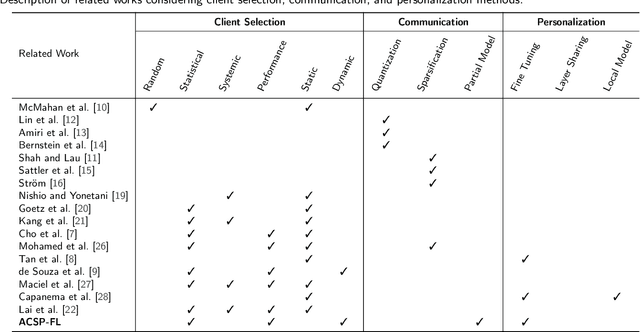
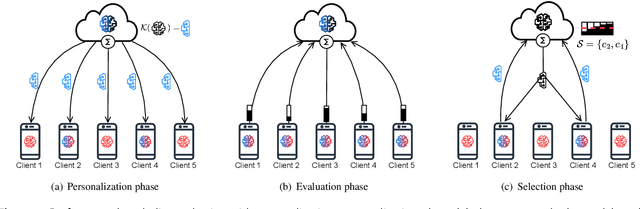
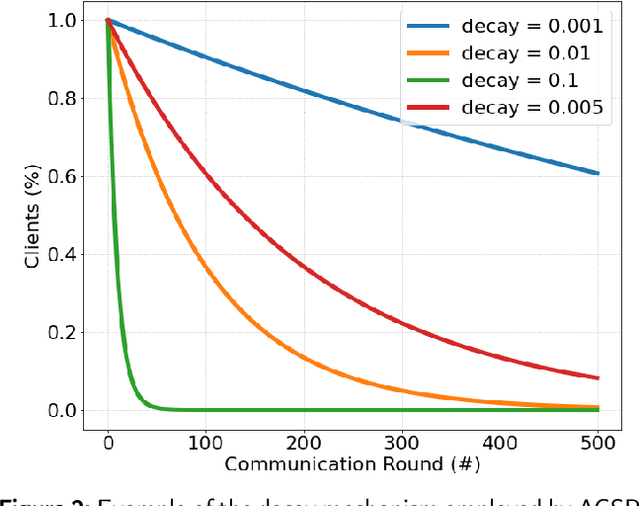
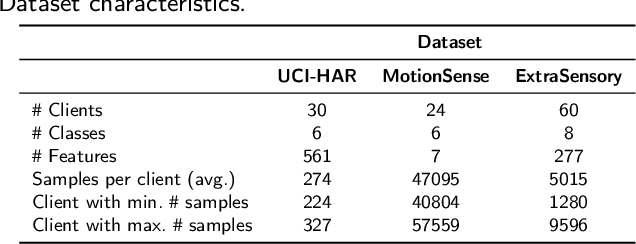
Federated Learning (FL) is a distributed approach to collaboratively training machine learning models. FL requires a high level of communication between the devices and a central server, thus imposing several challenges, including communication bottlenecks and network scalability. This article introduces ACSP-FL (https://github.com/AllanMSouza/ACSP-FL), a solution to reduce the overall communication and computation costs for training a model in FL environments. ACSP-FL employs a client selection strategy that dynamically adapts the number of devices training the model and the number of rounds required to achieve convergence. Moreover, ACSP-FL enables model personalization to improve clients performance. A use case based on human activity recognition datasets aims to show the impact and benefits of ACSP-FL when compared to state-of-the-art approaches. Experimental evaluations show that ACSP-FL minimizes the overall communication and computation overheads to train a model and converges the system efficiently. In particular, ACSP-FL reduces communication up to 95% compared to literature approaches while providing good convergence even in scenarios where data is distributed differently, non-independent and identical way between client devices.
Computação Urbana da Teoria à Prática: Fundamentos, Aplicações e Desafios
Dec 02, 2019The growing of cities has resulted in innumerable technical and managerial challenges for public administrators such as energy consumption, pollution, urban mobility and even supervision of private and public spaces in an appropriate way. Urban Computing emerges as a promising paradigm to solve such challenges, through the extraction of knowledge, from a large amount of heterogeneous data existing in urban space. Moreover, Urban Computing correlates urban sensing, data management, and analysis to provide services that have the potential to improve the quality of life of the citizens of large urban centers. Consider this context, this chapter aims to present the fundamentals of Urban Computing and the steps necessary to develop an application in this area. To achieve this goal, the following questions will be investigated, namely: (i) What are the main research problems of Urban Computing?; (ii) What are the technological challenges for the implementation of services in Urban Computing?; (iii) What are the main methodologies used for the development of services in Urban Computing?; and (iv) What are the representative applications in this field?