 Add to Chrome
 Add to Firefox
 Add to Edge
Adaptive Client Selection with Personalization for Communication Efficient Federated Learning
Nov 26, 2024
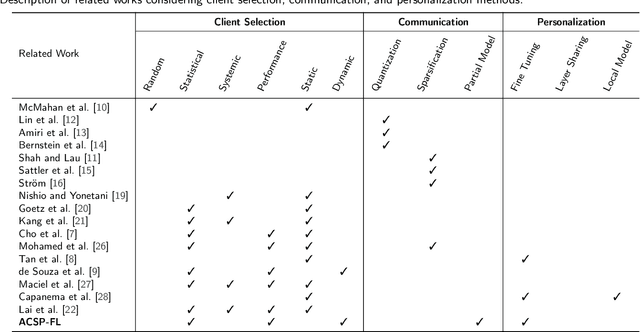
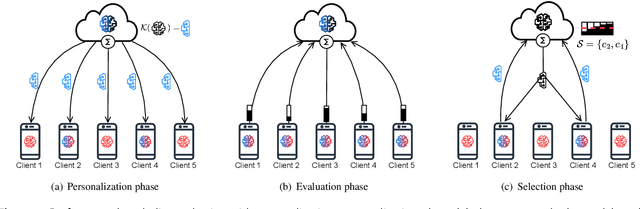
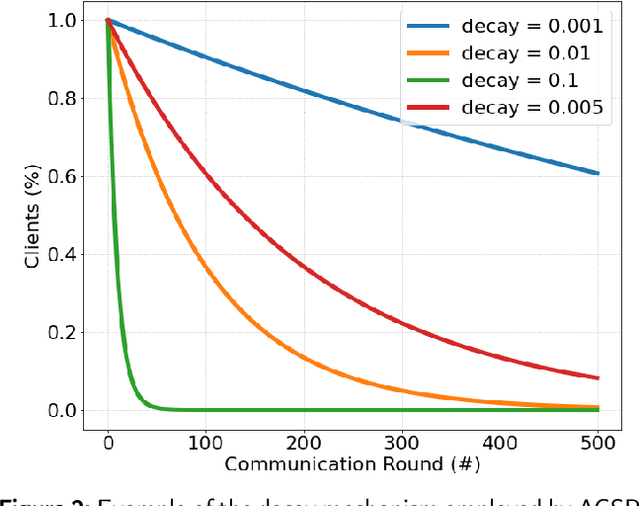
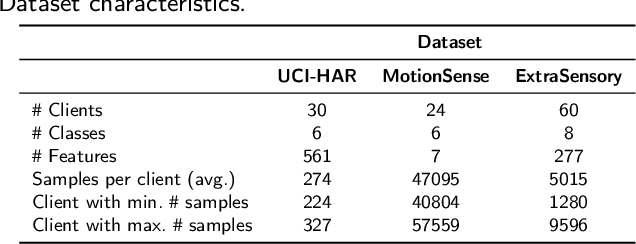
Federated Learning (FL) is a distributed approach to collaboratively training machine learning models. FL requires a high level of communication between the devices and a central server, thus imposing several challenges, including communication bottlenecks and network scalability. This article introduces ACSP-FL (https://github.com/AllanMSouza/ACSP-FL), a solution to reduce the overall communication and computation costs for training a model in FL environments. ACSP-FL employs a client selection strategy that dynamically adapts the number of devices training the model and the number of rounds required to achieve convergence. Moreover, ACSP-FL enables model personalization to improve clients performance. A use case based on human activity recognition datasets aims to show the impact and benefits of ACSP-FL when compared to state-of-the-art approaches. Experimental evaluations show that ACSP-FL minimizes the overall communication and computation overheads to train a model and converges the system efficiently. In particular, ACSP-FL reduces communication up to 95% compared to literature approaches while providing good convergence even in scenarios where data is distributed differently, non-independent and identical way between client devices.

Computação Urbana da Teoria à Prática: Fundamentos, Aplicações e Desafios
Dec 02, 2019The growing of cities has resulted in innumerable technical and managerial challenges for public administrators such as energy consumption, pollution, urban mobility and even supervision of private and public spaces in an appropriate way. Urban Computing emerges as a promising paradigm to solve such challenges, through the extraction of knowledge, from a large amount of heterogeneous data existing in urban space. Moreover, Urban Computing correlates urban sensing, data management, and analysis to provide services that have the potential to improve the quality of life of the citizens of large urban centers. Consider this context, this chapter aims to present the fundamentals of Urban Computing and the steps necessary to develop an application in this area. To achieve this goal, the following questions will be investigated, namely: (i) What are the main research problems of Urban Computing?; (ii) What are the technological challenges for the implementation of services in Urban Computing?; (iii) What are the main methodologies used for the development of services in Urban Computing?; and (iv) What are the representative applications in this field?