 Add to Chrome
 Add to Firefox
 Add to Edge
Adaptive Client Selection with Personalization for Communication Efficient Federated Learning
Nov 26, 2024
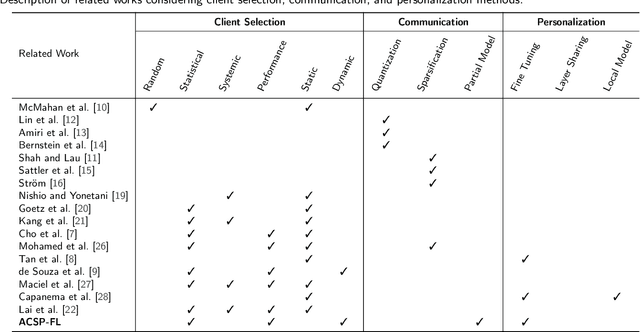
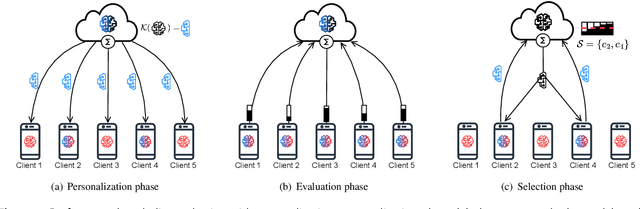
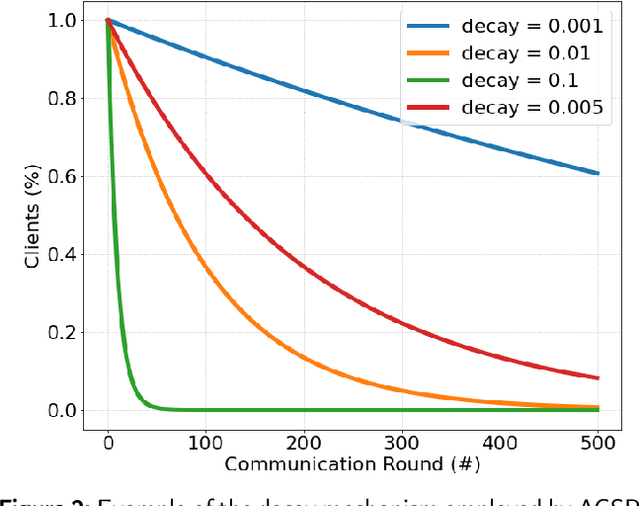
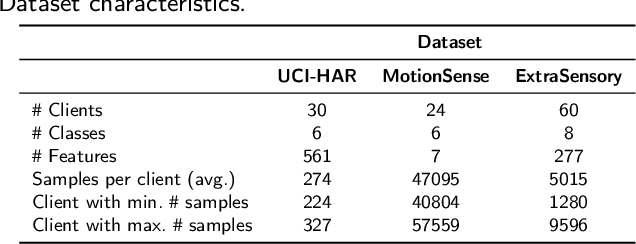
Federated Learning (FL) is a distributed approach to collaboratively training machine learning models. FL requires a high level of communication between the devices and a central server, thus imposing several challenges, including communication bottlenecks and network scalability. This article introduces ACSP-FL (https://github.com/AllanMSouza/ACSP-FL), a solution to reduce the overall communication and computation costs for training a model in FL environments. ACSP-FL employs a client selection strategy that dynamically adapts the number of devices training the model and the number of rounds required to achieve convergence. Moreover, ACSP-FL enables model personalization to improve clients performance. A use case based on human activity recognition datasets aims to show the impact and benefits of ACSP-FL when compared to state-of-the-art approaches. Experimental evaluations show that ACSP-FL minimizes the overall communication and computation overheads to train a model and converges the system efficiently. In particular, ACSP-FL reduces communication up to 95% compared to literature approaches while providing good convergence even in scenarios where data is distributed differently, non-independent and identical way between client devices.

Management of Resource at the Network Edge for Federated Learning
Jul 07, 2021


Federated learning has been explored as a promising solution for training at the edge, where end devices collaborate to train models without sharing data with other entities. Since the execution of these learning models occurs at the edge, where resources are limited, new solutions must be developed. In this paper, we describe the recent work on resource management at the edge, and explore the challenges and future directions to allow the execution of federated learning at the edge. Some of the problems of this management, such as discovery of resources, deployment, load balancing, migration, and energy efficiency will be discussed in the paper.