 Add to Chrome
 Add to Firefox
 Add to Edge
Humans Are More Diverse: Frontier LLMs Show Extreme Policies in Idealised AI Development Races
Aug 02, 2026
An AI development race creates a multi-agent safety dilemma. Each company can develop slowly and safely, or move faster while taking a risk that may remove its final reward. We use this repeated game to study strategic safety behaviour among large language model (LLM) agents in races with two to five players. However, a valid action does not show that an agent understands the game. We therefore place an audit gate before behavioural interpretation. We first verify the game engine, then test rule recall, state tracking, payoff calculation, and stability under different but equivalent task descriptions. We then compare LLM action sequences with an evolutionary game-theory benchmark and published human data, and explore differences across models, risk conditions, personas, and two- to five-player races. The audit shows that strong rule recall can coexist with weak state tracking and expected-payoff calculation. Providing verified arithmetic and changing the response representation can also change later actions, even when the game rules stay fixed. Across seven tested model endpoints, aggregate rates hide large differences in action sequences, responses to opponents, and responses to race position. Patterns across the tested three- to five-player races are also model-specific rather than a single effect of adding competitors. These results show why multi-agent AI-race simulations need validity checks and trajectory-level analysis before their outputs are described as strategic, human-like, or safety-aware. Our findings are exploratory and apply only to the tested models, prompts, and decoding settings.

Co-evolution of social reward and punishment under institutional interventions
Aug 02, 2026We investigate how peer and institutional incentives jointly shape the evolution of cooperation, social welfare, and enforcement efficiency in social dilemmas. In a Prisoners Dilemma with four strategies, unconditional cooperators (C), defectors (D), social punishers (SP), and social rewarders (SR), we allow decentralised peer incentives and centralised institutional incentives to act simultaneously, with the institution able to reward or punish any subset of strategies. In infinite well-mixed populations, we analyse the resulting four-strategy replicator dynamics, and in structured populations we use agent-based simulations on square lattices to study spatial effects and network reciprocity. Intervention schemes are evaluated by equilibrium states and evolutionary flow for infinite well-mixed populations, by cooperation levels and social welfare for structured populations, defined as aggregate population payoff net of institutional cost. We find that peer punishment most strongly promotes cooperation, whereas peer reward is more beneficial for social welfare. Institutionally rewarding peer incentive strategies substantially improves both cooperation and welfare, while subsidising unconditional cooperators has little impact. Under institutional punishment, directly penalising defectors is the only consistently effective policy; punishing peer incentive strategies dismantles decentralised incentives, reduces cooperation, and harms social welfare, showing that maximising cooperation does not necessarily optimise overall societal benefit. Our findings provide design principles for institutions seeking to balance cooperation promotion with welfare maximisation.
Social welfare optimisation under institutional reward and punishment
May 29, 2026Institutional incentives are widely used to promote cooperation among autonomous, self-regarding agents, from human societies to multi-agent and AI systems. Existing work typically treats incentive design as a bi-objective problem: minimise institutional cost while achieving a high long-run frequency of cooperation. Whether such schemes also maximise social welfare - total population payoff net of institutional expenditure - has remained largely unexplored. We develop a welfare-centric framework for institutional incentives in finite, well-mixed populations playing a social dilemma (Donation Game and Public Goods Game), considering both rewards for cooperators and punishments for defectors. For each mechanism, we derive explicit expressions for expected social welfare and characterise how it depends on incentive efficiency and selection intensity. Analytically, we identify parameter regimes where social welfare has a single optimal incentive level and regimes with qualitative phase transitions, in which welfare becomes non-monotonic with multiple local optima. We prove that any welfare-maximising incentive is either zero or concentrated around a simple closed-form target, and we provide an efficient algorithm to compute these optima. Comparing reward and punishment, we further derive close-formed conditions under which reward outperform punishment in terms of social welfare for any given budget. Overall, our results reveal a systematic gap between incentives optimised for cost or cooperation frequency and those that maximise welfare.
More at Stake: How Payoff and Language Shape LLM Agent Strategies in Cooperation Dilemmas
Jan 27, 2026As LLMs increasingly act as autonomous agents in interactive and multi-agent settings, understanding their strategic behavior is critical for safety, coordination, and AI-driven social and economic systems. We investigate how payoff magnitude and linguistic context shape LLM strategies in repeated social dilemmas, using a payoff-scaled Prisoner's Dilemma to isolate sensitivity to incentive strength. Across models and languages, we observe consistent behavioral patterns, including incentive-sensitive conditional strategies and cross-linguistic divergence. To interpret these dynamics, we train supervised classifiers on canonical repeated-game strategies and apply them to LLM decisions, revealing systematic, model- and language-dependent behavioral intentions, with linguistic framing sometimes matching or exceeding architectural effects. Our results provide a unified framework for auditing LLMs as strategic agents and highlight cooperation biases with direct implications for AI governance and multi-agent system design.
Social welfare optimisation in well-mixed and structured populations
Dec 14, 2025Research on promoting cooperation among autonomous, self-regarding agents has often focused on the bi-objective optimisation problem: minimising the total incentive cost while maximising the frequency of cooperation. However, the optimal value of social welfare under such constraints remains largely unexplored. In this work, we hypothesise that achieving maximal social welfare is not guaranteed at the minimal incentive cost required to drive agents to a desired cooperative state. To address this gap, we adopt to a single-objective approach focused on maximising social welfare, building upon foundational evolutionary game theory models that examined cost efficiency in finite populations, in both well-mixed and structured population settings. Our analytical model and agent-based simulations show how different interference strategies, including rewarding local versus global behavioural patterns, affect social welfare and dynamics of cooperation. Our results reveal a significant gap in the per-individual incentive cost between optimising for pure cost efficiency or cooperation frequency and optimising for maximal social welfare. Overall, our findings indicate that incentive design, policy, and benchmarking in multi-agent systems and human societies should prioritise welfare-centric objectives over proxy targets of cost or cooperation frequency.
Understanding LLM Agent Behaviours via Game Theory: Strategy Recognition, Biases and Multi-Agent Dynamics
Dec 11, 2025As Large Language Models (LLMs) increasingly operate as autonomous decision-makers in interactive and multi-agent systems and human societies, understanding their strategic behaviour has profound implications for safety, coordination, and the design of AI-driven social and economic infrastructures. Assessing such behaviour requires methods that capture not only what LLMs output, but the underlying intentions that guide their decisions. In this work, we extend the FAIRGAME framework to systematically evaluate LLM behaviour in repeated social dilemmas through two complementary advances: a payoff-scaled Prisoners Dilemma isolating sensitivity to incentive magnitude, and an integrated multi-agent Public Goods Game with dynamic payoffs and multi-agent histories. These environments reveal consistent behavioural signatures across models and languages, including incentive-sensitive cooperation, cross-linguistic divergence and end-game alignment toward defection. To interpret these patterns, we train traditional supervised classification models on canonical repeated-game strategies and apply them to FAIRGAME trajectories, showing that LLMs exhibit systematic, model- and language-dependent behavioural intentions, with linguistic framing at times exerting effects as strong as architectural differences. Together, these findings provide a unified methodological foundation for auditing LLMs as strategic agents and reveal systematic cooperation biases with direct implications for AI governance, collective decision-making, and the design of safe multi-agent systems.
A Robust and Low Complexity Deep Learning Model for Remote Sensing Image Classification
Nov 05, 2022
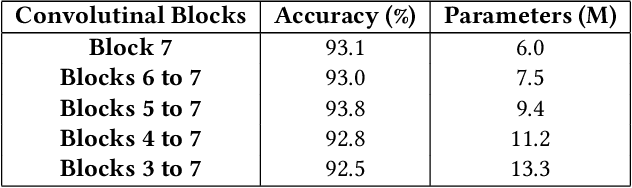

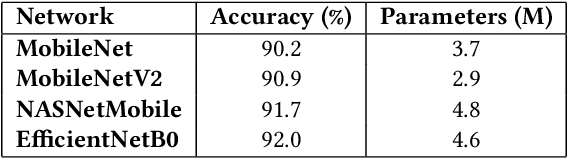
In this paper, we present a robust and low complexity deep learning model for Remote Sensing Image Classification (RSIC), the task of identifying the scene of a remote sensing image. In particular, we firstly evaluate different low complexity and benchmark deep neural networks: MobileNetV1, MobileNetV2, NASNetMobile, and EfficientNetB0, which present the number of trainable parameters lower than 5 Million (M). After indicating best network architecture, we further improve the network performance by applying attention schemes to multiple feature maps extracted from middle layers of the network. To deal with the issue of increasing the model footprint as using attention schemes, we apply the quantization technique to satisfies the number trainable parameter of the model lower than 5 M. By conducting extensive experiments on the benchmark datasets NWPU-RESISC45, we achieve a robust and low-complexity model, which is very competitive to the state-of-the-art systems and potential for real-life applications on edge devices.