 Add to Chrome
 Add to Firefox
 Add to Edge
WavesFM: Hierarchical Representation Learning for Longitudinal Wearable Sensor Waveforms
May 09, 2026
Wearable sensors enable the continuous acquisition of high-resolution physiological waveforms, such as photoplethysmography and accelerometry, under free-living conditions. However, inferring health-related phenotypes from these signals presents significant challenges due to high sampling frequencies, multimodal dependencies, and extreme sequence lengths (e.g., weeks of recordings), compounded by a scarcity of ground-truth labels. To address these challenges, existing self-supervised learning (SSL) methodologies typically follow two paradigms: (1) learning rich morphological representations from short waveform segments while collapsing longitudinal dynamics through simple aggregation, or (2) modeling behavioral patterns from coarse, hand-crafted features (e.g. heart rate, step counts) spanning longer horizons but foregoing subtle, predictive signatures in raw waveforms. To bridge this gap, we propose WavesFM, a foundation model utilizing a two-stage SSL framework for longitudinal physiological data. Specifically, we decompose the learning problem into two stages: first, a segment-level encoder is pretrained to extract local embeddings from short waveforms; subsequently, a temporal encoder is trained to model the sequence of these embeddings across a multi-day horizon. This hierarchical approach overcomes the computational complexity of high-resolution, long-sequence data, allowing the overall model to capture both local signal semantics and the complex circadian and inter-day variations governing physiological dynamics. Pretrained on over 6.8M hours (N=324k individuals) of recordings for the first stage and 5.3M hours (N=10k) for the second stage, WavesFM demonstrates superior performance across 58 diverse tasks spanning demographics, lifestyle, health conditions, and medications.

Smartphone monitoring of smiling as a behavioral proxy of well-being in everyday life
Dec 10, 2025Subjective well-being is a cornerstone of individual and societal health, yet its scientific measurement has traditionally relied on self-report methods prone to recall bias and high participant burden. This has left a gap in our understanding of well-being as it is expressed in everyday life. We hypothesized that candid smiles captured during natural smartphone interactions could serve as a scalable, objective behavioral correlate of positive affect. To test this, we analyzed 405,448 video clips passively recorded from 233 consented participants over one week. Using a deep learning model to quantify smile intensity, we identified distinct diurnal and daily patterns. Daily patterns of smile intensity across the week showed strong correlation with national survey data on happiness (r=0.92), and diurnal rhythms documented close correspondence with established results from the day reconstruction method (r=0.80). Higher daily mean smile intensity was significantly associated with more physical activity (Beta coefficient = 0.043, 95% CI [0.001, 0.085]) and greater light exposure (Beta coefficient = 0.038, [0.013, 0.063]), whereas no significant effects were found for smartphone use. These findings suggest that passive smartphone sensing could serve as a powerful, ecologically valid methodology for studying the dynamics of affective behavior and open the door to understanding this behavior at a population scale.
Passive Heart Rate Monitoring During Smartphone Use in Everyday Life
Mar 04, 2025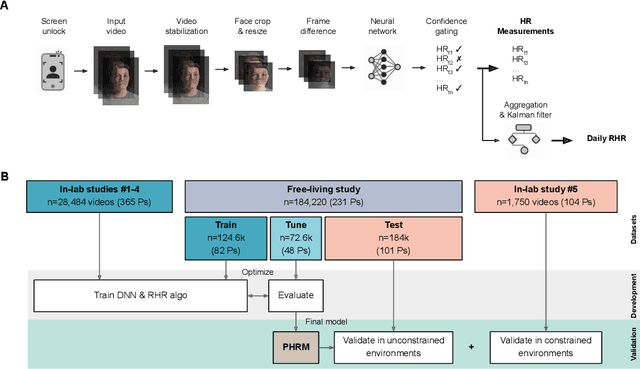
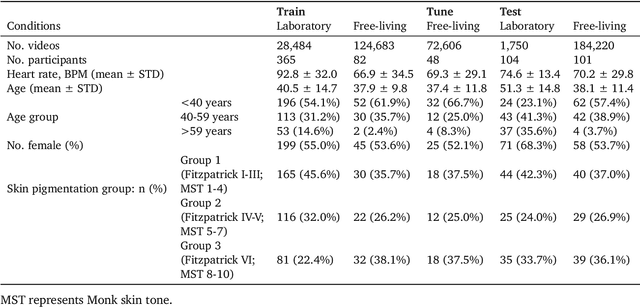
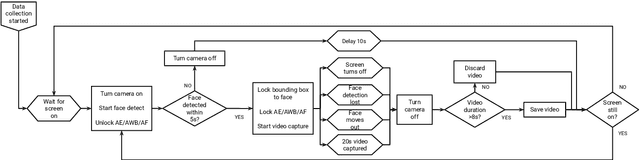
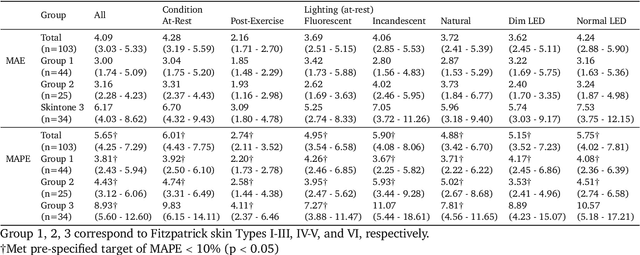
Resting heart rate (RHR) is an important biomarker of cardiovascular health and mortality, but tracking it longitudinally generally requires a wearable device, limiting its availability. We present PHRM, a deep learning system for passive heart rate (HR) and RHR measurements during everyday smartphone use, using facial video-based photoplethysmography. Our system was developed using 225,773 videos from 495 participants and validated on 185,970 videos from 205 participants in laboratory and free-living conditions, representing the largest validation study of its kind. Compared to reference electrocardiogram, PHRM achieved a mean absolute percentage error (MAPE) < 10% for HR measurements across three skin tone groups of light, medium and dark pigmentation; MAPE for each skin tone group was non-inferior versus the others. Daily RHR measured by PHRM had a mean absolute error < 5 bpm compared to a wearable HR tracker, and was associated with known risk factors. These results highlight the potential of smartphones to enable passive and equitable heart health monitoring.