 Add to Chrome
 Add to Firefox
 Add to Edge
TEMPER: Testing Emotional Perturbation in Quantitative Reasoning
Apr 09, 2026
Large language models are trained and evaluated on quantitative reasoning tasks written in clean, emotionally neutral language. However, real-world queries are often wrapped in frustration, urgency or enthusiasm. Does emotional framing alone degrade reasoning when all numerical content is preserved? To investigate this, a controlled emotion translation framework is developed that rewrites problems into emotional variants while preserving all quantities and relationships. Using this framework, Temper-5400 (5,400 semantically verified emotion--neutral pairs) is constructed across GSM8K, MultiArith, and ARC-Challenge, and evaluated on eighteen models (1B to frontier scale). Two core results emerge: First, emotional framing reduces accuracy by 2-10 percentage points even though all numerical content is preserved. Second, neutralizing emotional variants recovers most of the lost performance, showing both that the degradation is tied to emotional style rather than content corruption and that neutralization can serve as a lightweight inference-time mitigation. Non-emotional paraphrases cause no such degradation, implicating emotional content rather than surface-level changes. Beyond emotion specifically, the benchmark construction procedure provides a general framework for controlled stylistic translation and robustness evaluation.

SNEAK: Evaluating Strategic Communication and Information Leakage in Large Language Models
Mar 31, 2026Large language models (LLMs) are increasingly deployed in multi-agent settings where communication must balance informativeness and secrecy. In such settings, an agent may need to signal information to collaborators while preventing an adversary from inferring sensitive details. However, existing LLM benchmarks primarily evaluate capabilities such as reasoning, factual knowledge, or instruction following, and do not directly measure strategic communication under asymmetric information. We introduce SNEAK (Secret-aware Natural language Evaluation for Adversarial Knowledge), a benchmark for evaluating selective information sharing in language models. In SNEAK, a model is given a semantic category, a candidate set of words, and a secret word, and must generate a message that indicates knowledge of the secret without revealing it too clearly. We evaluate generated messages using two simulated agents with different information states: an ally, who knows the secret and must identify the intended message, and a chameleon, who does not know the secret and attempts to infer it from the message. This yields two complementary metrics: utility, measuring how well the message communicates to collaborators, and leakage, measuring how much information it reveals to an adversary. Using this framework, we analyze the trade-off between informativeness and secrecy in modern language models and show that strategic communication under asymmetric information remains a challenging capability for current systems. Notably, human participants outperform all evaluated models by a large margin, achieving up to four times higher scores.
Emotion is Not Just a Label: Latent Emotional Factors in LLM Processing
Mar 10, 2026Large language models are routinely deployed on text that varies widely in emotional tone, yet their reasoning behavior is typically evaluated without accounting for emotion as a source of representational variation. Prior work has largely treated emotion as a prediction target, for example in sentiment analysis or emotion classification. In contrast, we study emotion as a latent factor that shapes how models attend to and reason over text. We analyze how emotional tone systematically alters attention geometry in transformer models, showing that metrics such as locality, center-of-mass distance, and entropy vary across emotions and correlate with downstream question-answering performance. To facilitate controlled study of these effects, we introduce Affect-Uniform ReAding QA (AURA-QA), a question-answering dataset with emotionally balanced, human-authored context passages. Finally, an emotional regularization framework is proposed that constrains emotion-conditioned representational drift during training. Experiments across multiple QA benchmarks demonstrate that this approach improves reading comprehension in both emotionally-varying and non-emotionally varying datasets, yielding consistent gains under distribution shift and in-domain improvements on several benchmarks.
Unlearning in LLMs: Methods, Evaluation, and Open Challenges
Jan 19, 2026Large language models (LLMs) have achieved remarkable success across natural language processing tasks, yet their widespread deployment raises pressing concerns around privacy, copyright, security, and bias. Machine unlearning has emerged as a promising paradigm for selectively removing knowledge or data from trained models without full retraining. In this survey, we provide a structured overview of unlearning methods for LLMs, categorizing existing approaches into data-centric, parameter-centric, architecture-centric, hybrid, and other strategies. We also review the evaluation ecosystem, including benchmarks, metrics, and datasets designed to measure forgetting effectiveness, knowledge retention, and robustness. Finally, we outline key challenges and open problems, such as scalable efficiency, formal guarantees, cross-language and multimodal unlearning, and robustness against adversarial relearning. By synthesizing current progress and highlighting open directions, this paper aims to serve as a roadmap for developing reliable and responsible unlearning techniques in large language models.
Evaluating Cross-Lingual Unlearning in Multilingual Language Models
Jan 10, 2026We present the first comprehensive evaluation of cross-lingual unlearning in multilingual LLMs. Using translated TOFU benchmarks in seven language/script variants, we test major unlearning algorithms and show that most fail to remove facts outside the training language, even when utility remains high. However, subspace-projection consistently outperforms the other methods, achieving strong cross-lingual forgetting with minimal degradation. Analysis of learned task subspaces reveals a shared interlingua structure: removing this shared subspace harms all languages, while removing language-specific components selectively affects one. These results demonstrate that multilingual forgetting depends on geometry in weight space, motivating subspace-based approaches for future unlearning systems.
FLEx: Language Modeling with Few-shot Language Explanations
Jan 07, 2026Language models have become effective at a wide range of tasks, from math problem solving to open-domain question answering. However, they still make mistakes, and these mistakes are often repeated across related queries. Natural language explanations can help correct these errors, but collecting them at scale may be infeasible, particularly in domains where expert annotators are required. To address this issue, we introduce FLEx ($\textbf{F}$ew-shot $\textbf{L}$anguage $\textbf{Ex}$planations), a method for improving model behavior using a small number of explanatory examples. FLEx selects representative model errors using embedding-based clustering, verifies that the associated explanations correct those errors, and summarizes them into a prompt prefix that is prepended at inference-time. This summary guides the model to avoid similar errors on new inputs, without modifying model weights. We evaluate FLEx on CounterBench, GSM8K, and ReasonIF. We find that FLEx consistently outperforms chain-of-thought (CoT) prompting across all three datasets and reduces up to 83\% of CoT's remaining errors.
Outside Knowledge Conversational Video (OKCV) Dataset -- Dialoguing over Videos
Jun 11, 2025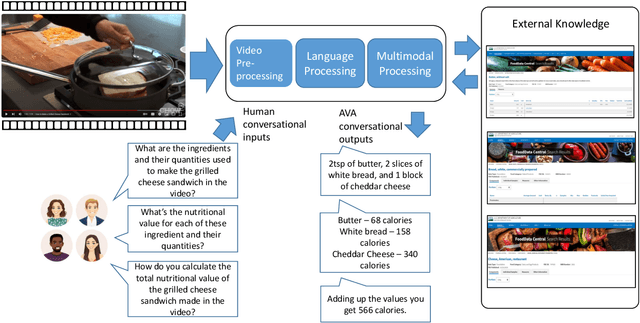
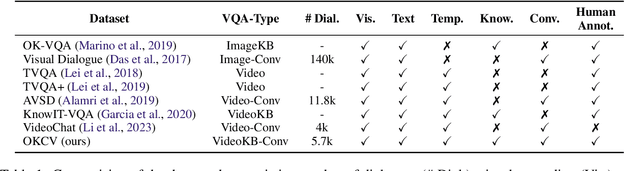
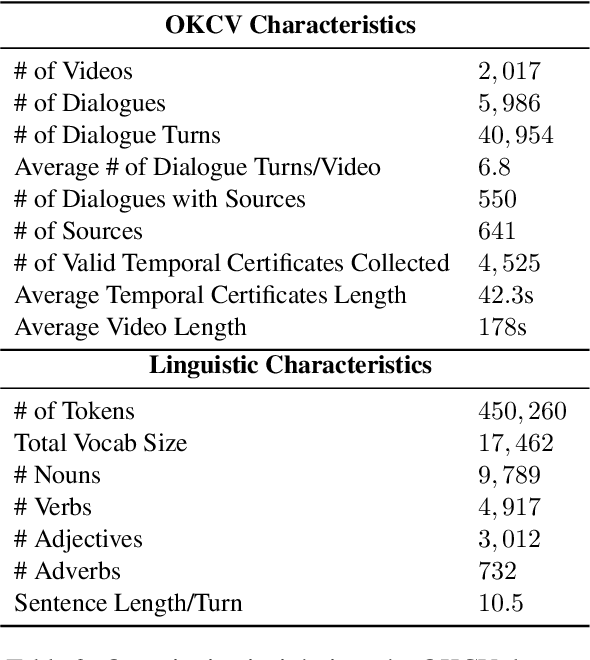
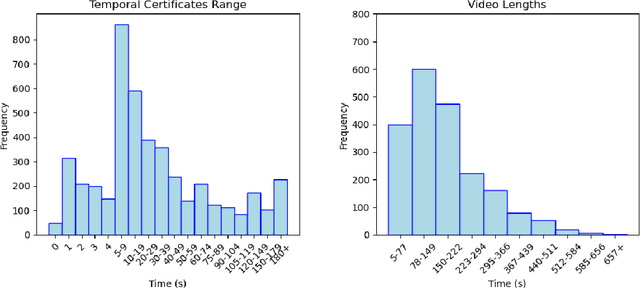
In outside knowledge visual question answering (OK-VQA), the model must identify relevant visual information within an image and incorporate external knowledge to accurately respond to a question. Extending this task to a visually grounded dialogue setting based on videos, a conversational model must both recognize pertinent visual details over time and answer questions where the required information is not necessarily present in the visual information. Moreover, the context of the overall conversation must be considered for the subsequent dialogue. To explore this task, we introduce a dataset comprised of $2,017$ videos with $5,986$ human-annotated dialogues consisting of $40,954$ interleaved dialogue turns. While the dialogue context is visually grounded in specific video segments, the questions further require external knowledge that is not visually present. Thus, the model not only has to identify relevant video parts but also leverage external knowledge to converse within the dialogue. We further provide several baselines evaluated on our dataset and show future challenges associated with this task. The dataset is made publicly available here: https://github.com/c-patsch/OKCV.
Weight-of-Thought Reasoning: Exploring Neural Network Weights for Enhanced LLM Reasoning
Apr 14, 2025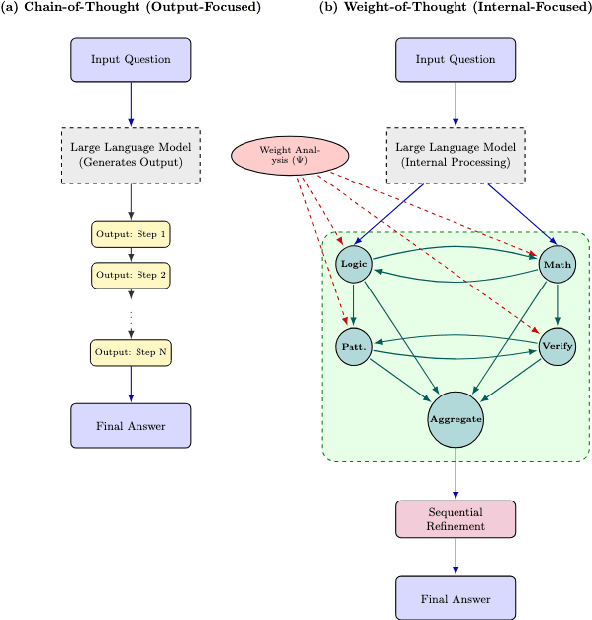

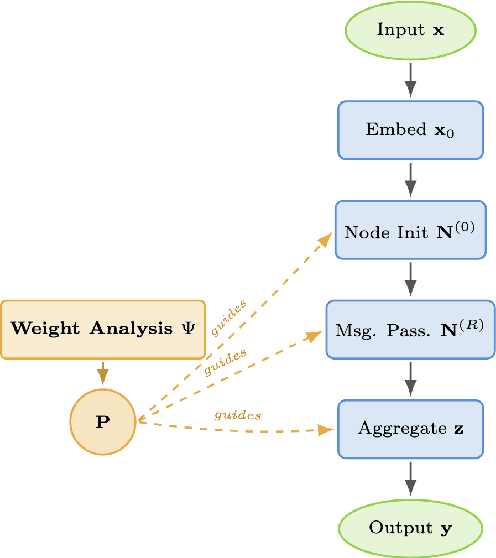
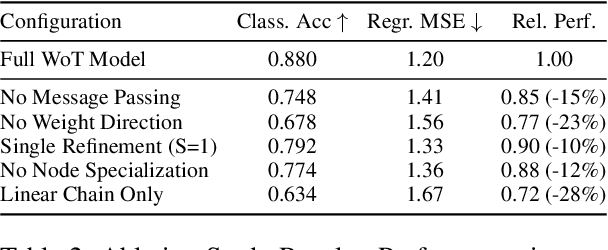
Large language models (LLMs) have demonstrated remarkable reasoning capabilities when prompted with strategies such as Chain-of-Thought (CoT). However, these approaches focus on token-level output without considering internal weight dynamics. We introduce Weight-of-Thought (WoT) reasoning, a novel approach that examines neural network weights before inference to identify reasoning pathways. Unlike existing methods, WoT explores the weight space through graph-based message passing, multi-step reasoning processes, and attention mechanisms. Our implementation creates an interconnected graph of reasoning nodes. Experiments on diverse reasoning tasks (syllogistic, mathematical, algebraic, combinatorial, and geometric) demonstrate that WoT achieves superior performance compared to traditional methods, particularly for complex problems. This approach leads to both improved performance and greater interpretability of the reasoning process, offering a promising direction for enhancing LLM reasoning capabilities.
SensorChat: Answering Qualitative and Quantitative Questions during Long-Term Multimodal Sensor Interactions
Feb 05, 2025Natural language interaction with sensing systems is crucial for enabling all users to comprehend sensor data and its impact on their everyday lives. However, existing systems, which typically operate in a Question Answering (QA) manner, are significantly limited in terms of the duration and complexity of sensor data they can handle. In this work, we introduce SensorChat, the first end-to-end QA system designed for long-term sensor monitoring with multimodal and high-dimensional data including time series. SensorChat effectively answers both qualitative (requiring high-level reasoning) and quantitative (requiring accurate responses derived from sensor data) questions in real-world scenarios. To achieve this, SensorChat uses an innovative three-stage pipeline that includes question decomposition, sensor data query, and answer assembly. The first and third stages leverage Large Language Models (LLMs) for intuitive human interactions and to guide the sensor data query process. Unlike existing multimodal LLMs, SensorChat incorporates an explicit query stage to precisely extract factual information from long-duration sensor data. We implement SensorChat and demonstrate its capability for real-time interactions on a cloud server while also being able to run entirely on edge platforms after quantization. Comprehensive QA evaluations show that SensorChat achieves up to 26% higher answer accuracy than state-of-the-art systems on quantitative questions. Additionally, a user study with eight volunteers highlights SensorChat's effectiveness in handling qualitative and open-ended questions.
SensorQA: A Question Answering Benchmark for Daily-Life Monitoring
Jan 10, 2025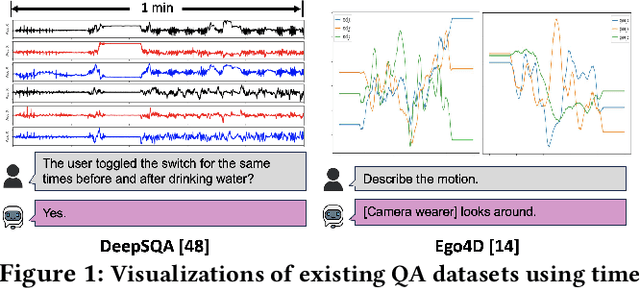
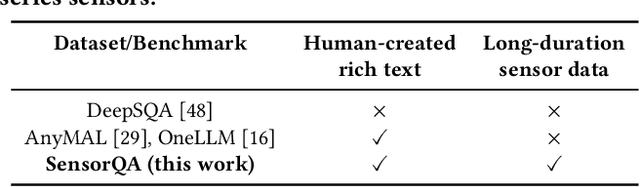

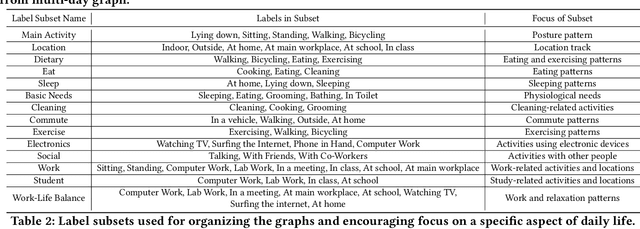
With the rapid growth in sensor data, effectively interpreting and interfacing with these data in a human-understandable way has become crucial. While existing research primarily focuses on learning classification models, fewer studies have explored how end users can actively extract useful insights from sensor data, often hindered by the lack of a proper dataset. To address this gap, we introduce SensorQA, the first human-created question-answering (QA) dataset for long-term time-series sensor data for daily life monitoring. SensorQA is created by human workers and includes 5.6K diverse and practical queries that reflect genuine human interests, paired with accurate answers derived from sensor data. We further establish benchmarks for state-of-the-art AI models on this dataset and evaluate their performance on typical edge devices. Our results reveal a gap between current models and optimal QA performance and efficiency, highlighting the need for new contributions. The dataset and code are available at: \url{https://github.com/benjamin-reichman/SensorQA}.