 Add to Chrome
 Add to Firefox
 Add to Edge
Latent-IM: Latent Interaction Management for Speech LLMs
Jul 29, 2026
Classical spoken dialogue systems often separated dialogue management from response realization: a policy selected the next dialogue action, and a generation component expressed that action. As dialogue systems shift toward LLMs, this decomposition has largely disappeared into the model's hidden representations. We ask whether an LLM-internal analogue of state estimation and action control can be recovered for conversational moves such as acknowledging, checking, querying, explaining, and replying. We formulate move control as two coupled problems: selection, predicting the appropriate next move from the dialogue context, and realization, causally producing a chosen move at generation time. We introduce Latent-IM, an internal dialogue-management framework that provides a general interface for choosing and deploying conversational moves under different objectives. Here, we use this control to reproduce human move choices, improving average end-to-end move accuracy by 12.5 points over the unsteered backbone while performing comparably to fine-tuning.

SNEAK: Evaluating Strategic Communication and Information Leakage in Large Language Models
Mar 31, 2026Large language models (LLMs) are increasingly deployed in multi-agent settings where communication must balance informativeness and secrecy. In such settings, an agent may need to signal information to collaborators while preventing an adversary from inferring sensitive details. However, existing LLM benchmarks primarily evaluate capabilities such as reasoning, factual knowledge, or instruction following, and do not directly measure strategic communication under asymmetric information. We introduce SNEAK (Secret-aware Natural language Evaluation for Adversarial Knowledge), a benchmark for evaluating selective information sharing in language models. In SNEAK, a model is given a semantic category, a candidate set of words, and a secret word, and must generate a message that indicates knowledge of the secret without revealing it too clearly. We evaluate generated messages using two simulated agents with different information states: an ally, who knows the secret and must identify the intended message, and a chameleon, who does not know the secret and attempts to infer it from the message. This yields two complementary metrics: utility, measuring how well the message communicates to collaborators, and leakage, measuring how much information it reveals to an adversary. Using this framework, we analyze the trade-off between informativeness and secrecy in modern language models and show that strategic communication under asymmetric information remains a challenging capability for current systems. Notably, human participants outperform all evaluated models by a large margin, achieving up to four times higher scores.
FLEx: Language Modeling with Few-shot Language Explanations
Jan 07, 2026Language models have become effective at a wide range of tasks, from math problem solving to open-domain question answering. However, they still make mistakes, and these mistakes are often repeated across related queries. Natural language explanations can help correct these errors, but collecting them at scale may be infeasible, particularly in domains where expert annotators are required. To address this issue, we introduce FLEx ($\textbf{F}$ew-shot $\textbf{L}$anguage $\textbf{Ex}$planations), a method for improving model behavior using a small number of explanatory examples. FLEx selects representative model errors using embedding-based clustering, verifies that the associated explanations correct those errors, and summarizes them into a prompt prefix that is prepended at inference-time. This summary guides the model to avoid similar errors on new inputs, without modifying model weights. We evaluate FLEx on CounterBench, GSM8K, and ReasonIF. We find that FLEx consistently outperforms chain-of-thought (CoT) prompting across all three datasets and reduces up to 83\% of CoT's remaining errors.
Reading with Intent -- Neutralizing Intent
Jan 07, 2025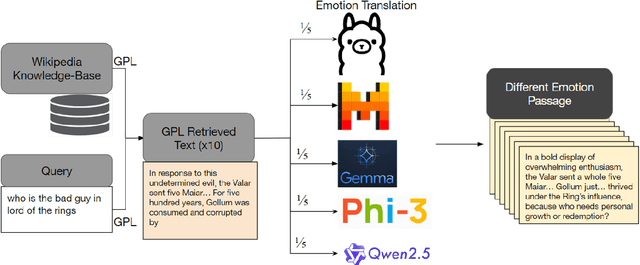


Queries to large language models (LLMs) can be divided into two parts: the instruction/question and the accompanying context. The context for retrieval-augmented generation (RAG) systems in most benchmarks comes from Wikipedia or Wikipedia-like texts which are written in a neutral and factual tone. However, when RAG systems retrieve internet-based content, they encounter text with diverse tones and linguistic styles, introducing challenges for downstream tasks. The Reading with Intent task addresses this issue by evaluating how varying tones in context passages affect model performance. Building on prior work that focused on sarcasm, we extend this paradigm by constructing a dataset where context passages are transformed to $11$ distinct emotions using a better synthetic data generation approach. Using this dataset, we train an emotion translation model to systematically adapt passages to specified emotional tones. The human evaluation shows that the LLM fine-tuned to become the emotion-translator benefited from the synthetically generated data. Finally, the emotion-translator is used in the Reading with Intent task to transform the passages to a neutral tone. By neutralizing the passages, it mitigates the challenges posed by sarcastic passages and improves overall results on this task by about $3\%$.